
All Your Bases Are Belong to U.S.
Global military bases control the world’s political and economic sovereignty for US interests.
It’s not a coincidence nearly every nation aligned with the global agenda has an economically conservative government. The world’s police intervene in foreign democracies and provoke wars to force conformity, but no one messes with the US. The military-industrial complex is the most bankrolled, heavily armed, trigger-happy maniac. It doesn’t hesitate to annihilate millions of lives for a profit, and the US government needs conflicts. The public might focus on domestic issues if it wasn’t distracted by an enemy.
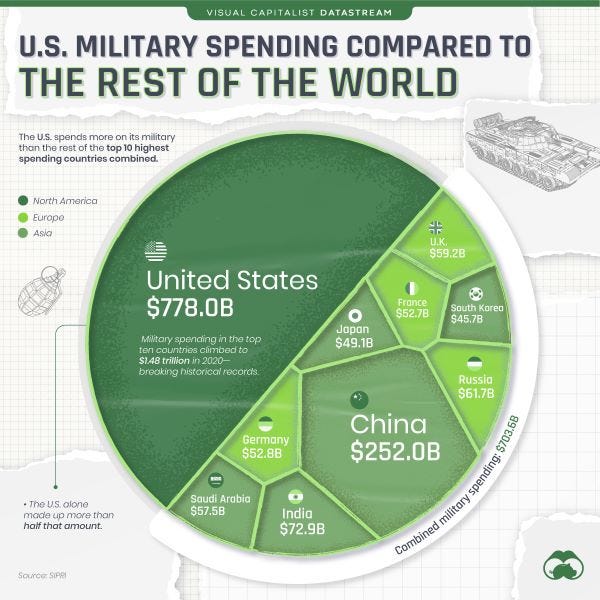
The US has been at war most of its existence, including subversions, coup d’états, secret armies, and assassinations. The nation’s 750 military bases in 80 countries, 1,750 internationally deployed nuclear missiles, and $778 billion violence budget is more than the following ten governments combined.
After WWII, the army and airforce Chief of Staff proposed establishing permanent combatant commands for global military readiness to protect US interests, promote human rights, build cooperation, and deter illegal activities. Today, unified and sub-unified commands occupy 210 countries in seven (including Space) “areas of responsibility.”
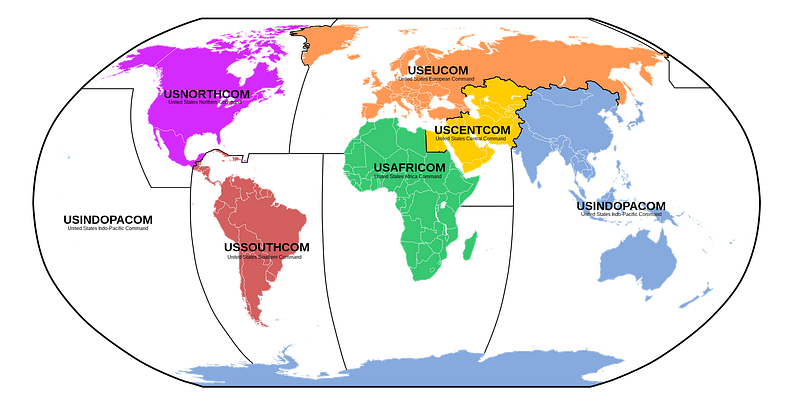
AFRICOM’s position statement explicitly mentions securing influence, economic opportunities, commerce routes, and African prosperity — aligned with the US. While the Indo-Pacific command explains their role in overseeing the largest Muslim-majority nation and “fighting to win when necessary.”
NATO and the CIA formed Operation Gladio and, from the 1950s to the 1980s, supported right-wing, anti-communist terrorist groups in every Western European country. While Italy endured bombing massacres, US-backed militias overthrew governments in Central and South America, Indonesia, the Congo, Iran, India, and numerous others.
When the Berlin Wall fell in 1989, the North Atlantic Treaty Organization should have been among the rubble. The Cold War and the Soviet Union ended, but NATO increased instead of decreasing influence, and US supremacy occupied the Eastern Bloc within a decade. Unsurprisingly, the Russian government felt threatened by the aggressive act, but NATO needed an enemy, and Russia perfectly replaced the Soviet Union’s role.
NATO guarantees political and military support for every member nation, and if Ukraine accepts NATO’s invitation, US military and weapons will be at Russia’s front door. Provoking Russia is senseless, and Putin’s reaction isn’t unreasonable. US policy authorizes “first use” deployment against China, Russia, and North Korea, and there are at least 150 American nuclear weapons in five European countries.
Russia might be influencing Ukrainian elections, but the US has. In a 2014 leaked phone call, the Assistant Secretary of State and the ambassador to Ukraine discussed appointing Ukraine’s Prime Minister and using the UN’s support. The US diplomats achieved their objective, but what was their goal, and does meddling in an election benefit anyone?
Ukraine’s president refuted Western media’s fearmongering and told the US to stop creating panic, but this isn’t about Ukraine — or Russia. The military-industrial complex needs conflicts to make profits. Withdrawing from Afghanistan diminished business activities, and selling weapons to rebel groups in Africa isn’t providing the desired return, but an arms race; that’s a winner. When China publically declared it would not participate in the US game, Russia was the next best option.
Propaganda, sanctions, bribery, coups, and weapon sales don’t promote peace or human rights, and democracy isn’t hand-picking nations’ politicians. Foreign citizens relentlessly protest the interventions, but governments must accept American economic and political demands or face retaliation. The military’s eyes, ears, and hands are everywhere, and its actions jeopardize millions of lives, but what are US interests, and who do they benefit?