
All you need to know about login (SSO, LDAP, SAML, OAuth, OpenID)I was recently asked this question again: “What is the difference between authentication and authorization?”
Let’s touch all of them in this single post. walkthrough in 10 mins.
Back to the old-school
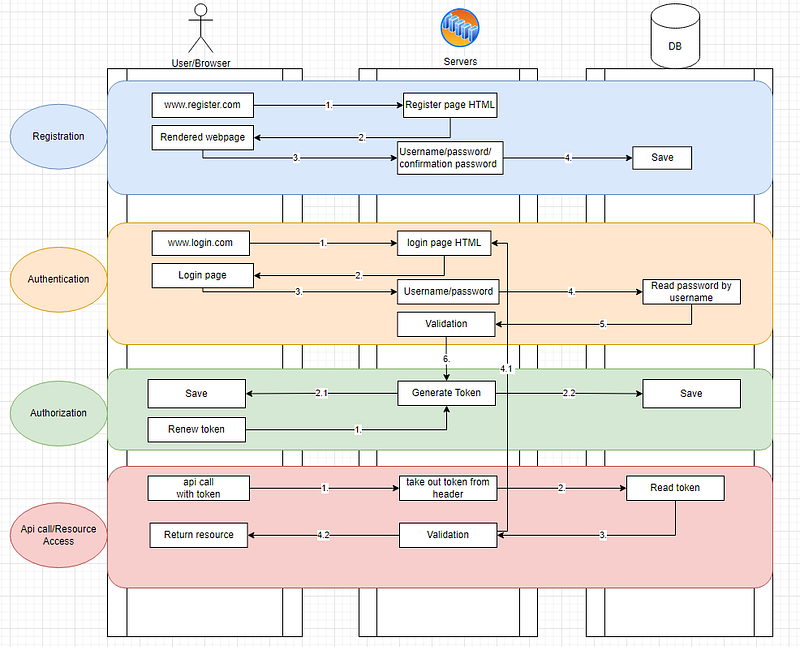
A quick explanation.
Login: Authentication (Who you are). before accessing any resource, you need a “token”. and of course, before login, you need to register first.
Token generation and verification: Authorization (What you can do). this is the step after logging in or renewing a token(using a refresh token). the token that is stored in db (or here could be a standalone IDP, which depends on the design) is valid for a certain time window.
So what is a token? — You can think of it as “an encrypted identity within a time window”. or, you can also treat it as either of below:
- A movie or whatever ticket when watching a show
- A “day pass” when you enter a building
So the problem with the above traditional flow is — to reinvent the wheel. Let’s think about 2 cases.
- Company system (every company will have to build its own login)
- Web application. every system there will be a “login module”. which is a big waste and disaster for the end user.
Let’s move on to see the solutions.
AD(1998) Login and LDAP (Lightweight Directory Access Protocol) (1993)
The short, LDAP is a protocol, and AD is an implementation of LDAP in the MS world.
So now let’s focus on LDAP to understand how the “company standard authentication flow” works.
The Org chart
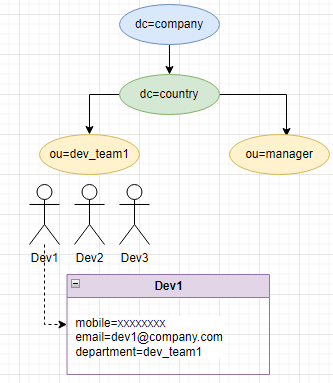
So LDAP is designed for “company login and directory search” quickly.
- Stores an “organization tree” (directory) for every staff.
- combined with username/password validation becomes an “LDAP search”.
The LDAP login flow
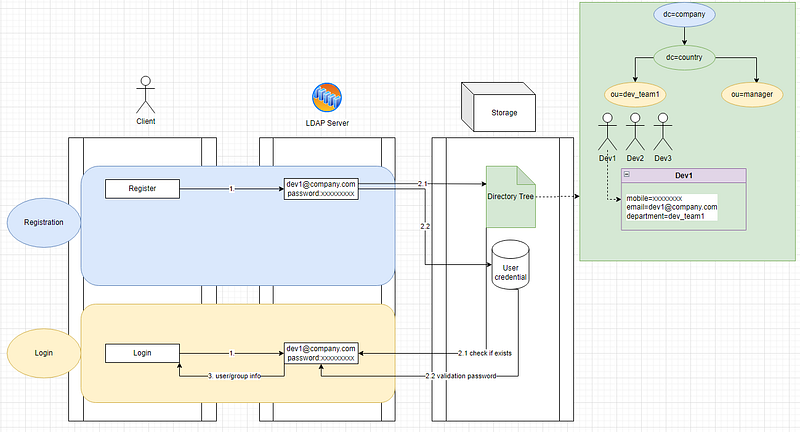
As you can see, the LDAP flow is not that complicated. highlight 2 things.
- Directory. An org tree that stores staff information for quick search (tree structure For quick search).
- Username Password “validation”(bind) process
Let’s move on.
SAML(2005)
SAML(Security Assertion Markup Language) is a protocol that first implemented SSO (Single sign-on) data transfer using XML format. if we look at single sign-on itself, the biggest achievement of SAML is to decouple the SP(Service Provider) and IDP(Identity Provider)
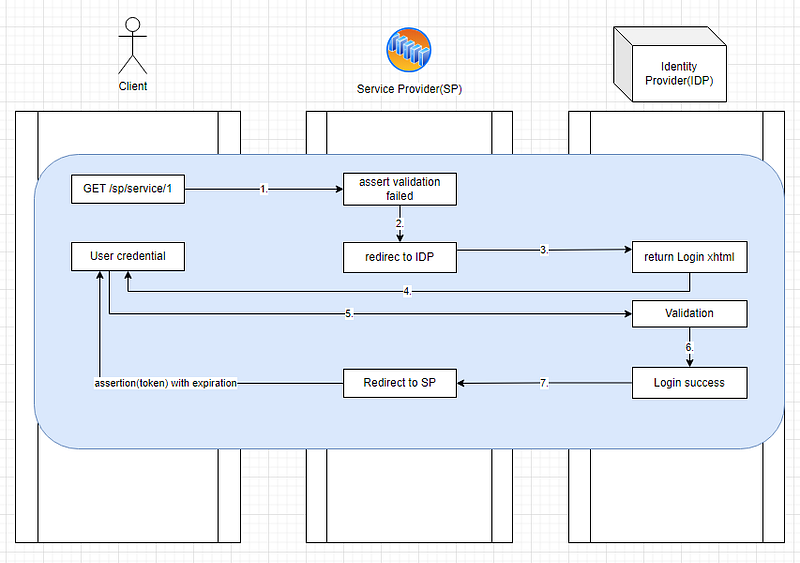
Once decoupled SP and IDP the login flow is now “reusible”. SSO brings 2 values
- Build IDP once and reuse for SP
- Single login “session”
OpenID(2007) and OAuth2 (2012)
Let’s look at one example.
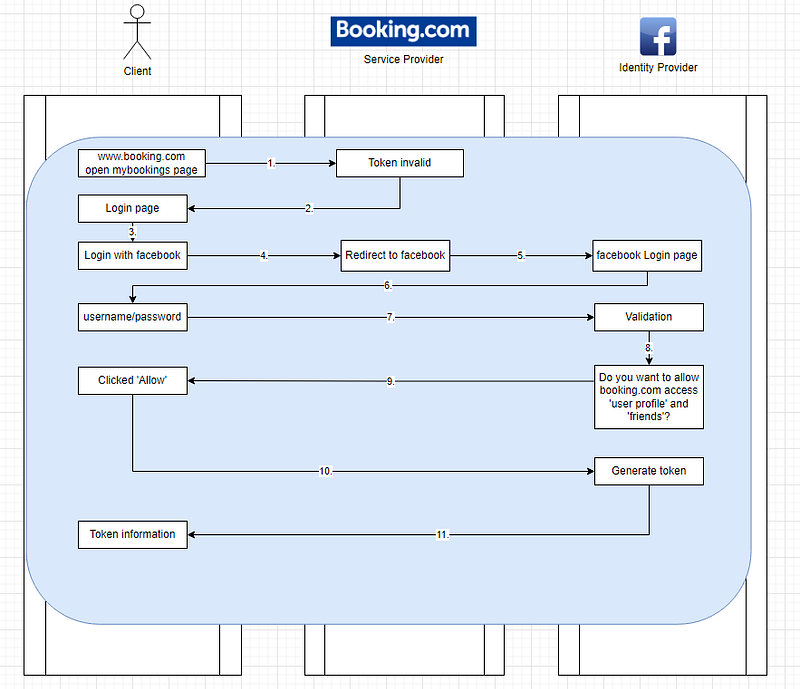
Above is a combination of OpenID (#1 to #7) with OAuthn2. OpenID focuses on authentication (who you are) and OAuth2 focuses on Authorization (what resource you can access).
So as you can see. Oauth2 focus is a bit different from SAML. SAML decouples the IDP from SP so that one login protocol can be reused for all. OAuth2 here kind of “extended” the SAML.
- Using OpenID to arrive SSO. one login, everywhere.
- It uses JSON (dev like JSON hates XML, I assume we dev all agreed on this)
- granular control. (What can be accessed)
Refresh token
What’s the point of a “refresh token”? I have been always asked this question.
The use case is usually to extend the ‘access token’ expiry window. then I was often asked, “Can we always use a username/password login to get a new access token every time when expires?”
Yes, but not recommended. because the system security will be brought down.
- The user credential has to be passed through the network very often (every 20 minutes or less).
- You made the expiry date very long to avoid the above which increased the risk of the system (once the token was stolen by the man in the middle).
JWT (2010)
But wait. what about the JWT token? can JWT be used in OAuth2?
Let’s assume the above token is a “random string” generated by IDP and stored in a database or some cache. what’s the first problem you could think of?
yes, bottleneck of centralization service(server). JWT comes to address this problem:
- Decentralization. Fit in a distributed system.
- It is self-contained token information, which reduces server load
- Separation of token Issuing and token validation process improves both security and flexibility and also performance.
- The usage of strong cryptographic algorithms(e.g. elliptic curve cryptography (ECC)) improves cyber security.
In short JWT itself is another topic, you may refer to my earlier post here.
Kerberos (1988)
You may refer to my earlier post here.
Last
Please let me if anything I have missed or any interesting topic you want to discuss.
Thanks for reading and see you in the next post.


