
Observational Musings
All Roads Lead to Trees
And you thought trees were pointless
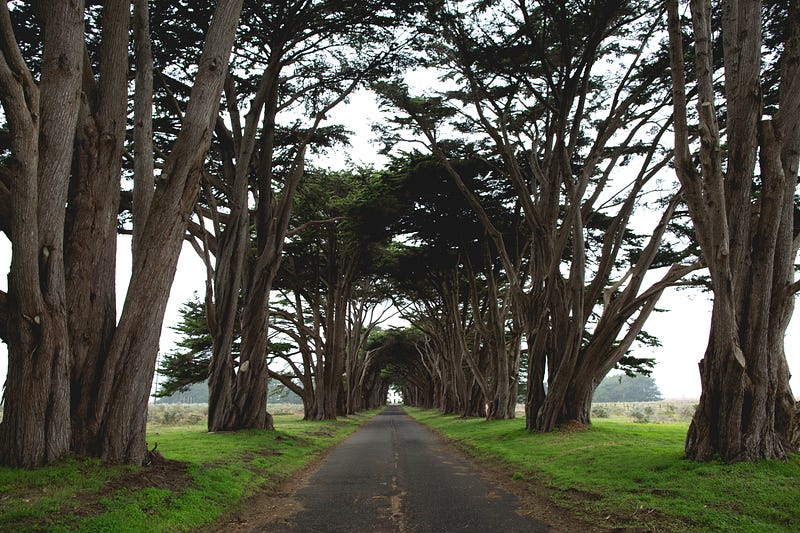
One of the most memorable rites of passage in the U.S. is getting your junior driver’s license and pretending to be independent of your parents by driving to meet up with your friends and to school. Driving is one of those all-time liberating American things where you will remember fondly rolling down the windows in summer and turning up the good old radio radiating of American rock, pop, and other classics, hauling down interstate or local highways to explore your world alone or with friends.
The Tree Riddle
I was one of those who passed the driving test on the first shot, yup, I can do the perfect parallel parking job in the tightest of spaces too, to the chagrin of my sibling and some friends, and didn’t have to even take the driving course offered in my high school for defensive driving. I took a 7-hour course on a Saturday to get my driver’s education certification so I could qualify getting my driver’s license. Driving to me was as natural as running.
Driving being the biggest trend in school among juniors would of course yield a lot of complaints, jokes about instructors and the Driver’s Ed course itself, and driving riddles. So I, having bypassed the course at school, as I took the condensed private one on a Saturday, would come to hear from hearsay about the riddle apparently posed at class or by some wise cracks in class about trees.
You know the one where you’re posed with the scenario in driving:
You’re about to crash — no two ways around it — and you’re headed towards a lamp post or a tree. So which do you choose?
I may have been good at the whole driving thing, but I said ‘tree’. *BUZZER*
If you’re with me, you might have thought, okay, it’ll unfortunately just uproot the darn thing (as you weep silently as a Nature-lover). But unfortunately that would have apparently totaled your car and by extension possibly yourself!
The lamp post being man-made and artificial is exactly the reason that should break more easily than a deeply firmly rooted tree. Choose the lamp post.
Thankfully, to this day, I’ve not ever been placed in that position to have to choose, and it having been years ago, I still couldn’t tell you if that was just us teens being silly shooting around all sorts of riddles or if that would even be an authentic piece of advice to even follow today. Maybe the lamp posts these days consist of way more sturdier materials. So don’t take this as any concrete advice, but I have to admit, as a teen it made me think way differently — more respect — for trees.
Trees Become Them
Yeah, we’re going to stick a little longer with the school theme because it’s entertaining…
Who doesn’t remember the story of George Washington and — yup, you might already know where this is going — the cherry tree. (Apparently, a false story after all those years somehow ingrained through school), but seriously, it was like the never-dying American myth but was a reminder of the virtue of honesty.
My paraphrased short version of the Washington story is: As a boy, George Washington chopped down his father’s cherry tree with an ax and then didn’t lie about it. His father used it as a lesson to praise his character.
The U.S. government National Park Service version of this story is here:
Of course, it’s interesting PR to hear a childhood story of your first ever American president, which years on apparently can’t be proven to be actually true, but the teaching of the cherry tree story won’t ever be chopped down in our students’ memories. The cherry tree is synonymous to American morality and the purity of American values at its roots (pun intended).
Of course, this leads us naturally to the Science Department as well. How one of the basic forces on Earth and the universe and in one of my favorite films, Interstellar (2014), is explored, if we cracked the code of it— gravity — which we were taught yet through another happy tale of discovery by Sir Isaac Newton and, yup, by the assistance of yet another tree. This time an apple tree. So the story goes that an apple fell on Newton’s head while he was under it and that gave him the bright idea of the existence of this mysterious force to further explain planetary motion.
Here’s an interesting explanation of Newton’s coming to the law, here.
So as the cherry tree becomes American symbolism for a lesson in morality, the apple tree could arguably be the symbolism for the origins of scientific breakthroughs. Apples are in fact a commonplace basic fruit in all American supermarkets.
The Tree of Man
So you must know by now where we are going with this? Apples are the commonplace fruit to explain any fruit we can’t name like the one in the first chapter of the Old Testament, Genesis.
Yes, the forbidden Tree of Life (or more precisely the Knowledge of Good and Evil) in The Garden of Eden and the apple that tempts the woman, Eve, because of the deceptive snake. It’s the origin of Man’s downfall and Woman’s childbirth pains.
Genesis 3 (NLV), in part:
2 Then the woman said to the snake, “We may eat the fruit of the trees of the garden. 3 But from the tree which is in the center of the garden, G** has said, ‘Do not eat from it or touch it, or you will die.’” …
6 The woman saw that the tree was good for food, and pleasing to the eyes, and could fill the desire of making one wise. So she took of its fruit and ate. She also gave some to her husband, and he ate. …
16 To the woman He said, “I will make your pain much worse in giving birth. You will give birth to children in pain. Yet your desire will be for your husband, and he will rule over you.”
17 Then He said to Adam, “Because you have listened to the voice of your wife, and have eaten from the tree of which I told you, “Do not eat from it,” the ground is cursed because of you. By hard work you will eat food from it all the days of your life. 18 It will grow thorns and thistles for you. You will eat the plants of the field. 19 You will eat bread by the sweat of your face because of hard work, until you return to the ground, because you were taken from the ground. You are dust, and you will return to dust.”
(I guess it seems fitting after all to name what we call the Adam’s apple).
Art class, history, and modern trends of DNA testing remind us also of the symbolic and ever utilitarian use of the tree as well when we want to document or trace our own family tree.
Is it any surprise that the story of the origins of the Roman Empire began with a family and tree of their very own?
I.e. the twin brothers, Romulus and Remus, rescued by a she-wolf near the Ficus ruminalis (or fig tree) — the future site of Rome. Romulus is the one that eventually wins out, killing his brother and being elevated to the status of deity (Quirinus) by the Romans.
The Britannica version here:
Fig leaves are also symbolic going back to Adam and Eve covering themselves with them after eating the forbidden fruit of The Tree of Life so the fig leaf has come to mean the of covering up of something embarrassing.
So you see, both the origins of Man and one of the greatest empires of history, Roman, leads us back to trees.
Fairy Tale Trees
OK. Just a few and we’re almost done.
There’s a whole bunch of fairy tales that use trees in their stories but the ones that have it as part of an essential element to their story lines have been used to captivate us since we were little, like:
Little Red Riding Hood and Hanzel and Gretel —their setting is key to their lore: forests.
Thinking of Germany (from the Hanzel and Gretel tale), there is also the origin of the Christmas tree — accredited to the Germans decorating evergreens in their homes and carried on by the Christians from the 16th century on.
But back to the fictional depictions of massive trees that form legends of unbelievable origins of fantastical cultures in vast dream worlds that similarly impress the sense of scale and history that trees can bestow, which can only be attributed to the inspirations of real trees in our world —
Two impressive ones of fantasy (for me) were:
№1 The Hometree of the Na’vi clan in Avatar (2009)
Incredibly enormous likened to the Californian redwoods and filled with the unimaginable sacred and deeply held secrets and histories of life in that world.
Let’s not forget the Tree of Souls too, likened to a gigantic beautiful willow tree, that emanates the aura of spiritual powers and the healing of renewal and new life.
№2 The White Tree in The Lord of the Rings
Not going to geek-out (I don’t quite qualify — but enjoy when others do) but the story of The White Tree in The Lord of the Rings is magical; it fans hopes of old friendships, Good over Evil, rightful kings, and the blessings of Man.
While this was meant originally to be a somewhat introspective reflection on trees, it’s become a fast realization how deeply trees were the originators of all our commonly praised and celebrated culture, lore, historical accounts, and even holidays!
Heck, I’m starting to see trees all around me — even my coat stand looks like a tree.
Some other lore-like references:
If you are not yet a Medium member and would like to show your support for me and my content, please consider becoming a member through me, here:
A portion of your membership fee directly supports my efforts in continually writing here but at no additional cost to you and without any changes to your membership — you still get full access to every story on Medium besides mine. But your support would make a real difference for a writer.
Thank you for reading!
© 2021 The Secret Aspirant. All rights reserved.


