
Alkaline Foods — Should You Eat Them?
Yes, but not for the reasons you think

Have you come across rows and rows of alkaline water in the supermarket aisle and wondered what the fuss was all about?
The dozens of brands of alkaline water out there certainly seem to point to a sizable and still-growing market. Between 2013 and 2018, sales grew by more than 12 percent annually and are expected to top US$4 billion by 2023. Nevertheless, the buzz has died down somewhat in the last couple of years, perhaps as a result of consumer complaints and criticism about the lack of scientific evidence to support the manufacturers’ health claims.
The Alkaline Diet
Alkaline water is part of a broader nutrition plan known as the Alkaline Diet, where the overarching idea is that the pH of our body affects our health.
Advocates of the Alkaline Diet argue that as our body metabolizes the food we eat, it leaves behind an “ash” residue, which can be acidic, neutral, or alkaline. They believe that acidic ash is harmful to the body, while alkaline ash has protective properties.
The Alkaline Diet, therefore, calls for the replacement of acidic foods (or more accurately, foods that purportedly produce acidic ash) with alkaline ones to improve one’s health.
The Body’s Acid-Base Balance
First, let’s take a step back and try to recall some high school chemistry.
The pH table, if you remember, runs from 0 to 14. 0 is completely acidic and 14 is completely alkaline. The same spectrum can be applied to the body as well as the foods we eat.
Our body is on the whole slightly alkaline, with a pH balance of 7.4. However, the stomach is rather acidic, with a pH balance of 3.5. (Think acid reflux.) The pH of urine can fluctuate over a large range, from 4.5 to 8, depending on what one recently ate and drank.
At the risk of spoiling the ending of this article, there is little evidence to suggest that the food we eat affects our body’s pH balance. The body generally maintains a homeostatic pH by excreting excess acid in the urine (for example, for several hours after eating a large steak).
Therefore, although the food we eat may affect the pH balance of our urine, it may not affect the pH of blood or the body more generally.
Acidic versus Alkaline Foods
Next, let’s take a look at examples of acidic and alkaline foods.
- Acidic: meat, poultry, fish, dairy, eggs, grains, alcohol
- Neutral: natural fats, water
- Alkaline: vegetables, fruits, legumes (including soy and lentils), nuts
Below is a handy chart you can refer to.
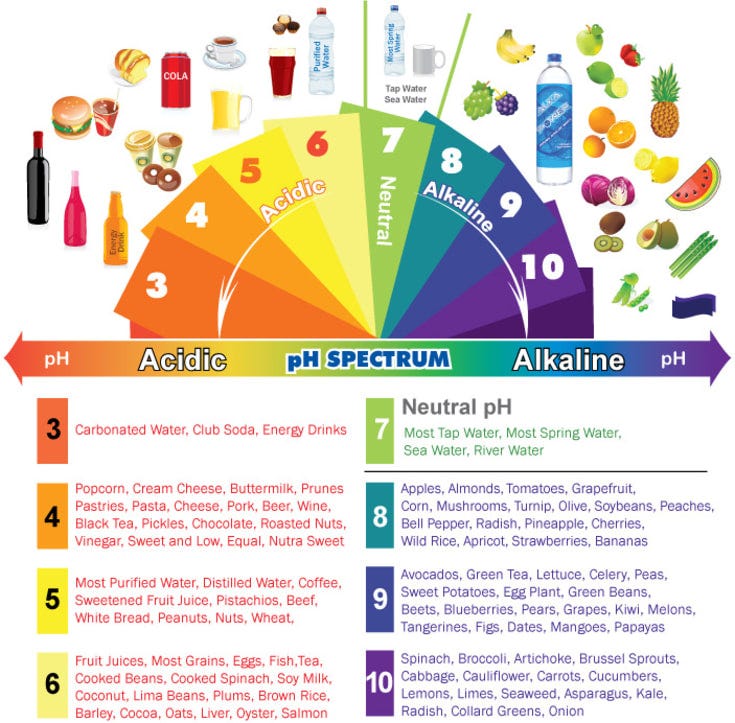
Before proceeding any further, let’s clear up a potential misunderstanding. Some of us probably think that citrus fruits like lemons and limes would be acidic; our stomachs certainly seem to churn if we eat too many of them. However, their effect on the body is alkalinizing.
Conversely, you may think that milk is alkaline. You might even have been advised to drink milk to fight heartburn or acid reflux. However, the fat in milk is acidic and could aggravate such conditions. Milk, or at least the fatty versions of it, are therefore acidic.
Incidentally, alkaline water has a pH of 8 to 9, compared to a more neutral 7 in the case of regular water. There were small studies a while back suggesting that alkaline water can help with acid reflux, high blood pressure, diabetes, and high cholesterol, but the sample sizes are too small to be convincing.
What Else Does the Science Say?
There is little compelling scientific evidence that eating more alkaline foods results in purported health benefits such as a lower risk of cancer or osteoporosis.
There is also little evidence that consuming more alkaline foods can change the body’s pH balance.
It is highly doubtful that alkalinizing the body is a good idea. On the contrary, even a slight change in the body’s pH balance can make one sick. Lowering the stomach’s natural pH balance can impair its ability to eliminate bacteria and other dangerous pathogens. Excessive alkalinity in the body is also associated with gastrointestinal issues and skin irritations. It can even result in metabolic alkalosis.
The Case for Alkaline Foods
To be fair to the Alkaline Diet, alkaline foods tend to be healthy options. Vegetables, fruits, nuts, and legumes all feature prominently in healthy nutrition plans such as the Mediterranean diet, the Dietary Approaches to Stop Hypertension (DASH), and the Flexitarian diet.
Besides, the Alkaline Diet does not call for people to completely give up acidic foods like meat and poultry, just to reduce their consumption. In this sense, the Alkaline Diet can potentially lead to healthy lifestyle changes.
Final Thoughts
Here are 3 takeaways:
- Eating more alkaline foods will likely benefit your health. However, this is not due to any expected change in your body’s pH, but the inherent nutritional content of alkaline foods like vegetables, fruits, nuts, and legumes.
- Don’t just guzzle alkaline water; eat alkaline foods. The nutritional case for alkaline foods is significantly stronger than that for alkaline water.
- It would not be advisable to only consume alkaline foods, as you may potentially miss out on important nutrients. Please consult a physician or a registered dietitian.

You just read another post from In Fitness And In Health: a health and fitness community dedicated to sharing knowledge, lessons, and suggestions to living happier, healthier lives.
If you’d like to join our newsletter and receive more stories like this one, tap here.