
Casey’s Reviews
Alien (1979) — Does it hold up?
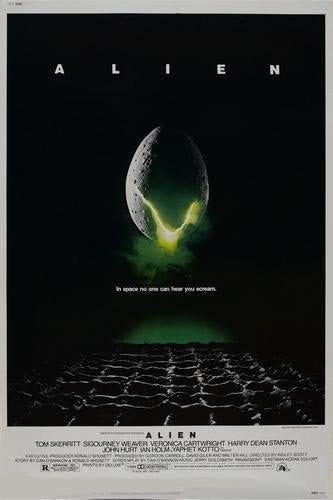
It’s Reviewsday Tuesday! Does Ridley Scott’s Alien (1979) hold up for a modern audience?
This review may contain spoilers.
Ridley Scott’s Alien (1979), starring Sigourney Weaver, Tom Skerrit, John Hurt, Ian Holm, Veronica Cartwright, Yaphet Kotto, and Harry Dean Stanton, is a fairly early example of a science fiction horror cross-genre film. In 2002, Alien was deemed “culturally, historically, [and/or] aesthetically significant” by the US Library of Congress and was selected for preservation in the US National Film Registry. The movie takes place almost entirely on the Nostromo, a commercial spaceship returning with cargo for the Weyland-Yutani Corporation (called only “the Company” in the first film of the franchise), making it a closed-room mystery: the killer is inside the ship. The eponymous alien, a “xenomorph,” has been brought aboard due to the actions/orders of the Company and its representative on the ship, and the plot a race to kill/disable the creature before it kills everyone on board.
Does the movie hold up for modern audiences?
Surprisingly, yes, the film holds up on nearly every criteria. To break it down:
Characters
One of the first things I look for in an older film, when determining if it “holds up,” is casual or unaddressed racism, sexism/misogyny, homophobia, and other problematic tropes or isms that would irk the average viewer or take them out of the immersion. For example, Alien is set in the future, so an all-male cast would be out of place, as would an all-white cast or jokes about segregation, women being in the kitchen, etc. Alien avoids many of the tropes and jokes that would date the film, and one of the reasons for this was the blind casting.
Alien was written with a gender-neutral and race-blind script, which was — and frankly, still is — revolutionary. The writers intentionally wrote all roles to be “generic” and, according to the documentary The Beast Within: The Making of Alien, the casting call explicitly stated that “The crew is unisex and all parts are interchangeable for men or women.” This meant that there are very few stereotypes in the film related to the race or gender of the characters. Ripley’s character was supposedly first assumed to be a man, but but Sigourney Weaver so impressed the casting director and Ridley Scott that the role was tweaked to suit her. Tweaked, not re-written: her role is not stereotypical, and one could imagine a male actor reading the same script without problem. She swears like a trucker and banters with the rest of the crew like “one of the guys” because she is one of the guys; although there is a ranked command structure, for the most part, the crew is on equal footing. Ripley is also often read as a lesbian or bisexual.
Having the main character be a woman in a male-dominated career who takes no shit from her male co-workers, was and, I hate to say it, still is, pretty radical. The same goes for Lambert, the ship’s pilot and the other woman aboard the Nostromo. Lambert is, at times, a bit stereotypically feminine, such as becoming very emotional and over-excitable at moments of high tension. However, during Ripley’s tribunal in a later film (Aliens, 1986), it is revealed that Lambert is a trans woman; this is not an aspect mentioned in either movie, but it is a cool detail that adds to the overall feel of inclusivity. Having a feminine trans woman with a pixie cut (a hairdo that could easily be read as masculine) is, I also hate to say it, still incredibly radical. The role was played by cis actress Veronica Cartwright.
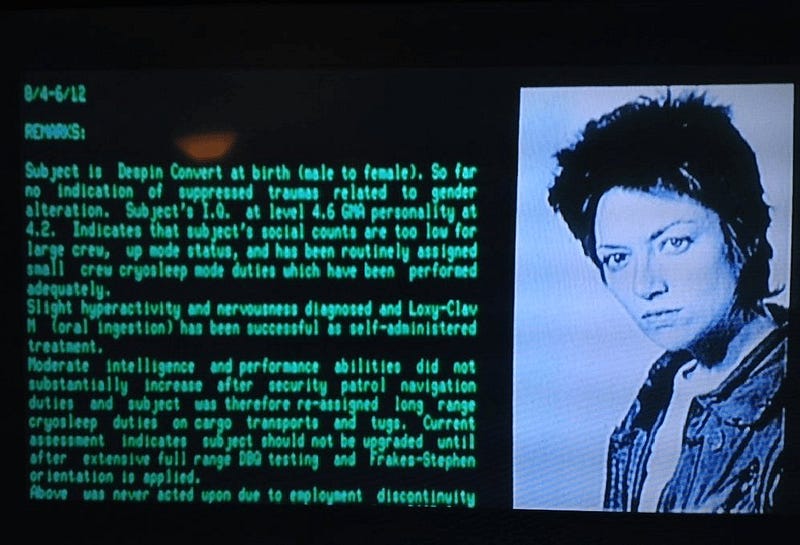
In most horror movies, the first to die is usually the black guy (i.e., Parker) or the pretty blonde woman (Lambert). It’s a trope we’re still fighting in modern cinema, and one which is actively harmful tokenism. In Alien, the diversity of the cast does not feel like tokenism, and the film does not follow that trope. While race is not discussed in the film, it is also not addressed in a negative way; there is a divide between the ranked officers and the engineers/manual laborers, but that divide is not racial — it’s class-based, and leads into a major theme of the film: the critique of capitalism.
The film’s one black character, Parker (Yaphet Kotto), is the chief engineer. His primary motivation is making sure he and his assistant, Brett, are paid their fair share for risking their lives. Although a member of the “laborer” crew rather than a ranked officer, Parker is in a position of power/authority (over Brett) and is an antagonistic foil to Ripley for parts of the film. Parker is also one of the last surviving members of the crew, due in part to his level-headedness and logical methodology (unlike other characters, who act without thinking and put themselves in danger). He is killed trying to save a white woman, Lambert, from the xenomorph, whose attack on Lambert is extremely sexualized (more on that in a moment). Parker reverses a lot of the tropes and stereotypes associated with black characters in the horror genre and in other media. He is extremely intelligent, driven, in a position of power, creates a viable solution (the flamethrower), and sacrifices himself to protect others.
(The xenomorph was also played by a black actor, Nigerian artist Bolaji Badejo, who was chose for the role due to his unusual height, six feet ten inches. While Parker was the only black character in the film, he was not the only black performer.)
Themes
The themes of Alien hold up for a modern audience. Two of the film’s overarching themes are particularly relevant in the 2020s: the dangers of unbridled capitalism, and the fight for bodily autonomy.
Capitalism is explicitly decried in the film. Represented by the Company (Weyland-Yutani Corp.), the greed of executives and the idea that potential profit is worth risking human lives is present throughout the movie. The Company’s representative on the crew is perhaps a bigger “villain” than the xenomorph itself. Moreover, it is the Company’s desire for profit and power that leads to the alien becoming a threat in the first place, and the Company is willing to risk the lives of not only the crew of the Nostromo but all of humanity in search of new weapons and technology. While this theme is continued throughout the rest of the franchise, the first film establishes the inhuman result of unrestrained capitalism — destruction and death follow all attempts to capitalize on the alien.
Bodily autonomy is another major theme in the film and the franchise which came out of it. Many of the xenomorph’s actions parallel or allude to sexual violence. Consistently, the crew of Nostromo face a fear of violation. The “facehugger” iteration of the alien forces an appendage down the throat of its victim to impregnate them. The “chestburster” then kills the host, a parasitic pregnancy brought to term unknowingly. Both these iterations of the xenomorph are oddly phallic. The xenomorph’s constant drooling, and the dripping of various fluids create anxiety and tension as the crew are picked off one by one. Lambert’s death is particularly sexualized, with the xenomorph wrapping its tail around her leg and killing her in a way that necessitates removing her uniform pants (her body is discovered half-naked). Near the end of the film, when Ripley believes the ordeal is over and she is alone, she undresses. Her state of near-nudity leaves her particularly vulnerable, and creates an eerie sexual tension at the climax of the film.
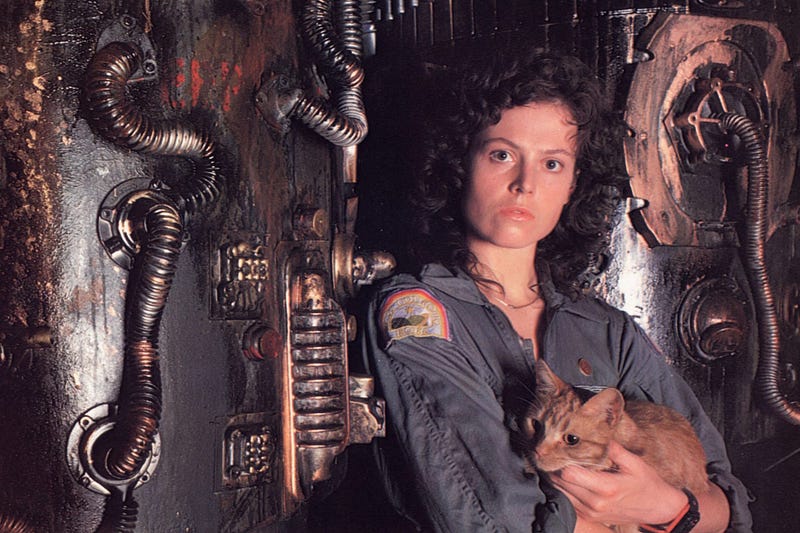
What makes the theme of bodily autonomy most notable, however, is how it is brought about not only through the alien, or the external threat of the plot, but through the internal threat. The traitor on the crew, the Company’s representative, becomes violent when his true nature is revealed. In this scene, he forces Ripley onto a bed and shoves a rolled up pornographic magazine into her mouth. The walls are covered in pornographic images while this is happening, and the attack is clearly a rape allegory. This scene is one which, perhaps, does not “hold up” as well as the rest of the movie, because heavy-handed rape metaphors like this one can be triggering. While I think the overall theme of violation and autonomy holds up, this particular scene could be seen as dated. It does, however, add to the horror of the film, and the “overall vibe” of paranoia surrounding the vulnerability of the body not only from the outside threat, but from other people.

Visuals
For the most part, the visuals in this film do hold up. Although some effects are dated, overall they do not distract from the plot or aesthetic of the film. The xenomorph itself is very convincing, perhaps even more so than later films in the franchise that attempted to use early CGI technology. Alien (1979) uses very little CGI, instead relying on camera angles, lighting, and Bolaji Badejo in the alien suit. The few shots of the xenomorph are that much more terrifying for the lack of presence in other scenes; the alien’s presence is known, and there is a paranoia and anxiety surrounding where and when it will pop out. The external shots and space are, for the most part, not campy or distracting, though they are a product of the era. The one thing that might make a modern view laugh is the rudimentary computer, which uses a DOS-like command prompt system (text only). This can, however, be explained away when one considered the Nostromo to be a cheap/dated ship, since the vibe is explicitly supposed to be “truckers in space” and gritty, low-budget interstellar cargo-hauling.
The visuals that might not hold up are, again, not to do with the alien or the science-fiction elements, but with the people. The choice to have Lambert lose her pants, to have Ripley be assaulted in a bedroom wallpapered with nude women, or to be in her underwear during one of the most frightening scenes are, frankly, misogynistic. While the casting may have been blind, these decisions were most certainly made once two women were put into these roles. Ripley-in-her-underwear, while now considered iconic, is unnecessary fan service, and puts a lot of sexualized focus on Sigourney Weaver’s body. We could have done without the closeups of her butt, is all I’m saying. The xenomorph’s POV shots looking up and down Ripley’s body makes it clear that the alien is supposed to have a “male gaze.” But contemporary films also use the male gaze and sexualize women’s bodies, so while I see this scene as dated and misogynistic, it really isn’t that different as to how things were done in the 1990s, the 2000s, and even the 2010s.
Script
Finally, the script. The story holds up. The themes hold up. The dialogue even, for the most part, holds up. Like I mentioned in my review of the characters, as a modern viewer I often notice errant sexism, homophobia, racism, etc. in films from this era. I can think of no obvious examples from Alien, though later films in the franchise do fall into the trap of dated dialogue (with sexism and homophobia especially; I think the franchise as a whole deliberately avoids any comment on race and tries to be race-inclusive with casting).
The script itself is well-paced, creating a slow burn toward the horror. The xenomorph doesn’t really show up until midway through the movie, by which point you know the characters and are, perhaps, attached to some of them. Rather than jumping right into the gore, the deaths are meaningful because the characters have all (with the exception of John Hurt’s character, Kane) given a lot of screen time. The film’s death scenes and jumps-scares are iconic because they have so much buildup; unlike many modern films, the Alien script is patient and allows for comic relief and moments of feeling safe before the next threat is identified.
The Verdict
Alien (1979) doesn’t just hold up, it is still a cinematic masterpiece. Sigourney Weaver’s performance is absolutely fantastic, and it is no wonder the film got several sequels starring the then-unknown actress. Weaver paved the way for other female action heroes, and Alien paved the way for other gritty, “dirty space” science fiction. The dystopic nature of the universe is pretty shrouded in this first film, but the capitalism-ruined-the-future aesthetic is definitely already emerging in this film. It’s cast and crew did a fantastic job to imagine a future where one’s gender, sexuality, and race does not equal status — everyone is equally vulnerable and exploitable in this dystopian future, and the real “bad guy” is the Company willing to kill their employees to make a quick buck.
Support the author:
For more like this, subscribe to me on Medium or check out my personal nonfiction, nonfiction journalism and longform fiction. I do not monetize poetry or flash fiction. My novels are temporarily out of print; find out why in my article, “The Dreamspinner Press Controversy.” You can also find me on Twitter or like my public Facebook page.
If you’re enjoying my content, consider showing your support by buying me a coffee. If you sign up using my referral link to get unlimited access to all of Medium, I receive a small commission.