Alice Perrers: Accused Of Seducing A King With “Magic Rings”
Fake News from the 14th century
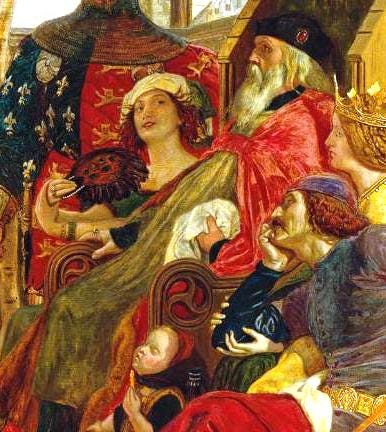
Alice Perrers had one very powerful friend: King Edward III (King of England 1327–77). But that led to her acquiring a lot of enemies, who made things very difficult for her after Edward died.
She was the daughter of a Hertfordshire knight and entered the service of Edward’s Queen Philippa when aged about 20, in 1365. Although she was not noticeably beautiful, she attracted the attention of King Edward and soon became his mistress, bearing him two children.
It became apparent that Alice had much more influence over Edward than Philippa ever managed, and this only increased after Philippa’s death in 1369.
Philippa of Hainault had actually been very influential in the past, being responsible for saving the lives of the “Burghers of Calais” in 1346, when Edward had threatened to execute four hostages but had been persuaded otherwise by Philippa. For Alice Perrers to have exceeded this level of persuasion she must have had an enormous degree of influence over the ageing King.
As Edward got older, his mental health went into a severe decline, his symptoms suggesting a form of dementia, and his dependence on Alice Perrers increased as his mind grew weaker.
Edward treated her just as he would have done his Queen, holding tournaments for her benefit, heaping gifts on her that had belonged to Queen Phillipa, and allowing her to exercise considerable authority within the royal household.
There is plenty of evidence to suggest that Alice played a full part in enriching herself at the King’s expense, aided by her own shrewd business sense and considerable ruthlessness when it came to money matters and corrupting the legal system.
Her property folio eventually extended to 22 manors, land in 17 counties and a London house. When Parliament debated her situation in 1376, the claim was made that the wealth being diverted in her direction was not therefore available for supporting the country’s military objectives. As the Commons Speaker declared:
“It would be a great profit to the kingdom to remove that lady from the King’s company so that the King’s treasure could be applied to the war and wardships in the King’s gift be not so likely granted away”.
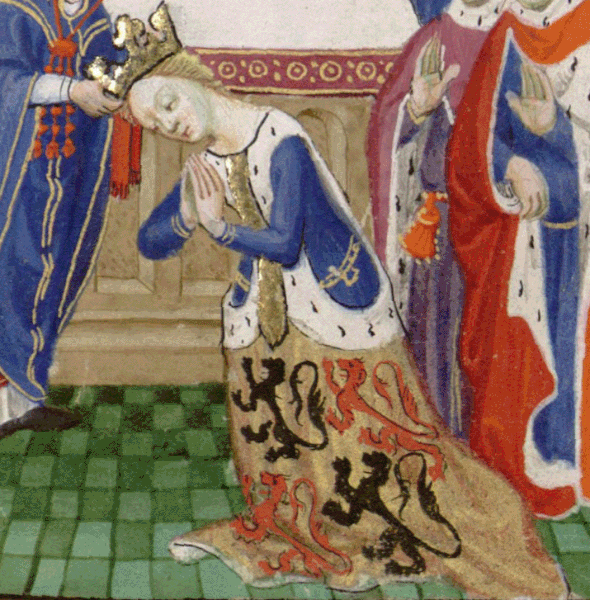
Magic Rings?
It was hardly surprising that the faction opposed to Alice Perrers was not slow in accusing her of using some form of magic to get where she did. King Edward’s increasing senility was surely due to the evil influence she was having on him?
The story that was put about involved a Dominican friar, employed by Alice Perrers, who used magical herbs and images made from wax, and recited incantations first used by an ancient Egyptian sorcerer.
He was also supposed to have given Alice a set of magical rings for the King to wear. These were supposed to confer both remembrance and forgetfulness and were therefore the reason behind Edward’s confused state of mind.
The source for these claims was Thomas Walsingham, a monk of St Albans Abbey, who had long distrusted Alice’s motives and was perfectly happy to blacken her reputation. He wrote that Alice:
“Was a shameless, impudent harlot, and of low birth, for she was the daughter of a thatcher, elevated by fortune. She was not attractive or beautiful, but knew how to compensate for these defects with the seductiveness of her voice. Blind fortune elevated this woman to such heights and promoted her to a greater intimacy with the King than was proper. While the Queen was still alive, the King loved this woman more than he loved the Queen”.
Some of Walsingham’s “facts” were pure invention, but they made their mark when presented as evidence against her, weak though that evidence was.
However, no charge of sorcery was ever brought against Alice Perrers, and the mysterious friar was never identified or arrested.
Trial by the Parliament
In practical terms, this lack of firm evidence was unnecessary, because Parliament needed little persuasion to urge Alice to cease using her influence on the King and affairs in general, on pain of banishment. Alice clearly ignored this command, because she had no problem in getting Edward to pardon her, after which she returned to his side.
Alice was with King Edward when he died in 1377, and this event marked the end of her power. Thomas Walsingham gleefully put it about that she had immediately taken the “magic rings” off the King’s dead fingers, but this was almost certainly another invention on Walsingham’s part. He would clearly have been very happy to see her burned as a witch, but it never came to that.
Instead, Alice Perrers, shorn of royal protection, was tried again on charges of having used undue evidence with King Edward, and she had no answer to what was clearly true.
She was deprived of most of her possessions and lived out her days comfortably enough but in nothing like the luxury she had previously enjoyed. This did not stop her from doing everything she could to recover her losses through the courts but to no avail.
Alice Perrers died in 1400, at the age of 55.
William Langland and Geoffrey Chaucer
It has been thought by some scholars that Alice Perrers was the model for “Lady Mede” in the long allegorical poem Piers Plowman, attributed to William Langland. Langland was a peasant poet who condemned the evils of his day and urged the sinners he castigated to turn to true religion. Piers Plowman appeared around 1377, which fits well with the known facts about Alice Perrers.
Lady Mede symbolises reward and bribery. She is richly dressed and is about to be married to Falsehood. However, Theology objects and the various characters proceed to London to have the matter decided by the King, who threatens punishment for Falsehood, and the other figures surrounding Lady Mede (Flattery and Guile), who run off and leave Lady Mede alone to face the court.
Lady Mede tries her tricks on the justices but confesses to a friar and promises to pay for new windows in a church. She recommends the acceptance of bribes to mayors and justices. The King is fooled and proposes that Lady Mede should marry Conscience, who refuses and delivers a formidable indictment of her.
The parallels between Lady Mede and Alice Perrers are therefore very strong!
Another contemporary of Alice Perrers was Geoffrey Chaucer (they died in the same year). However, there is no character in The Canterbury Tales who can be seen as having been modelled on her.
Chaucer had close associations with royalty during this time — notably with John of Gaunt, the third son of King Edward III, so it is impossible that Chaucer could not have been fully aware of Alice Perrers and her activities. Although the Tales were composed after Alice had fallen from power, he might still have wanted to avoid any legal complications, knowing her litigious character.
From what we know of her story, and it has to be remembered that most of this was written by her enemies, it would appear that Alice Perrers was a schemer who played her cards with considerable skill to worm her way to a privileged lifestyle at the top of the social pyramid.
However, we can also see elements of “fake news” that were used to bring her down. Then as now, it appears that the truth is less important than what you can get people to believe is the truth.
References
- Justin Pollard The Interesting Bits: The History You Might Have Missed. John Murray, 2007
- Michael Hicks Who’s Who In Late Medieval England. Shepheard-Walwyn, 1991
- David Daiches A Critical History of English Literature. Vol 1. Secker & Warburg, 1969.


