avatarJoshua

Free AI web copilot to create summaries, insights and extended knowledge, download it at here

8590

Abstract

platforms have embraced them to steer your attention towards what is the most extreme, most attention-grabbing, and what you most likely will purchase. Platforms like Twitter, Meta (Facebook and Instagram), Google, TikTok, and countless more, utilize the algorithm to show you nearly predictable imagery, information, or products with a sprinkling of random to keep you addicted. Thus, perpetuating what you think and how you think into an entrenched perspective that becomes unshakeable, mundane, and dangerous.</p><p id="376d">Kyle Chayka, a freelance journalist, and writer for The New Yorker, has written a new book called “Filterworld: How Algorithms Flattened Culture.” He has studied how platform algorithms have been invisibly guiding culture and how they continue to fail us. He was recently on one of my favorite podcasts, <a href="https://crooked.com/podcast-series/offline/">OFFLINE with Jon Favreau</a>.</p><blockquote id="c830"><p>This ever-tightening web woven by algorithms is called “Filterworld.” Kyle Chayka shows us how online and offline spaces alike have been engineered for seamless consumption, becoming a source of pervasive anxiety in the process. Users of technology have been forced to contend with data-driven equations that try to anticipate their desires — and often get them wrong. What results is a state of docility that allows tech companies to curtail human experiences — human lives — for profit. But to have our tastes, behaviors, and emotions governed by computers, while convenient, does nothing short of call the very notion of free will into question.</p></blockquote><p id="d737">Algorithms are in part flattening our experience online just as much as they are pushing the most extreme and problematic views, often views that are not rooted in fact and are designed to draw attention and engagement for the purposes of profit.</p><h1 id="e187">The Great Divide.</h1><p id="fa0a">As I have mentioned before in other articles and online, algorithms are a central contributor and factor when it comes to the dangerous and abhorrent spread of misinformation and disinformation. <a href="https://integrityinstitute.org/blog/misinformation-amplification-tracking-dashboard">Multiple studies</a> have shown that misinformation is more likely to be reshared than factual information and <i>well-crafted lies</i> will get more engagement. Essentially, the more mechanisms there are for content to go viral and for folks to be rewarded by going viral, the more misinformation is spread.</p><p id="1904">This spreading of misinformation can lead to fake news, false evidence, and even horrible outcomes like the erosion of rights or death. The COVID pandemic was a perfect case study for how algorithms perpetuated misinformation on platforms like Facebook, due to sensationalized statements and burning distrust for public health officers. The roots of misinformation during the COVID pandemic have contributed to current vaccine hesitancy and the current outbreaks of once-eradicated diseases like polio.</p><p id="97dc">As we continue to divide, we will only experience more problems in the realms of public health, politics, regulation, education, and more.</p><p id="4c4e">However, I would be remiss to not point out the benefits of being online and social media. Platforms where information is shared can be integral to citizen journalism, bearing witness to atrocities, and progressive social change. Algorithms can help like-minded people or people searching for specific information connect and build social or political movements. In one <a href="https://www.ncbi.nlm.nih.gov/pmc/articles/PMC8853081/">article</a>, it notes:</p><blockquote id="b848"><p>“…alongside these challenges, social media has also been highly influential in spreading timely and useful information. For example, the recent #BlackLivesMatter movement was enabled by social media, which united concurring people’s solidarity across the world when George Floyd was killed due to police brutality, and so are 2011 Arab spring in the Middle East and the 2017 #MeToo movement against sexual harassments and abuse”</p></blockquote><p id="f0d1">Social media has been integral in the ability of people to mobilize globally. Large social movements have been directly correlated with social media and comparable platforms — and social media platforms are one of the central spaces to normalize and use algorithms. But as algorithms have become more prominent and more secretive, there has been a steady increase in misinformation and disinformation that perpetuates harm and continues to divide societies and push for greater material consumption.</p><p id="52bf">As was noted at the beginning of this article, the information you provide to a platform is organized as data that then reflects your interests, desires, beliefs, values, and prejudices. However, just like the invisible hand of the algorithm, you may not notice this reflection. Instead, it reinforces these views as the truth and only truth and everything else is a lie, thus contributing to extreme hate, extreme distrust, and extreme confusion as the information we see online must now validate our biases.</p><p id="810e">Data gathered through platforms also contribute to targeted advertisements, which are integrated into the algorithm.<i> Though this can be a topic in and of itself.</i></p><figure id="b135"><img src="https://cdn-images-1.readmedium.com/v2/resize:fit:800/1*wGk604CT0CfHrwEadUa6Dw.jpeg"><figcaption>2024 — Perplexity Search, Dirty Windows, and a Cat — Photo by myself, Joshua M.</figcaption></figure><h2 id="75d3">So, after all of this trash-talking of algorithms — which I have barely scratched the surface — what can you do?</h2><p id="d8a2">For starters, being aware and continuing to read up on how algorithms play a role in your life is key. Knowledge is power as they say.</p><p id="af20">Currently, there are few regulations, in particular transparency laws around algorithms that could help stem the impact and power of tech. Having transparency on how algorithms work and what they prioritize for you to consume, would help clarify what parts of it are causing harm. Contacting your local political representatives to push them to act is integral in addressing tech-associated harms.</p><p id="0e35">If you can, become directly involved in the development of software, build skills in coding, and software development, and have your critical lens play a key role in rectifying these far-reaching issues.</p><p id="fdec">Get involved in social justice organizations and support companies that situate social justice, equity, and inclusion at the core of their work. If you know of current companies, please share them in the comments. If you have more information or recommendations on books/articles/podcasts, please also share them below.</p><p id="232b">Finally, some folks on threads intentionally call out the algorithm with text to identify the types of things you want to engage with. I am not sure if it works, but worth a try. It is almost like talking with the algorithm.</p><p id="a2dd">Taking back control of our digital lives is an important next step in moving forward together. While algorithms may be a massive contributor to isolation, division, and the harms associated with that, we are still able to fix it. Humans have the full ability to fix this.</p><p id="a51a">Finally, do not forget to take time away from all things technology. Remember that it is only one part of life, and there is an actual, beautiful, natural world with physical humans and adorable animals for you to explore. The key to addressing algorithm harms and the increasing impact of Artificial Intelligence is to have a healthier balance with them.</p><p id="c124">In her recent memoir, Burn Book, Kara Swisher discusses the multi-decade shifts of personalities and technological advancements. A deep lover of most things tech, Kara aptly points out both the positive advancements and negative dangers associated with the sector as it rumbles on. At the end, while discussing the increasing flood 24/7 of disparaging information and the insurmountable feeling of powerlessness, she says,</p><blockquote id="f446"><p>That is why I tell them (her kids) and anyone else who will listen that it is ever more urgent that we take back control, because what happens next will be due to the choices we make now. When it comes to the tech tsunami that has blown down so much already, people like me hardly matter, because we are not the ones who will endure teh weight of what is coming and we are not the

Options

oens who will be impacted the most. What worries me most is apathy in the face of all this Internet convenience. The deluge of digital, which is both necessary to participate in society while also increasingly addictive, makes it harder for anyone to act. It’s heartbreaking to see so little energy put into fighting back… Despite the heartbreak, we must act.</p></blockquote><p id="bf57">Thank you for reading. Make sure you share, follow, and clap at this article to keep the conversation going. Also, if you are able to, click on the tip link to help me get a new computer for writing.</p><h1 id="8cc4">Resources & References</h1><div id="8824" class="link-block"> <a href="https://arc.net/l/quote/bzebkdmk"> <div> <div> <h2>Quote from "Editing Algorithms, Capitalism, and your stolen thoughts - Medium"</h2> <div><h3>Edit description</h3></div> <div><p>arc.net</p></div> </div> <div> <div style="background-image: url(https://miro.readmedium.com/v2/resize:fit:320/0*O7N22dGDaVoSsJ_e)"></div> </div> </div> </a> </div><div id="a2ce" class="link-block"> <a href="https://crooked.com/podcast/youve-got-no-mail/"> <div> <div> <h2>"You've got (no) mail." | Crooked Media</h2> <div><h3>The Trump campaign smashes that reset button, the President tries to undermine the election by attacking mail-in voting…</h3></div> <div><p>crooked.com</p></div> </div> <div> <div style="background-image: url(https://miro.readmedium.com/v2/resize:fit:320/0*0AF_n48NbB0PKkjg)"></div> </div> </div> </a> </div><div id="b660" class="link-block"> <a href="https://www.linkedin.com/pulse/watching-watchmen-black-mirror-technology-tenth-person-baxter/"> <div> <div> <h2>Watching the Watchmen: Black Mirror, Technology, and the Tenth Person</h2> <div><h3>I recently heard an interview with Kara Swisher, a wonderful technology business journalist, and something she said has…</h3></div> <div><p>www.linkedin.com</p></div> </div> <div> <div style="background-image: url(https://miro.readmedium.com/v2/resize:fit:320/0*F2vSlChj04KisA3W)"></div> </div> </div> </a> </div><div id="f3eb" class="link-block"> <a href="https://readmedium.com/2slgbtq-youth-and-community-are-being-targeted-by-hate-groups-and-it-must-stop-c8955b99fa57"> <div> <div> <h2>2SLGBTQ+ youth and community are being targeted by hate groups, and it must stop.</h2> <div><h3>undefined</h3></div> <div><p>undefined</p></div> </div> <div> <div style="background-image: url(https://miro.readmedium.com/v2/resize:fit:320/0*giEFUhoMaOHtDLGF.jpeg)"></div> </div> </div> </a> </div><div id="46e0" class="link-block"> <a href="https://www.theguardian.com/world/2024/mar/14/india-block-documentary-sikh-activist-canada"> <div> <div> <h2>India blocks access to documentary about death of Sikh activist in Canada</h2> <div><h3>CBC aired an investigation into the death of Hardeep Singh Nijjar, whose killing the Canadian government suspects India…</h3></div> <div><p>www.theguardian.com</p></div> </div> <div> <div style="background-image: url(https://miro.readmedium.com/v2/resize:fit:320/0*5X7GEEt9-YbXUtsG)"></div> </div> </div> </a> </div><div id="e67b" class="link-block"> <a href="https://integrityinstitute.org/blog/misinformation-amplification-tracking-dashboard"> <div> <div> <h2>Misinformation Amplification Analysis and Tracking Dashboard - Integrity Institute</h2> <div><h3>We are tracking how misinformation performs on platforms to measure the extent to which platforms are amplifying…</h3></div> <div><p>integrityinstitute.org</p></div> </div> <div> <div style="background-image: url(https://miro.readmedium.com/v2/resize:fit:320/0*KeiXBlu-8lwwLTkW)"></div> </div> </div> </a> </div><div id="0408" class="link-block"> <a href="https://www.ncbi.nlm.nih.gov/pmc/articles/PMC8853081/"> <div> <div> <h2>The disaster of misinformation: a review of research in social media</h2> <div><h3>The spread of misinformation in social media has become a severe threat to public interests. For example, several…</h3></div> <div><p>www.ncbi.nlm.nih.gov</p></div> </div> <div> <div style="background-image: url(https://miro.readmedium.com/v2/resize:fit:320/0*nUKWTy8cAjmox8mB)"></div> </div> </div> </a> </div><div id="7a95" class="link-block"> <a href="https://www.simonandschuster.com/books/Burn-Book/Kara-Swisher/9781982163891"> <div> <div> <h2>Burn Book</h2> <div><h3>Burn Book by Kara Swisher - Instant New York Times Bestseller From award-winning journalist Kara Swisher comes a witty…</h3></div> <div><p>www.simonandschuster.com</p></div> </div> <div> <div style="background-image: url(https://miro.readmedium.com/v2/resize:fit:320/0*exrskvKhD832alIw)"></div> </div> </div> </a> </div><div id="ff94" class="link-block"> <a href="https://storestock.massybooks.com/item/Tjsi1wmychNUwiX8uH3R4Q"> <div> <div> <h2>Filterworld</h2> <div><h3>How Algorithms Flattened Culture</h3></div> <div><p>storestock.massybooks.com</p></div> </div> <div> <div style="background-image: url(https://miro.readmedium.com/v2/resize:fit:320/0*4eekXNmOE3kKM818)"></div> </div> </div> </a> </div><div id="72ae" class="link-block"> <a href="https://www.theverge.com/2020/8/3/21352309/microsoft-tiktok-acquisition-deal-why-us-countries-data"> <div> <div> <h2>Why Microsoft wants TikTok</h2> <div><h3>Microsoft has confirmed it's trying to secure a deal for TikTok in the US. If successful, Microsoft will run TikTok in…</h3></div> <div><p>www.theverge.com</p></div> </div> <div> <div style="background-image: url(https://miro.readmedium.com/v2/resize:fit:320/0*39YFY1U4zXWQQLeF)"></div> </div> </div> </a> </div><div id="7e2e" class="link-block"> <a href="https://www.goodreads.com/book/show/34762552-algorithms-of-oppression"> <div> <div> <h2>Algorithms of Oppression: How Search Engines Reinforce ...</h2> <div><h3>Read 498 reviews from the world's largest community for readers. Run a Google search for "black girls" - what will you…</h3></div> <div><p>www.goodreads.com</p></div> </div> <div> <div style="background-image: url(https://miro.readmedium.com/v2/resize:fit:320/0*_hXn8nPZcE6Gl1th)"></div> </div> </div> </a> </div><div id="ce26" class="link-block"> <a href="https://usa.kaspersky.com/resource-center/definitions/cookies"> <div> <div> <h2>What are Cookies?</h2> <div><h3>Everyone has seen the website banners that ask you if you'll allow cookies on your browser or not. But what exactly…</h3></div> <div><p>usa.kaspersky.com</p></div> </div> <div> <div style="background-image: url(https://miro.readmedium.com/v2/resize:fit:320/0*mq1rWQ6c9sn4_oHv)"></div> </div> </div> </a> </div></article></body>

Algorithms, Capitalism, and Your Stolen Thoughts

Together we must take action and push back against the tech oligarchs who insist we do things their way, even when it only benefits them and harms the rest of us.

Check out the list of links/resources at the end of the article. Everything is also sourced throughout the text. Clap, comment, follow, and subscribe to my newsletters here.
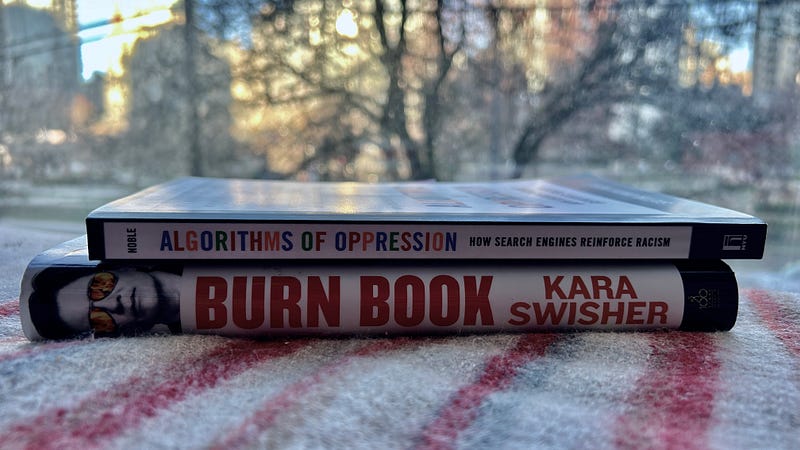
2024 — Books on Tech — Photo by Myself, Joshua M.

It is capitalist neoliberal greed at best and dystopian at worst. The majority of applications determine search results through a series of complex mathematical equations. From scrolling on Instagram to using Google to search for flights, to buying new clothes and looking for the best restaurants in your neighborhood. Those equations essentially create what is called an algorithm and it is based on your data.

As it turned out, it was capitalism after all. — Kara Swisher, Burn Book

What is an algorithm?

Algorithms are not imaginary entities that humanity has no control over. Rather, algorithms are human-constructed systems, such as by mathematicians, computer scientists, or software engineers. The algorithmic systems utilize data and information captured by the use of platforms such as how long you may watch the same video, what you “heart”, or the information directly entered into the platform. If this feels abstract, hold on, we will get to more specifics.

I am no computer scientist. If you are curious, check out the resources linked throughout this article and at the end.

The human-built systems, like all systems outside of nature itself, are fundamentally flawed and reinforce harmful issues like racism, homophobia, xenophobia, and disinformation, and perpetuate binaries such as the political left and right. While they might help you find a new television series or new fitness influencer to follow, they also have a more sinister side that requires broader awareness. In showing users a constant influx of information, ideas, or products, algorithms reinforce our cognitive biases. We do not need to be computer scientists and tech billionaires to understand that there is a real and direct impact on your daily life when you are able to avoid perspectives or information that you might disagree with or learn from. In other words, algorithms help shield us from what we do not like or understand and only surround us with what we do like or what supports our perspective. Algorithms isolate you from a diversity of experiences by limiting your ability to understand other perspectives, cultures, or options.

In a podcast episode of Pod Save America by Crooked Media, one of tech’s most notorious and influential journalists, Kara Swisher stated,

“…when you’re on Netflix and they give you something you like, that’s great. The question is, think…of the Black Mirror episode on this and then organize yourself around that.”

The dystopian statement from someone who has had a very honest love affair with tech since the 1990’s and has witnessed its evolution, provides a stark warning for everyone to critically think about how we consume information and how that information is regulated. Should the tech oligarchs be the only ones with the power to decide what you see and how you see it without transparency while making literal billions and struggling to pay rent or a mortgage?

In the book, “Algorithms of Oppression,” by Safiya Umoja Noble, algorithms are defined as more than just mathematical constructs as they exist within social contexts. The ways in which algorithms are instructed by society are intertwined with human biases and prejudices. They are imbued with the beliefs, values, ideals, and fears that contribute to the worldviews of the algorithm creators.

You might think of algorithms as the new invisible hand of the market economy and act like the puppeteers to your daily life with strings attached to the cookies you accept and essentially give up the power to control your data and your information.

2015 — Canadian Human Rights Museum — Photo taken by myself, Joshua M.

Who controls the algorithm? Not you.

Algorithms exist in the majority of tech products you use — it is important to clarify here that in democratic-leaning places, the algorithm is mostly shaped by the oligarchs of the tech world such as Mark Zuckerberg (Meta), Elon Musk (Twitter/X), Tim Cook (Apple), Sundar Pichai (Google), Ruth Porat (Google), Alison Wagonfeld (Google), Aravind Srinivas (Perplexity), Satya Nadella (Microsoft), Jeff Bezos (Amazon, Washington Post), Jim Lanzone (Yahoo), George Arison (Grindr), Sam Altman (Open AI), Daniel Ek (Spotify), Netflix (Ted Sarandos), Shou Zi Chew (TikTok), Evan Spiegel (Snapchat), and so many more that I have forgotten about, or have moved on from specific leadership roles, or have passed on — like Steve Jobs. These “leaders” are not elected officials, nor are they well regulated (or even pay their share of taxes). They also play a very key role in politics due to their incredible power over information.

“The people who make these decisions hold all types of values, many of which openly promote racism, sexism, and false notions of meritocracy, which is well documented in studies of Silicon Valley and other tech corridors.” — Safia Noble

In authoritarian or comparable political spaces, the algorithm is deeply impacted by the governing leaders in collaboration with the tech elite. This leads to incredible censorship of identities, political ideology, and narratives. For example, Russia’s Vladimir Putin has direct control over state media and any companies that operate within the country, blocking information on big issues like the brutal war in the Ukraine or LGBTQ content. In Hungary and up until recently in Poland, the extreme populist leaders were following the same Russian playbook.

I also want to make clear that I choose democratic leaning intentionally. As is noted later in this article, in part because of algorithms, there is an increasing erosion of democratic principles with the attack on rights. See my other article, 2SLGBTQ+ youth and community are being targeted by hate groups, and it must stop. Even in countries with democratic-leaning governments, there are issues of censorship. We see this predominantly in Western media and social media as it relates to the horrific genocide occurring in Gaza, or in India where the government forced YouTube to remove a documentary on the killing of a Sikh activist in Canada. Algorithms are vulnerable to the whims of governments and tech elites, everywhere.

Therein lies a key element of algorithms, they are controlled by formidable folks to maintain their grip on power, while reinforcing this power through neoliberal capitalist methods of the commodification of bodies, creative content, and ideas.

As algorithms have become more dominant in our daily lives, oligarchy-like platforms have embraced them to steer your attention towards what is the most extreme, most attention-grabbing, and what you most likely will purchase. Platforms like Twitter, Meta (Facebook and Instagram), Google, TikTok, and countless more, utilize the algorithm to show you nearly predictable imagery, information, or products with a sprinkling of random to keep you addicted. Thus, perpetuating what you think and how you think into an entrenched perspective that becomes unshakeable, mundane, and dangerous.

Kyle Chayka, a freelance journalist, and writer for The New Yorker, has written a new book called “Filterworld: How Algorithms Flattened Culture.” He has studied how platform algorithms have been invisibly guiding culture and how they continue to fail us. He was recently on one of my favorite podcasts, OFFLINE with Jon Favreau.

This ever-tightening web woven by algorithms is called “Filterworld.” Kyle Chayka shows us how online and offline spaces alike have been engineered for seamless consumption, becoming a source of pervasive anxiety in the process. Users of technology have been forced to contend with data-driven equations that try to anticipate their desires — and often get them wrong. What results is a state of docility that allows tech companies to curtail human experiences — human lives — for profit. But to have our tastes, behaviors, and emotions governed by computers, while convenient, does nothing short of call the very notion of free will into question.

Algorithms are in part flattening our experience online just as much as they are pushing the most extreme and problematic views, often views that are not rooted in fact and are designed to draw attention and engagement for the purposes of profit.

The Great Divide.

As I have mentioned before in other articles and online, algorithms are a central contributor and factor when it comes to the dangerous and abhorrent spread of misinformation and disinformation. Multiple studies have shown that misinformation is more likely to be reshared than factual information and well-crafted lies will get more engagement. Essentially, the more mechanisms there are for content to go viral and for folks to be rewarded by going viral, the more misinformation is spread.

This spreading of misinformation can lead to fake news, false evidence, and even horrible outcomes like the erosion of rights or death. The COVID pandemic was a perfect case study for how algorithms perpetuated misinformation on platforms like Facebook, due to sensationalized statements and burning distrust for public health officers. The roots of misinformation during the COVID pandemic have contributed to current vaccine hesitancy and the current outbreaks of once-eradicated diseases like polio.

As we continue to divide, we will only experience more problems in the realms of public health, politics, regulation, education, and more.

However, I would be remiss to not point out the benefits of being online and social media. Platforms where information is shared can be integral to citizen journalism, bearing witness to atrocities, and progressive social change. Algorithms can help like-minded people or people searching for specific information connect and build social or political movements. In one article, it notes:

“…alongside these challenges, social media has also been highly influential in spreading timely and useful information. For example, the recent #BlackLivesMatter movement was enabled by social media, which united concurring people’s solidarity across the world when George Floyd was killed due to police brutality, and so are 2011 Arab spring in the Middle East and the 2017 #MeToo movement against sexual harassments and abuse”

Social media has been integral in the ability of people to mobilize globally. Large social movements have been directly correlated with social media and comparable platforms — and social media platforms are one of the central spaces to normalize and use algorithms. But as algorithms have become more prominent and more secretive, there has been a steady increase in misinformation and disinformation that perpetuates harm and continues to divide societies and push for greater material consumption.

As was noted at the beginning of this article, the information you provide to a platform is organized as data that then reflects your interests, desires, beliefs, values, and prejudices. However, just like the invisible hand of the algorithm, you may not notice this reflection. Instead, it reinforces these views as the truth and only truth and everything else is a lie, thus contributing to extreme hate, extreme distrust, and extreme confusion as the information we see online must now validate our biases.

Data gathered through platforms also contribute to targeted advertisements, which are integrated into the algorithm. Though this can be a topic in and of itself.

2024 — Perplexity Search, Dirty Windows, and a Cat — Photo by myself, Joshua M.

So, after all of this trash-talking of algorithms — which I have barely scratched the surface — what can you do?

For starters, being aware and continuing to read up on how algorithms play a role in your life is key. Knowledge is power as they say.

Currently, there are few regulations, in particular transparency laws around algorithms that could help stem the impact and power of tech. Having transparency on how algorithms work and what they prioritize for you to consume, would help clarify what parts of it are causing harm. Contacting your local political representatives to push them to act is integral in addressing tech-associated harms.

If you can, become directly involved in the development of software, build skills in coding, and software development, and have your critical lens play a key role in rectifying these far-reaching issues.

Get involved in social justice organizations and support companies that situate social justice, equity, and inclusion at the core of their work. If you know of current companies, please share them in the comments. If you have more information or recommendations on books/articles/podcasts, please also share them below.

Finally, some folks on threads intentionally call out the algorithm with text to identify the types of things you want to engage with. I am not sure if it works, but worth a try. It is almost like talking with the algorithm.

Taking back control of our digital lives is an important next step in moving forward together. While algorithms may be a massive contributor to isolation, division, and the harms associated with that, we are still able to fix it. Humans have the full ability to fix this.

Finally, do not forget to take time away from all things technology. Remember that it is only one part of life, and there is an actual, beautiful, natural world with physical humans and adorable animals for you to explore. The key to addressing algorithm harms and the increasing impact of Artificial Intelligence is to have a healthier balance with them.

In her recent memoir, Burn Book, Kara Swisher discusses the multi-decade shifts of personalities and technological advancements. A deep lover of most things tech, Kara aptly points out both the positive advancements and negative dangers associated with the sector as it rumbles on. At the end, while discussing the increasing flood 24/7 of disparaging information and the insurmountable feeling of powerlessness, she says,

That is why I tell them (her kids) and anyone else who will listen that it is ever more urgent that we take back control, because what happens next will be due to the choices we make now. When it comes to the tech tsunami that has blown down so much already, people like me hardly matter, because we are not the ones who will endure teh weight of what is coming and we are not the oens who will be impacted the most. What worries me most is apathy in the face of all this Internet convenience. The deluge of digital, which is both necessary to participate in society while also increasingly addictive, makes it harder for anyone to act. It’s heartbreaking to see so little energy put into fighting back… Despite the heartbreak, we must act.

Thank you for reading. Make sure you share, follow, and clap at this article to keep the conversation going. Also, if you are able to, click on the tip link to help me get a new computer for writing.

Resources & References

Tech
Algorithms
Capitalism
Economics
Greed
Recommended from ReadMedium