
Alarm over WHO global ‘power grab’
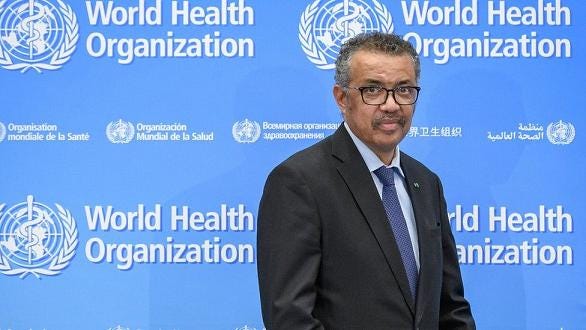
In a new survey, the WHO has come out on top as the most trusted multinational organisation. But that might change.
Ironically, just as the 2023 Edelman Trust Barometer shows that trust in the World Health Organisation increased in 15 of 28 countries surveyed in 2022, fears grow over behind-the-scenes talks about proposed changes to the WHO’s International Health Regulations (IHR) which, it’s claimed, could usher in a global authoritarian state.
Only one country, Japan, expressed distrust in the WHO, reveals the annual Barometer report, launched by Edelman, an international PR firm, on January 18, 2023. The report is based on an online survey of 32,000 respondents across 28 countries, measuring the levels of trust that the general public had in various institutions.
From a list, respondents were asked to indicate how much they trusted a particular institution to do what is right. The WHO was the top scorer with 67 points out of 100, against the UN (59) and the EU (56). Fieldwork was conducted in November, 2022.
The IHR negotiations took place earlier this month (January, 2023) in Geneva, Switzerland, and followed similar talks in December, 2022, about a new WHO ‘pandemic treaty’ which would be legally-binding under international law and regulate how nations prepare for and respond to future pandemic threats.
The IHR already allow the director-general of the WHO, Tedros Adhanom Ghebreyesus, to declare a public health emergency anywhere in the world without the consent of the government concerned, although the two parties are supposed to reach agreement first.
But taken together, the IHR and treaty proposals, if enacted, would radically alter the way in which the WHO responds to public health ‘emergencies’ worldwide, potentially enabling it to override the sovereignty of nations.
Human rights
I contacted the human rights lawyer Professor Francis Boyle, of the University of Illinois College of Law, who is among those sounding the alarm. He confirmed his opinion that the new proposals, which amounted to a ‘massive power grab’ and might violate international law, are so dangerous that the US federal and state governments should pull out of the WHO right away.
He warned: ‘Either one or both [regulations or treaty] will set up a worldwide totalitarian medical and scientific police state under the control of Tedros and the WHO, which are basically a front organisation for the Centers for Disease Control and Prevention (CDC), Anthony Fauci, Bill Gates, Big Pharma, the biowarfare industry and the Chinese communist government that pays a good chunk of their bills.
‘Either they’ll get the regulations or they’ll get the treaty, but both are existentially dangerous. These are truly dangerous and insidious documents.’
The WHO treaty would set up a separate international organisation, whereas the proposed regulations would work within the context of the WHO as it is today. Having read through both texts, it was ‘a distinction without a difference’, said Prof Boyle, who has written widely on international law and argued cases in the International Court of Justice.
He said he had never seen documents that were so totalitarian in nature: ‘Either one or both will set up a totalitarian medical and scientific police state that will be beyond the control of national, state and local government authorities.’
In his view, the proposed WHO treaty violates the Vienna Convention on the Law of Treaties, ratified in 1969, under Article 18 of which a treaty does not come into force when signed; when a state has signed, it is obligated to act only in a manner that does not defeat the object and purpose of the treaty. But under the WHO proposal the treaty would come into force at the moment it was signed.
This meant that, assuming the World Health Assembly adopts the treaty, US President Biden, for example, could order the treaty to be signed by his medical chief and it would come into effect immediately on a provisional basis.
‘I don’t know, in any of my extensive studies of international treaties, let alone treaties setting up international organisations, of any that has a provision like that in it,’ Prof Boyle added. ‘It’s completely insidious.’
Matters concerning the treaty and the IHR will go to the WHO’s 76th World Health Assembly in May, 2023. An intergovernmental negotiating body (INB) working on the treaty will present a progress report with the aim of the treaty being adopted at the May 2024 assembly.
Tedros told the INB in December, 2022: ‘The lessons of the pandemic must not go unlearned.’ The early draft of the treaty was ‘a true reflection of the aspirations for a different paradigm for strengthening pandemic prevention, preparedness, response and recovery’ (france24.com, December 6, 2022).
According to the WHO, the treaty discussions are taking place not only with all 194 member states, but also with various stakeholders listed in document A/INB/2/4, ‘Modalities of engagement for relevant stakeholders’.
In connection with the identity of some of these stakeholders, it’s interesting to refer to the important new book by cultural historian and philosopher Nicholas Hagger, The Fall of the West: The story behind covid, the levelling-down of the West and the shift of power to the East with the rise of China (O-Books, November 2022).
Hagger warns that key happenings from the ‘War on Terror’ to covid-19 have brought the Western financial system to the brink of collapse and shifted power from the West to the East and neo-imperialist China. The Fall of the West is the third instalment of Hagger’s trilogy on the West.
In The Syndicate (2004), he described how, in the twentieth century, a group of elitist mega-rich families — the Rothschilds, Rockefellers and co-operators — levelled down leading Western countries by promoting revolutions, wars and independence movements against their empires, and planned a New World Order and world government to control the earth’s resources for their own benefit. In terming this group, ‘the Syndicate’, Hagger equates it with the West’s ‘military-industrial complex’.
His The Secret History of the West (2005) traced the Syndicate’s roots back to secret Freemasonic organisations and revolutions that undermined the West from the Renaissance to the early twentieth century.
Developing countries
When we look at the list of treaty talks stakeholders it’s like opening up a series of Russian ‘nesting’ dolls.
An example is Gavi, the Vaccine Alliance (G for global), a public-private health partnership which aims to increase access to immunisation in developing countries, and which is listed as an observer.
Gavi is in partnership with the WHO, UNICEF, the Bill and Melinda Gates Foundation and the World Bank, and also with the ID2020 Alliance, an NGO which advocates digital ID and ‘digital health certificates’ (vaccine passports). Founding partners of ID2020 include the Rockefeller Foundation, Gavi, Microsoft and Accenture, a Dublin-based Irish-American professional services company specialising in IT.
In the same WHO document, under Annex C, listed among 220 ‘non-state actors in official relations with WHO’, are the Gates Foundation, the Clinton Health Access Initiative, the Rockefeller Foundation, which includes the Population Council — founded by John D Rockefeller in 1952 and known for its population control initiatives — and which has a ‘strategic plan’ for 2023–30.
Other stakeholders invited to attend and speak at open sessions of the INB include the International Air Transport Association, the International Civil Aviation Organisation and the World Bank Group.
By way of some further background, in 2014 the WHO was among the organisations that launched the Global Health Security Agenda, an international operator in the field of infection prevention and control, and a ‘brainchild’ of the US Centers for Disease Control and Prevention (CDC).
Members of the GHSA steering group include a group of contributors, the Global Health Security Consortium, plus the World Bank and the Private Sector Round Table, ‘a cross-industry coalition that leverages companies’ capabilities to strengthen health security’, members of which are AstraZeneca and Johnson & Johnson, makers of covid-19 vaccines.
In fact, the co-chairs of the PSRT have been Dr Alan Tennenberg, former chief medical officer of Johnson & Johnson Global Public Health, and Ashling Mulvaney, former global head of access to healthcare at AstraZeneca. Their terms ended in December, 2022 (businesswire.com, January 12, 2023).
‘Dress rehearsals’
The GHS Consortium steering committee includes the Johns Hopkins Center for Health Security, co-host of Event 201 in 2019 which, as Nicholas Hagger has pointed out, was one of two ‘dress rehearsals’ for a pandemic before covid-19 arrived: Lock Step in 2010 was the other one.
Event 201, also hosted by the World Economic Forum, the Gates Foundation and the CIA, was an exercise in preparing for a coming severe pandemic, requiring cooperation between governments, industries and international institutions. Lock Step involved the Rockefeller Foundation and the US-based Global Business Network.
Members of the GHS Consortium include the Gates Foundation and Amazon Web Services with its covid-19 public ‘data lake’, a ‘centralised repository of up-to-date and curated datasets focused on the spread and characteristics of the novel coronavirus (SARS-CoV-2)’, which has kept databases for the US Centers for Disease Control and Prevention (aws.amazon.com).
Also in the Consortium are Boston University and its National Emerging Infectious Disease Laboratories (NEIDL) whose researchers created a new version of the coronavirus virus, ‘only a little less deadly than the Wuhan strain, killing 80% rather than 100% of laboratory mice that are particularly sensitive to the virus. But it was still much deadlier in these mice than omicron’ (‘Lab-leak fears are putting virologists under scrutiny’, Washington Post, January 20, 2023).
Wheels within wheels.
NOTE: the 28 countries in the Edelman Trust Barometer survey are Argentina, Australia, Brazil, Canada, China, Colombia, France, Germany, India, Indonesia, Ireland, Italy,Japan, Kenya, Malaysia, Mexico, Nigeria, Saudi Arabia, Singapore, South Africa, South Korea, Spain, Sweden, Thailand, The Netherlands, UAE, UK, US.
*****
You can subscribe to Medium by using this link: