
Al Naslaa: Deciphering the Oddities of Earth’s Most Unusual Rock Formation
This rock appears as though it was split by a sword or a laser, according to supporters of conspiracy theories. However, it’s not just the shape that intrigues.
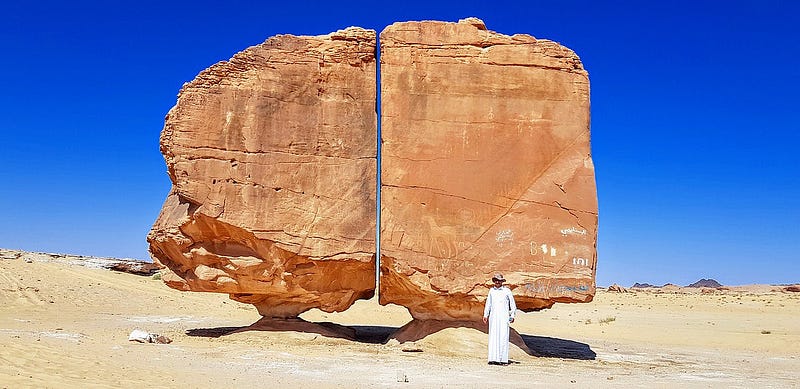
Many countries around the world vie for tourists by setting architectural records almost yearly, boasting the tallest, largest, or most extraordinary buildings. Yet, throughout history, nature has been the most adept builder. Unlike human-made creations, we can’t always explain the origins of certain natural wonders. One of the biggest geological mysteries on Earth lies in Saudi Arabia. Have you heard about the Al Naslaa rock?
Where is Al Naslaa located?
This remarkable formation lies in the northwest of Saudi Arabia, in the remote Tabuk region surrounded by vast desert expanses. In theory, such a place doesn’t seem inviting for exploration. However, due to Al Naslaa, more and more people interested in geology, archaeology, and even conspiracy theories are making their way there (although not in massive crowds).
The most intriguing aspect of the rock is the narrow space between its two parts. This wouldn’t be extraordinary except that the split looks precise, almost as if measured with a ruler. How and when did this happen? Speculation suggests the rock cracked due to natural processes like erosion and stress corrosion. There are also claims that the formation involved human or extraterrestrial intervention.
The entire formation measures approximately 6 meters in height and 9 meters in width. The split into two nearly equal parts isn’t the only intriguing aspect. Both halves of the rock stand vertically on small pedestals, seemingly defying the laws of gravity. Interestingly, the southeastern face of Al Naslaa is covered with numerous petroglyphs.
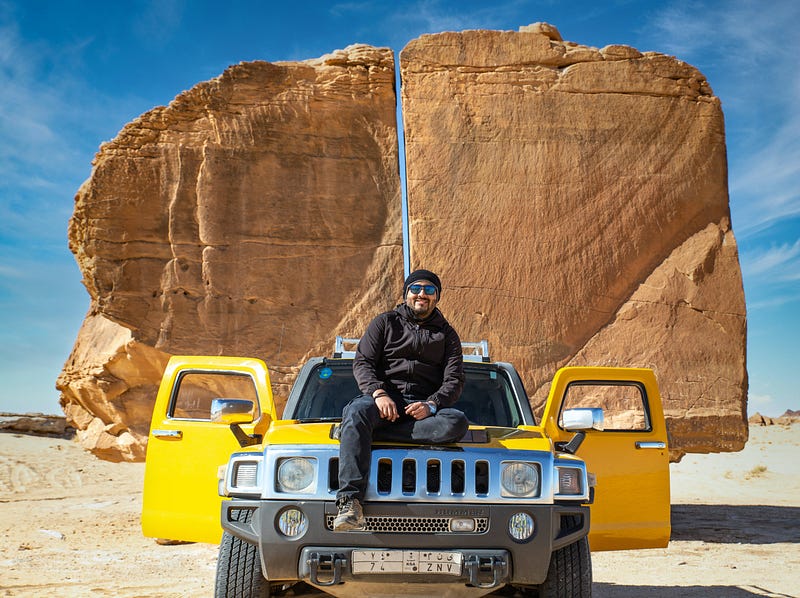
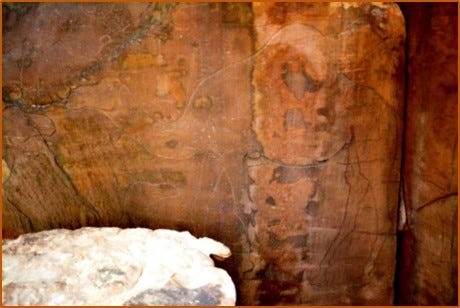
Petroglyphs on the Al Naslaa rock
Petroglyphs, or drawings carved into the rock, on Al Naslaa provide researchers with insights into people who inhabited or at least passed through the area thousands of years ago. They are also a crucial part of Saudi Arabia’s archaeological and cultural heritage, likely originating from prehistoric times. Many depict animals, hunting scenes, and human figures. Some of the petroglyphs could be interpreted as religious or spiritual symbols revered by the local ancient cultures.
Experts also point to their astronomical significance. Geometrically shaped petroglyphs might have served for navigation or tracking celestial events. It’s plausible they were used in rituals associated with the cosmos. However, they haven’t been fully deciphered yet. When they are, we might gain entirely new insights into ancient astronomers’ and mathematicians’ practices.
As of now, more is unknown than known about these specific petroglyphs. Researchers emphasize that these drawings serve as evidence that humans have almost always had the desire to record and pass on their experiences, beliefs, and history through art.
How was this rock formation created?
Despite various theories, the exact cause of Al Naslaa rock’s split remains a subject of ongoing geological research. One of the most popular theories (yet to be confirmed) suggests it resulted from natural weathering and erosion occurring over millions of years. Al Naslaa is made of sandstone, a type of rock known for layers and faults. The combination of wind, rain, temperature fluctuations, and geological forces supposedly led to stress fractures along existing lines. Ultimately, the split could have resulted from weaknesses in the rock’s structure.
Some geologists, on the other hand, suggest that movements in the Earth’s crust could have caused the rock to split. This is possible because Al Naslaa is located in a region experiencing tectonic activity on our planet.
As known, deserts are among the places where temperature amplitudes are most pronounced. One theory suggests that it was the weather fluctuations that led the rock formation to appear as it does today. Specifically, it refers to a phenomenon called “frost wedging.” In this case, it would involve water getting into cracks in the rock. It would then freeze, expanding and potentially leading to the fracturing of the rocks.
The lack of conclusive geological evidence and the extraordinary precision of the split have contributed to some believing that Al Naslaa is the work of humans or aliens. However, this is highly unlikely.
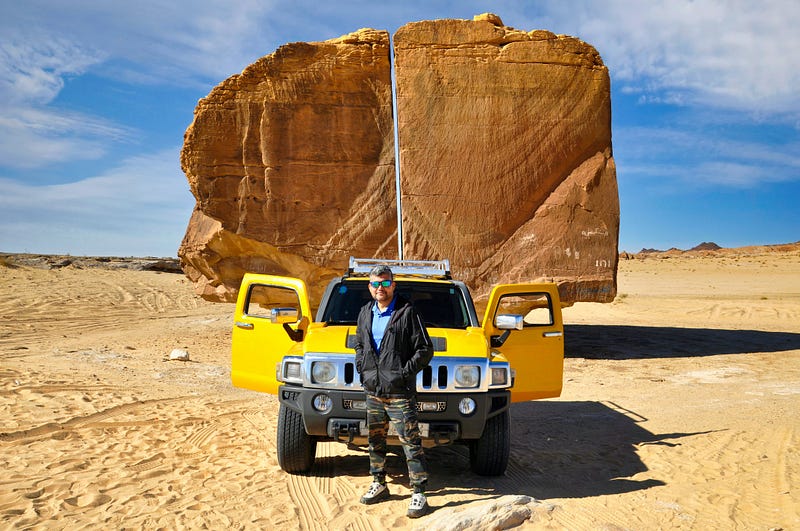
Visiting the Al Naslaa rock
Thanks to its unique features, the Al Naslaa rock has become one of the country’s major attractions. The influx of tourists has brought both opportunities and challenges to Saudi Arabia. It’s important to preserve and protect this enigmatic place. Therefore, tourists must obtain permission for visits or travel with authorized guides. This practice helps monitor visitor numbers and minimizes potential damage.
Additionally, local authorities and conservation organizations organize initiatives to raise awareness about the importance of preserving the Al Naslaa rock and its surroundings. These programs target both residents and tourists. The formation is also continuously monitored by geologists studying how anthropogenic pressures impact it.
Attention all readers!
As content creators on Medium.com, we face minimal compensation for our hard work. If you find value in my articles, please consider supporting me on my “Buy Me a Coffee” page. Your small contributions can make a big difference in fueling my passion for creating quality content. Thank you for your support!


