
Al-’Isrā’ wal-Miʿrāj: Prophet Muhammad’s (ﷺ) Night Journey and Ascension to the Heavens
Part One
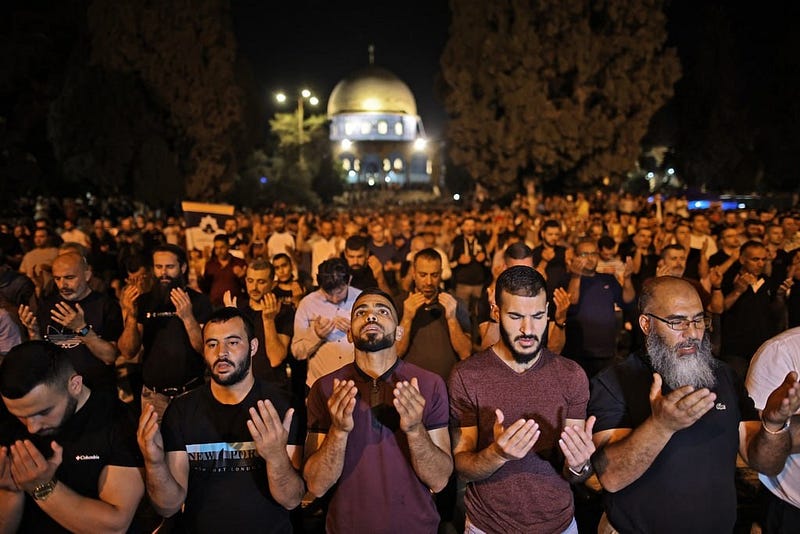
One of the most seminal events in the life of Prophet Muhammad (ﷺ) was a journey that took him from Mecca to Bayt al-Maqdis (al-’Isrā’) and then to the heavens and back (the Miʿrāj) in a portion of a night. The event has been related in the Qur’an and a number of ḥadīṯhs provide greater detail of the event. This episode constitutes a primary theological foundation for Muslims and constitute their attachment and affinity to Bayt al-Maqdis land (al-Quds, Jerusalem). It is therefore important for an understanding of the merits and rights toward Bayt al-Maqdis in general and al-Quds(Jerusalem) as a city in particular. Primary text in this respect is verse one of chapter seventeen of the Qur’an:
“Glory be to Him Who carried His servant by night from the Sacred Mosque to the Farthest Mosque Whose surroundings We have blessed, that We might show him some of Our signs, for He is the Hearer, the Seer.” (Qur’an 17, verse 1)

For Muslims, the verse above makes a direct reference to the miraculous night journey that took the Prophet (ﷺ) from Mecca to the “Farthest Mosque” the location of which as Bayt al-Maqdis. Indeed, one of the titles given to chapter seventeen is al-’Isrā’ because of the episode that is mentioned in verse one. For Muslims several questions arise in connection with al-’Isrā’ wal-Miʿrāj.
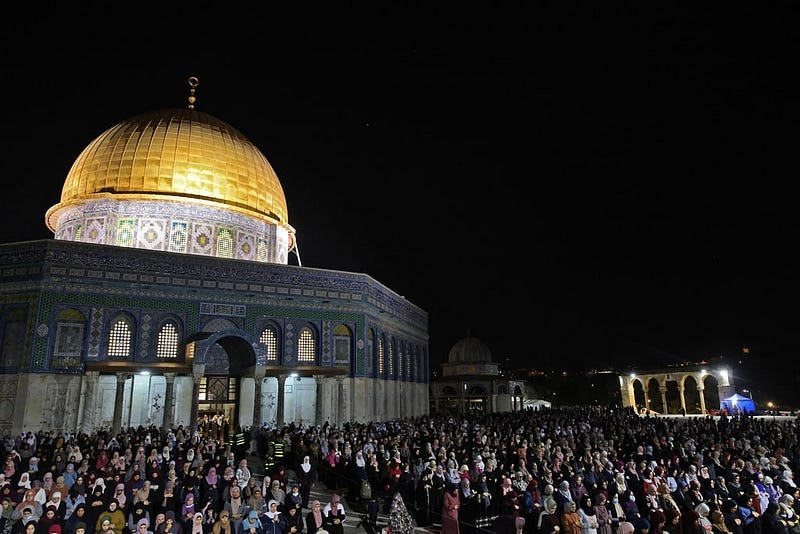
When did this event take place? Was it during the Meccan or Medina period? Was it a onetime occurrence or did it occur several times? Some might ask whether the occurrence falls within the realm of the possible or is it simply a myth made up by Muslims later. This question of possibility is easily answered from the point of view of theology for a believing Muslim or anyone who accepts the existence of an All Powerful God. The issue is secondary to the fundamental question of the existence of God, everything else is but a mere detail of the unfolding divine attributes in the world. What is relevant to our purpose is to examine what Muslims believe with respect to Bayt al-Maqdis, for miracles that are accepted as Allah’s intervention in His own creation for a reason, which is sometimes expressed and known but often is not mentioned. A point of contention among early Muslim scholars is whether this event was a dream or did it take place in both body and spirit.
The answer to many of the questions raised will cause us to consider the stages of al-’Isrā’ wal-Miʿrāj and the conflicting accounts of it appearing in various hadith. These differing accounts actually make a significant contribution to understanding Muslims’ feelings toward al-Aqsa mosque, Al-Quds (Jerusalem) and Palestine in general. In some accounts of the al-’Isrā’ wal-Miʿrāj, we find that the prophet is reported to have prayed in Bayt al-Maqdis. We may ask whether indeed this prayer took place, was it before or after al-Miʿrāj and what was its significance? These are just a few critical questions that are relevant to our main theme.
What is the al-’Isrā’?
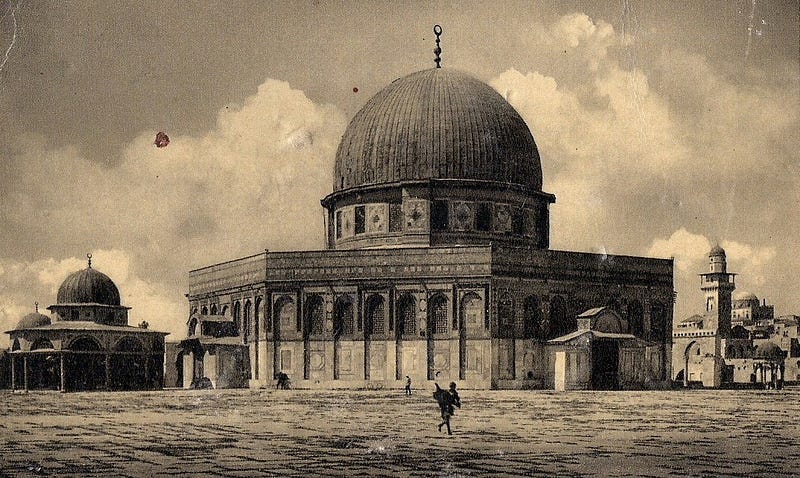
The term al-’Isrā’comes from a root meaning to undertake a journey at night. Thus, the verse and the Qur’anic chapter’s name both refers to the night journey undertaken by the prophet to Bayt al-Maqdis, aided by the angel Jibrīl (Gabriel). Even though the word al-’Isrā’ itself means to travel at night, the Qur’anic verse in Arabic uses an adverbial expression (laylan) meaning ‘by night’ which is understood to imply that the entire event took place in only a portion of the night. The miraculous aspect of this journey is not that it took the prophet from Mecca to Bayt al-Maqdis but that it was completed in a portion of the night something impossible at that time considering the modes of transportation available. People contemporary with the Prophet (ﷺ) viewed this journey as impossible for it would have taken about a month in each direction. The historical context of the miracle is therefore important. The length of the portion of the night is not made clear to us; it is left to the imagination to contemplate this aspect of the miracle.
What is al-Miʿrāj?
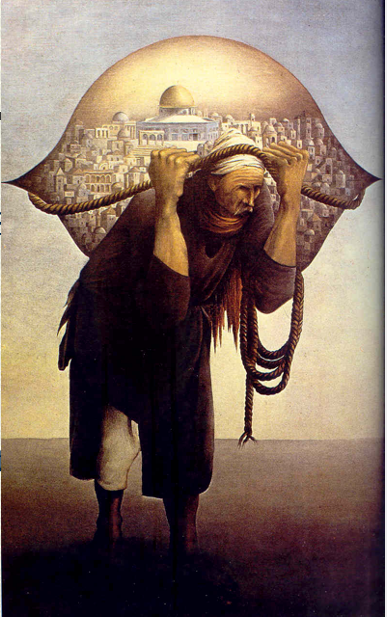
The Mi‘raj, on the other hand, derives from a root meaning to ascend a ladder, and it refers to the Prophet’s (ﷺ) journey to the heavens going by way of a jewel laden ladder the base of which is at the center of a gate leading into another or out of the world. The gate is believed by Muslims to be located in al-Quds (Jerusalem) and it constitutes the link between this realm and the heavens, which explains in part the choice of the location for the Prophet’s (ﷺ) journey to meet his Lord. While it is accepted as a fact by Muslims that the prophet did travel to the heavens, the word Miʿrāj does not appear in the Qur’an, the only direct use of the term is to be in the ḥadīṯhs. The Miʿrāj is considered the second stage of an episode beginning with the Isra’. An absence of the word itself in the Qur’an is not the same as the lack of Qur’anic textual proof to support it as can be seen from verses 5–18 chapter 53.
In verse 9, we are informed of the Prophet (ﷺ) being drawn near to the distance of “two bows length, or even nearer,” and in verse 14, that he came “near the Lote-tree of the utmost boundary.” The reference to the “two bows length, or even nearer” had two possible meanings for early commentators of the Qur’an with the majority maintaining that it refers to Jibrīl while some see it as referring to the Prophet (ﷺ) being drawn near to Allah. As for the “Lote-tree,” it is understood to indicate the Prophet’s (ﷺ) travel toward the “utmost boundary,” the location of the meeting with Allah as indicated in the ḥadīṯh. The meeting with Allah has been a subject of debate among scholars. One group of scholars has maintained that the Prophet (ﷺ) did not see his Lord with his own eyes, but he witnessed Him through his heart’s inner eye, while others hold the view that he did actually see Him, this being possible for him as a prophet.
When Did al-’Isrā’ wal-Miʿrāj Occur?
As to the date of the al-’Isrā’ wal-Miʿrāj, all scholars agree that it took place in the Meccan period of the prophetic mission but they differ on the exact date, month and year. The most widely cited narration is that of Ibrāhīm al-Ḥarbī who states that it took place on the 27th day of Rabīʿ al-ʾĀkhir, one year before the migration to Medina. However, al-Ḥarbī’s position was challenged on the date, and a number of other scholars among them ibn Ḥajar al-ʿAsqalānī disputes the dating as one year before migration while al-Qadi ‘Iyad considers five years after the beginning of the revelation to be a more likely date.
In the prophetic biography of Ibn Kathir we find a number of possible dates mentioned. He quotes Ibn ‘Asākir as placing the event ten years after the beginning of the prophet’s mission, al-Bayhaqī as affirming the date of one year prior to the emigration, and al-Hakam as affirming the date of 16 months before the move to Medina. The scholars are certain that the event took place in the Meccan period most likely towards its end rather than the beginning. The narrations of one year and 16 months are very close, the difference of only four months indicating perhaps an error in oral transmission.
We may also be certain that the event took place after the death of Khadīja bint Khuwaylid, the Prophet’s first wife, which would place it at least three years prior to the emigration to Medina. There is a divergent account that places the event prior to Khadīja’s death, in light of her having spoken of her prayers with the Prophet, the prayers which were fixed definitively during the Miʿrāj. This account runs contrary to the established consensus that the episode took place after Khadīja’s death. Furthermore, the Prophet (ﷺ) had a set of prayers mandated for him before the final prescription of the prayers during the Miʿrāj. If we take the event to have occurred after the death of Khadīja, then the dating of the episode five years into the Prophet’s (ﷺ) mission would be ruled out. However, ibn Ḥajar al-ʿAsqalānī maintains that the one year date is not the object of consensus among scholars; he identifies a total of ten possibilities for dating the event. On the other hand ibn Jamāʿah in his book, Mukhtaṣar al-Sīrah, puts the al-’Isrā’ wal-Miʿrāj on the 17th of Rabīʿ al-ʾAwwal and the Prophet’s (ﷺ) age at the time as 53 years, which would be about one year prior to the migration. In short, the question of the year is not settled, but most evidence points toward the end of the Meccan period, not earlier.
There are also a variety of possibilities with respect to the month and the day of the week on which the event took place. We find, for example, that al-Suddī places the al-’Isrā’ wal-Miʿrāj in the month of Ḏū al-Qaʿdah, al-Zuhrī and ‘Urwamention Rabīʿ al-ʾAwwal, while ‘Abd al-Ghanī ibn ‘Abd al-Wāḥid al-Jammā’īlī al-Maqdisi chooses the 27th of Rajab as the date. There are also two days of the week used in reference to the al-’Isrā’ wal-Miʿrāj, Monday and Friday. Both Monday and Friday have significance in Islamic spirituality. Monday is known to be the day on which the Prophet (ﷺ) was born, and as such it is highly regarded and is recommended for additional acts of worship including voluntary fasting outside the Month of Ramadan. Friday, on the other hand, according to the Islamic tradition is the day Adam was created, was given an abode in paradise, and placed down on earth; the day of mandatory congregational prayers for the Muslims; and according to a number of ḥadīṯhs the day on which judgment day will take place. It may be for these reasons that the Isra’ and Mi‘raj were assigned to a Monday or a Friday. At present, the al-’Isrā’ wal-Miʿrāj are celebrated in the Muslim world on the 27th of Rajab, signifying an acceptance of this date among Islamic institutions, and the rejection of all other narrations is the result of state organization of religious festivals throughout history.
Link to Part Two: https://medium.com/@drhatembazian/part-two-the-events-of-the-al-isr%C4%81-wal-mi%CA%BFr%C4%81j-prophet-muhammad-s-night-journey-and-ascension-to-572947ac7681