avatarGlenn Rocess

Free AI web copilot to create summaries, insights and extended knowledge, download it at here

4060

Abstract

raphic.org/resource/art-war/">Art of War</a> over a century before Alexander the Great was born, and it’s true today.</p><h2 id="a979">Supercarrier Operations 201 : Logistical Support For Supercarriers</h2><p id="10bc">A modern supercarrier requires a truly monstrous amount of logistical support, especially underway, and this is even more true of conventionally-powered carriers which require refueling at sea — “Underway Replenishment” or UnRep for short — every few days. Even nuclear-powered carriers must periodically top off their stores of jet fuel. It is crucial to be able to refuel underway; after all, if a carrier must moor pierside in order to refuel, this places serious constraints on the effective range and operational availability of the ship itself.</p><figure id="2335"><img src="https://cdn-images-1.readmedium.com/v2/resize:fit:800/1*msmu7Xx0kL8k7MBPL-DDIA.png"><figcaption>On the left is the USS Camden (AOE-2) UnRepping the USS Abraham Lincoln (CVN 72) and the USS Shiloh (CG 67) (photo: <a href="https://nara.getarchive.net/media/the-uss-camden-aoe-2-conducts-a-duel-underway-replenishment-unrep-at-sea-with-5a4cf6">NARA</a>). On the right is the PLA-N Liaoning UnRepping in the western Pacific. Full disclosure: I served five years on the Camden, and four years on the Lincoln. (<a href="https://news.usni.org/2021/12/31/chinese-carrier-strike-group-liaoning-returns-from-deployment#:~:text=A%20Joint%20Staff%20Office%20statement%20issued%20Monday%20said,and%20Miyako%20Island%20toward%20the%20East%20China%20Sea.">US Naval Institute</a>)</figcaption></figure><p id="0c18">But ‘logistical support’ is more than just fuel, bombs, bullets, and food. It’s also all the upkeep and repairs for the ship itself and for the squadrons on board. Every ship requires an industrial logistical chain for everything it requires to remain operational, and this is especially true of aircraft carriers and their respective squadrons. Carriers normally spend only a third of their operational lives on deployment. Another third is spent tied up pierside or in drydock for repairs and maintenance, and the remaining third is spent training the crew for deployment.</p><p id="a05c">For a modern navy, these challenges are not insurmountable, but one should bear in mind that outside of China, there are no secure military drydocks in the eastern hemisphere large enough for a Nimitz-class carrier, though with time and tax dollars, excavating such a drydock is not out of the question. This is just another example of the endless logistical challenges Ukraine would face should we give them the USS <i>Nimitz</i>.</p><h2 id="2190">Supercarrier Operations 301: Fighting The Ship</h2><p id="02ae">The thing about warships is…they’re warships. They’re built for war, which means not just the ability to take the fight to the enemy, but also the wherewithal to take a hard punch and keep fighting. This, gentle reader, is where the U.S. Navy shines. Of all the navies on the planet since the late 1700’s, only three have built real traditions of “fighting the ship,” which means engaging in battle even when taking significant damage: the British, the Americans, and the Japanese. And to give credit where credit is due, both we and the Japanese inherited that tradition directly from the Brits. Side note: for those who might point at the Soviets, the Soviet Navy never won a great battle against superior odds.</p><figure id="8c6f"><img src="https://cdn-images-1.readmedium.com/v2/resize:fit:800/0*zRwf3qS5gAv0uymQ.JPG"><figcaption>USS Stark after it was struck by two Iraqi Exocet missiles during the 1987 Iran-Iraq war. (<a href="https://www.history.navy.mil/content/history/museums/nmusn/explore/photography/ships-us/ships-usn-s/uss-stark-ffg-31.html">Navy</a>)</figcaption></figure><p id="4ae1">In modern times this is referred to as “damage control,” meaning that all hands are trained and repeatedly drilled in how to respond to fire, flooding, and battle damage, and how to keep the ship not just afloat, but able to keep fighting. The Brits, Ame

Options

ricans, and Japanese are the only modern navies who have rightly earned their pride with the most direct and hard-won experience, with rules metaphorically written in the blood of our seagoing forebears.</p><p id="6b7a">Yes, that high-minded rhetoric sounds like so much stuff and nonsense, but it’s not. Instead, it’s institutional knowledge and confidence gained over generations and even centuries, one that engenders a general feeling of, “we did it then, so we for damned sure can do it now” even in the darkest hours.</p><p id="044f">The application of this to the possibility of handing Ukraine a supercarrier is obvious: as skilled and courageous as they are, the Ukrainians have no tradition of fighting the ship. That’s something that simply can’t be taught.</p><h2 id="3770">Supercarrier Operations 401: Coordination With The Fleet</h2><p id="b173">To put it in terms a ground-pounder might better understand, an aircraft carrier is like a tank. The tank carries one hell of a punch, but if it’s not accompanied by infantry, it’s more often than not just a target. So it goes with supercarriers, for while they can achieve and maintain air supremacy within a thousand-mile radius, they are extremely vulnerable to attacks by missiles, drones, and especially submarines. This is why no American or British carrier <i>ever </i>deploys unescorted by destroyers and fast attack nuclear submarines.</p><figure id="ae82"><img src="https://cdn-images-1.readmedium.com/v2/resize:fit:800/0*99aGx6y87AZlKaSk.jpg"><figcaption>The HMS Queen Elizabeth and the UK Carrier Strike Group in 2021 (<a href="https://www.navylookout.com/more-details-of-the-upcoming-uk-carrier-strike-group-deployment-emerge/">Navy Lookout</a>)</figcaption></figure><p id="82fa">The destroyers provide missile defense, submarine detection, and electronic warfare interdiction, and the <a href="https://abcnews.go.com/International/wireStory/ukraine-downs-russian-hypersonic-missile-us-patriot-99128287">recent successes</a> of the Patriot missile defense system in Ukraine against Russia’s vaunted hypersonic missiles are a great indication of how far missile defense technology has advanced in the past twenty years. And as for the submarines, there’s a reason why they’re called the Silent Service. By the time the enemy knows they’re there, it’s too late.</p><p id="e472">And as in the previous section, this applies to Ukraine in that they have no effective fleet with which to protect their new carrier. It’s just a target that would be sunk in short order by Russian land-based missiles.</p><h2 id="2fc1">Conclusion</h2><p id="9ae3">No sailor likes to see his or her ship sold for scrap. Ten years ago there was a concerted, though ultimately unsuccessful effort by former officer and enlisted crewmembers to save the USS Ranger (CV 61) from the scrapyard, to have her sent from Naval Base Kitsap in Bremerton, Washington (the base is less than two miles from where I sit typing this article) to become a floating museum in Portland, Oregon.</p><p id="9eb1">But that’s how it must be. With the exception of the United Kingdom and Japan (<i>if</i> they decided to build large-enough drydocks and <i>greatly </i>expand their naval air capabilities), no other nation could fully utilize any of our modern supercarriers. China would likely find itself hamstrung, not by any lack of professionalism, determination, or industrial capability, but by its utter lack of the aforementioned institutional knowledge so crucial to modern fleet actions. To be sure, I could be wrong about China; I might be underestimating them just as the world so deeply underestimated Japan prior to the Battle of Tsushima against the Russian fleet in 1905. But I don’t think so.</p><p id="b28f">And in any case, the above reasons should make it crystal-clear why we would never offer a modern supercarrier to Ukraine (much less to any other nation), and why they themselves are likely aware enough of their own limitations that they would wisely refuse it even if we did make the offer.</p></article></body>

“Aircraft Carriers for Ukraine!” Bad for America, Even Worse for Ukraine
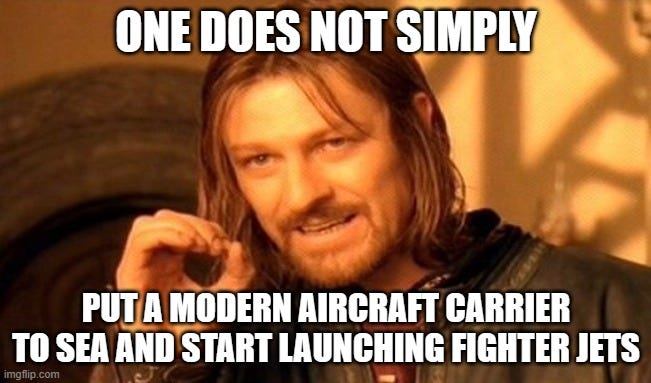
First off, I strongly support Ukraine in their fight against Russia’s unwarranted and illegal invasion. Every American who remembers the Cold War should support Ukraine, even if only because it’s a heck of a lot cheaper than having to fight Russia ourselves.

But last night I saw a tweet that I just couldn’t let go:
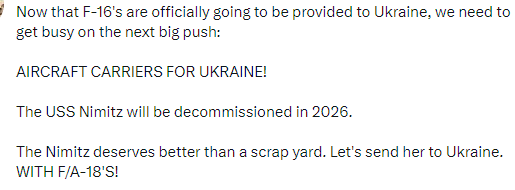
Twitter

One of the primary jobs of any senior sailor is to help junior sailors pull their heads out of their collective asses, just as was done for us when we were young, dumb, and full of…ah, back to the story. There’s one major reason why America’s never sold a supercarrier (i.e. every U.S. aircraft carrier since the commissioning of the USS Forrestal (CV 59) in 1955) to any other nation: logistics. We’d love to be able to sell them to, say, the United Kingdom, but no other nation — including China, whose brand-spanking new Type 003 aircraft carrier is nearing operational status — currently has the wherewithal to fully and effectively utilize a supercarrier. The key words, mind you, are “fully and effectively utilize.”

Supercarrier Operations 101: The Easy Stuff

Aircraft carriers are no longer the biggest ships afloat, and it’s not even close. Fully loaded, the newest supertankers have several times the displacement of the newest carrier, the USS Gerald R. Ford. Even Royal Caribbean's Wonder of the Seas luxury cruise liner is over twice the Ford’s displacement. These gargantuan ships, all of which are built overseas, serve as proof that there is no overwhelming challenge in building a modern aircraft carrier. Oh, sure, there’s the catapults (whether steam or electromagnetic), the nuclear reactors hardened for shock and battle damage, the multiple redundant systems, and so on, but none of these are a real stretch in the modern world of marine engineering.

Moreover, while there will be fits and starts and tragic mishaps along the way, any sufficiently-motivated and -funded navy can ensure a competent, well-trained, and motivated crew to operate a supercarrier.
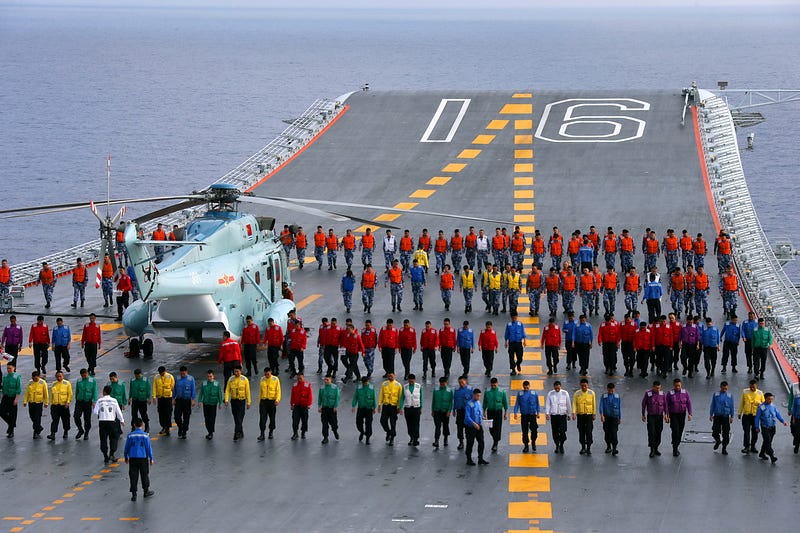
A “FOD walkdown” on board the PLA-N Liaoning. “FOD” stands for “foreign object damage” and a full walkdown of the flight deck looking for nuts, bolts, and any other loose items is normally done prior to flight ops. What every US Navy veteran is looking at here, however, is how the Chinese Navy’s flight deck uniforms are identical to our own. Imitation by a potential opponent truly is the sincerest form of flattery. (ChinaMil.com)

Again, I point to the Chinese People’s Liberation Army — Navy (PLA-N). While any good sailor would rightly take exception to the name of the organization, it would be a grave mistake to underestimate their professionalism and dedication. The single worst — and most common — mistake in warfare is to underestimate one’s enemy. Such was true when Sun Tzu penned his iconic Art of War over a century before Alexander the Great was born, and it’s true today.

Supercarrier Operations 201 : Logistical Support For Supercarriers

A modern supercarrier requires a truly monstrous amount of logistical support, especially underway, and this is even more true of conventionally-powered carriers which require refueling at sea — “Underway Replenishment” or UnRep for short — every few days. Even nuclear-powered carriers must periodically top off their stores of jet fuel. It is crucial to be able to refuel underway; after all, if a carrier must moor pierside in order to refuel, this places serious constraints on the effective range and operational availability of the ship itself.
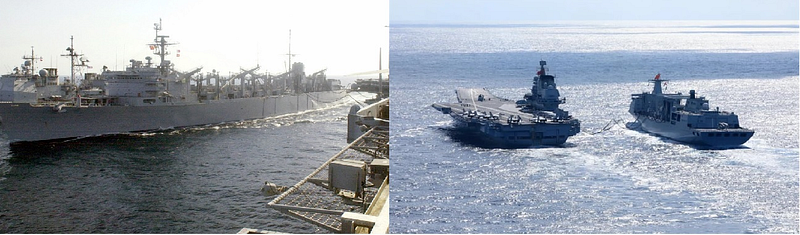
On the left is the USS Camden (AOE-2) UnRepping the USS Abraham Lincoln (CVN 72) and the USS Shiloh (CG 67) (photo: NARA). On the right is the PLA-N Liaoning UnRepping in the western Pacific. Full disclosure: I served five years on the Camden, and four years on the Lincoln. (US Naval Institute)

But ‘logistical support’ is more than just fuel, bombs, bullets, and food. It’s also all the upkeep and repairs for the ship itself and for the squadrons on board. Every ship requires an industrial logistical chain for everything it requires to remain operational, and this is especially true of aircraft carriers and their respective squadrons. Carriers normally spend only a third of their operational lives on deployment. Another third is spent tied up pierside or in drydock for repairs and maintenance, and the remaining third is spent training the crew for deployment.

For a modern navy, these challenges are not insurmountable, but one should bear in mind that outside of China, there are no secure military drydocks in the eastern hemisphere large enough for a Nimitz-class carrier, though with time and tax dollars, excavating such a drydock is not out of the question. This is just another example of the endless logistical challenges Ukraine would face should we give them the USS Nimitz.

Supercarrier Operations 301: Fighting The Ship

The thing about warships is…they’re warships. They’re built for war, which means not just the ability to take the fight to the enemy, but also the wherewithal to take a hard punch and keep fighting. This, gentle reader, is where the U.S. Navy shines. Of all the navies on the planet since the late 1700’s, only three have built real traditions of “fighting the ship,” which means engaging in battle even when taking significant damage: the British, the Americans, and the Japanese. And to give credit where credit is due, both we and the Japanese inherited that tradition directly from the Brits. Side note: for those who might point at the Soviets, the Soviet Navy never won a great battle against superior odds.
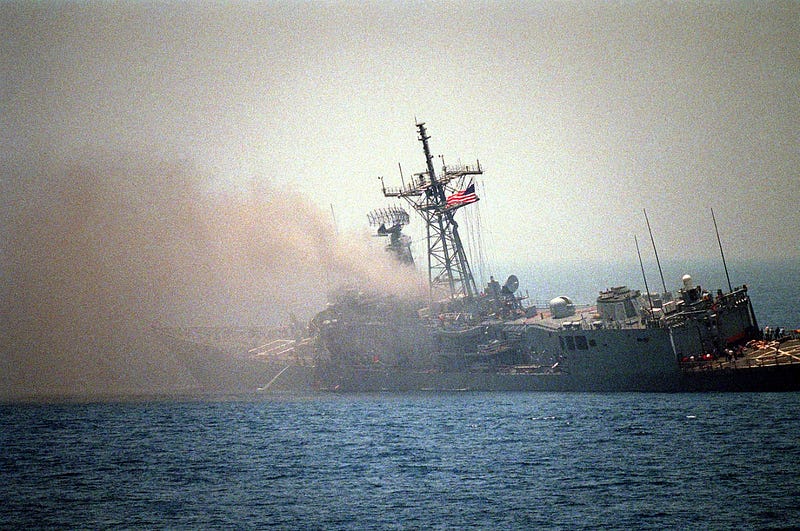
USS Stark after it was struck by two Iraqi Exocet missiles during the 1987 Iran-Iraq war. (Navy)

In modern times this is referred to as “damage control,” meaning that all hands are trained and repeatedly drilled in how to respond to fire, flooding, and battle damage, and how to keep the ship not just afloat, but able to keep fighting. The Brits, Americans, and Japanese are the only modern navies who have rightly earned their pride with the most direct and hard-won experience, with rules metaphorically written in the blood of our seagoing forebears.

Yes, that high-minded rhetoric sounds like so much stuff and nonsense, but it’s not. Instead, it’s institutional knowledge and confidence gained over generations and even centuries, one that engenders a general feeling of, “we did it then, so we for damned sure can do it now” even in the darkest hours.

The application of this to the possibility of handing Ukraine a supercarrier is obvious: as skilled and courageous as they are, the Ukrainians have no tradition of fighting the ship. That’s something that simply can’t be taught.

Supercarrier Operations 401: Coordination With The Fleet

To put it in terms a ground-pounder might better understand, an aircraft carrier is like a tank. The tank carries one hell of a punch, but if it’s not accompanied by infantry, it’s more often than not just a target. So it goes with supercarriers, for while they can achieve and maintain air supremacy within a thousand-mile radius, they are extremely vulnerable to attacks by missiles, drones, and especially submarines. This is why no American or British carrier ever deploys unescorted by destroyers and fast attack nuclear submarines.
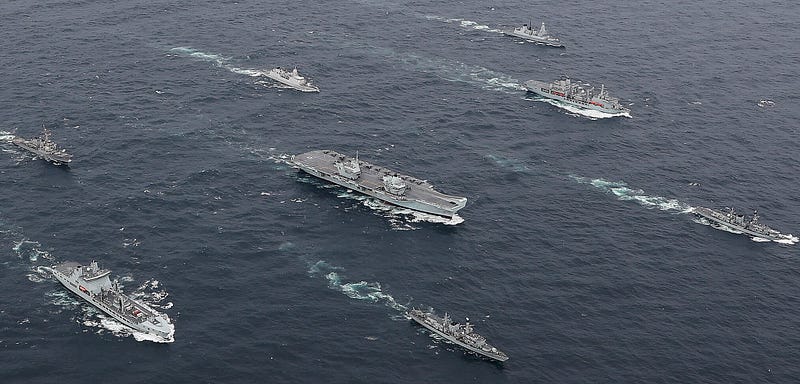
The HMS Queen Elizabeth and the UK Carrier Strike Group in 2021 (Navy Lookout)

The destroyers provide missile defense, submarine detection, and electronic warfare interdiction, and the recent successes of the Patriot missile defense system in Ukraine against Russia’s vaunted hypersonic missiles are a great indication of how far missile defense technology has advanced in the past twenty years. And as for the submarines, there’s a reason why they’re called the Silent Service. By the time the enemy knows they’re there, it’s too late.

And as in the previous section, this applies to Ukraine in that they have no effective fleet with which to protect their new carrier. It’s just a target that would be sunk in short order by Russian land-based missiles.

Conclusion

No sailor likes to see his or her ship sold for scrap. Ten years ago there was a concerted, though ultimately unsuccessful effort by former officer and enlisted crewmembers to save the USS Ranger (CV 61) from the scrapyard, to have her sent from Naval Base Kitsap in Bremerton, Washington (the base is less than two miles from where I sit typing this article) to become a floating museum in Portland, Oregon.

But that’s how it must be. With the exception of the United Kingdom and Japan (if they decided to build large-enough drydocks and greatly expand their naval air capabilities), no other nation could fully utilize any of our modern supercarriers. China would likely find itself hamstrung, not by any lack of professionalism, determination, or industrial capability, but by its utter lack of the aforementioned institutional knowledge so crucial to modern fleet actions. To be sure, I could be wrong about China; I might be underestimating them just as the world so deeply underestimated Japan prior to the Battle of Tsushima against the Russian fleet in 1905. But I don’t think so.

And in any case, the above reasons should make it crystal-clear why we would never offer a modern supercarrier to Ukraine (much less to any other nation), and why they themselves are likely aware enough of their own limitations that they would wisely refuse it even if we did make the offer.

Military
Ukraine
History
China
Navy
Recommended from ReadMedium