
AI Singularity realistically by 2029: year-by-year milestones
This existential threat could even come as early as, say, 2026. Or might even be a good thing, but whatever the Singularity exactly is, although it’s uncertain in nature, it’s becoming clearer in timing and much closer than most predicted.
AI is nevertheless hard to predict, but many agree with me that with GPT-4 we’re close to AGI (artificial general intelligence) already.
Add five years to that. Imagine. The mods required to turn GPT-4 into serviceable AGI are arguably much easier than the serendipitous 70 year route to GPT-4.
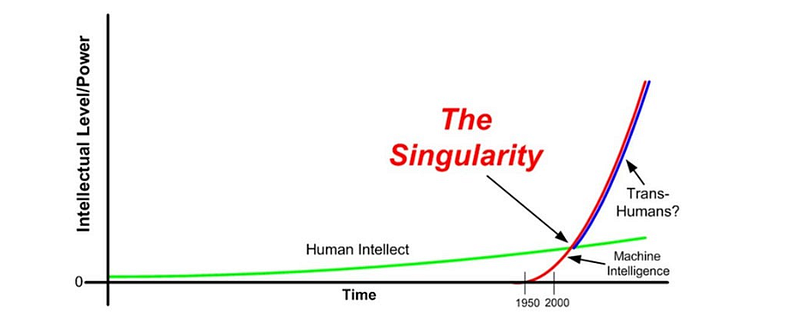
Something it’s important to appreciate is that AGI that could lead to the Singularity, the alleged future explosion of self-advancement of AI, need not be self-aware conscious.
AGI could arguably, simply be little more than GPT-4 or 5 plus long and short-term memory and perhaps some training to make appropriate goals.
Some people seem to expect or insist that AGI must be virtually artificial ‘life’ and put it off into the distant future.
That’s really not necessary.
Think Turing Test behavioralism or ‘philosophical zombies’, human-like AIs without consciousness.
Those things are smart and useful as is.
And if you’re skeptical about the current capability, reliability and ethics of AI, read the links in this sentence.
My predictions from 2012
For my CURRENT predictions, go to the next section.
My verifiable record is pretty good on this subject yet much more bold than almost everyone. I can verify online some of this in a blog article from 2021. For the rest you’ll just have to trust me. Most of my colleagues don’t even remember my claims as they just thought I was completely nuts. But colleagues Gideon Kowadlo, Craig Broadbear, Paul Heath and Jason Coates know from chats around 2014.
In 2012 I was working on NLU (natural language understanding) and predicted:
- AGI or good NLU won’t require advances like quantum computing and will be more like an advanced search algorithm that generalizes or existing neural nets
- Text AI will be very important and useful by 2015-ish
- Text AI is the crucial ingredient for AGI (I could barely get anyone to agree even on this)
- We’ll have decent NLU by 2020
- We’ll have human-like NLU by 2022
- We’ll have AGI by 2024
- We’ll have androids by 2026
- The AI Singularity could come as soon as 2025 and almost definitely by 2029
I couldn’t find anyone that agreed with me, including online.
This all assumed that :
- Someone would get interested in NLU (beyond me and a few others!) to start it. NLU research, in contrast to NLP, was very rare in 2012.
- And no efforts by anyone to stop or mitigate it would occur, or occur too late.
I largely stand by those predictions from 2012 although my central prediction for the Singularity is more like 2028 now that we’re closer and aware of the possibilities (and NLU interest took longer to peak).
Timeline to the AI Singularity (UPDATED 2023)
Here’s my updated timeline, predicated on the thinking that:
- Humans continue to work on these things
- AI will be able to improve itself at some point by 2025, thus setting the stage for potential super-explosive improvement of AI cognition
- Androids will be building androids by 2029
These assumptions above seem pretty safe given GPT-4 and it’s incredible human-like responses and code writing skills. Not to mention multiple promising android projects.
Here’s the timeline:
2023: Human-like NLU (DONE = GPT-4)
2023: Simple disembodied AGIs (independently can do real-world stuff, hints of DONE)
2024: Mature NLU (hallucination & task iteration robustly solved)
2024: Advanced disembodied AGIs (reliably, independently can do real-world stuff)
2025: 1000s of androids are available for under $100K (minimally dexterous but decently conversational, barely beyond prototypes, but are able to learn some tasks)
2026: Earliest possible disembodied super intelligence-based AI Singularity (more likely around 2028)
2027: Millions of androids available for under $50K (highly dexterous, perfect human-like intelligence, they can guess what to do most of the time, learn quickly and 1000s of App Store domain expertises are available)
2028: Earliest possible android-based AI Singularity (more likely around 2030)
2029: Tens of mIllions of near-super intelligent androids available for around $25K (advanced human-like in almost every way, they can build themselves)
So my central base-prediction is a 2028 Singularity of some sort. That conceivably could come as early as 2026.
Historical predictions
Historically, most AI researchers and scientists have predicted the Singularity to occur, on average, not until around 2050-ish depending on the survey, and include dates from 2030–2100 and some say never.
GPT is ‘aware’ (needs checking) of these specific predictions by futurists (with year prediction was made) to which I’ve added mine:
- Vernor Vinge: 2030 (1993)
- Ray Kurzweil: 2045 (2005)
- James Lovelock: 2040 (2009)
- Paul Pallaghy: 2025 (2012)
- Louis Del Monte: 2045 (2013)
- Masayoshi Son: 2047 (2016)
- Paul Pallaghy: 2028 (2023)
I expected NLU to be more interesting to researchers earlier, hence my change from 2025 to 2028-ish. But who knows?
None of this takes into much consideration possible efforts expended on ensuring the Singularity doesn’t happen or happens benignly.
Quick background on the Singularity
The term ‘singularity’ is borrowed from physics, where it refers to a point, such as in a black hole, at which rules as we understand them seem to break down and become ‘singular’.
In the context of AI, the ‘Singularity’ refers to a hypothetical future point at which technological growth becomes uncontrollable and irreversible, resulting in unforeseeable changes to human civilization due to the advent of artificial superintelligence.
The idea of the Singularity has deep historical roots. It was first popularized in the context of artificial intelligence (AI) by mathematician and science fiction author Vernor Vinge in 1993, who proposed that the creation of superhuman intelligence would likely signal the end of the human era.
Earlier, in 1965, British statistician I. J. Good had foreseen an ‘intelligence explosion’ as machines became capable of designing their own successors, leading to an exponential increase in intelligence. By the turn of the 21st century, this concept had taken a firm hold in the public imagination, thanks to proponents such as inventor and futurist Ray Kurzweil, who predicted in his 2005 book The Singularity is Near that the Singularity would occur around 2045.
The technological underpinnings of the Singularity concept are rooted in the observation of exponential growth in computing power, a trend described by Moore’s Law. Named after Gordon Moore, co-founder of Intel, this law posited in 1965 that the number of transistors on an integrated circuit would double approximately every two years, leading to an exponential increase in computational capacity. Kurzweil expanded this observation to claim a broader ‘law of accelerating returns’, arguing that technological progress overall was accelerating and would lead to the development of AI surpassing human intelligence.
However, the concept of the Singularity has also sparked considerable controversy and debate. While some like Kurzweil are optimistic about the prospects of superintelligent AI, others express deep concerns. Renowned physicist Stephen Hawking and tech entrepreneur Elon Musk, for instance, have warned about the existential risks posed by uncontrolled AI. The prospect of the Singularity also raises profound questions about the future of humanity and the ethical, legal, and societal implications of superintelligent AI. Even as advances continue to be made in AI and machine learning, the exact timing, nature, and impact of a possible Singularity remain deeply uncertain and widely debated topics.
In Superintelligence: Paths, Dangers, Strategies, philosopher Nick Bostrom elaborates on the potential consequences of creating artificial intelligence that surpasses human intelligence.
He warns that superintelligent AI, if not carefully controlled, could become an existential threat to humanity. Concluding, Bostrom emphasizes the urgency of researching and implementing safety measures and ethical guidelines in AI development to ensure that the rise of superintelligence is beneficial rather than destructive for humanity.
I can barely find anyone else talking about what exactly might be superintelligent about superintelligences. But I gave it a try a few months ago here. Whether superintelligence is qualitatively different or just fast and wide-scoped is something I am personally uncertain of.
Either way, we’ll get it.
My predictions on the build-up to the Singularity are based on companies like OpenAI and Tesla continuing to R&D in these areas. Until ‘they’ can take over.
That seems to be happening and AGI, FSD (full self driving) and androids will IMO up GDP by a factor of around 2-10 by 2033 ushering in an age of sustainable, green-friendly abundance for all. GDP increase can be sustainable.
If we survive them.
Yet the Singularity itself may even be a good thing.
But no guarantees on that.
I agree with the whistle blowers, we should try to avoid an unbridled Singularity.
I think that’s not entirely impossible by continuing to align AI to semi-universal human values.
More on that soon.


