
AI in Software Development: Obstacles and Opportunities
Did you hear that? ChatGPT creator OpenAI might be training its AI technology to replace some software engineers!
It may sound daunting at first, but numerous experts in the software development domain are unfazed by this news. There is a general consensus on adopting AI in software development as it can significantly improve efficiency. But when it comes to the question of AI taking over software development, experts believe that AI will instead expedite the pace of modern software development, promote experimentation, and transform the existing software engineering process.
Be it Requirement Gathering, User Stories, UI/UX Design, Architecture Definition, Coding, Integrations, Testing, or the Deployment process, popular AI tools like OpenAI Codex, Chat GPT-4, AWS Codewhisperer, Jenkins, and Github’s Copilot have much to offer and provide assistance in.
Jonathan Burket, a senior engineering manager at Duolingo, says that Copilot has made him 25% more efficient. This aligns well with a paper by Microsoft and MIT researchers, which found that developers using AI tools or an AI software developer can complete their tasks 55.8% faster.
Again, does this mean AI is taking over?
First, let’s get all caught up on what AI can and cannot do in software development.
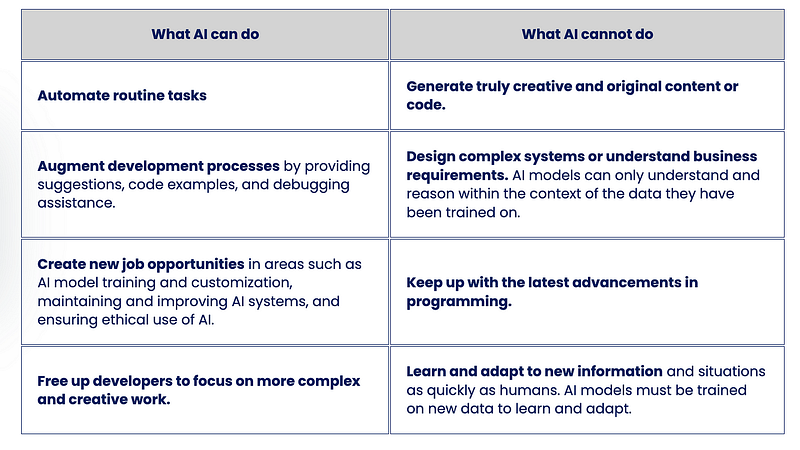
One thing we can conclude from this is: It is important to have a realistic understanding of AI’s capabilities to avoid making inaccurate or misleading claims about its abilities. While generative AI can be a valuable tool, it is not a replacement for human developers.
Ready for a reality check?
*Drum rolls* Rise of the Titans Software Developers!
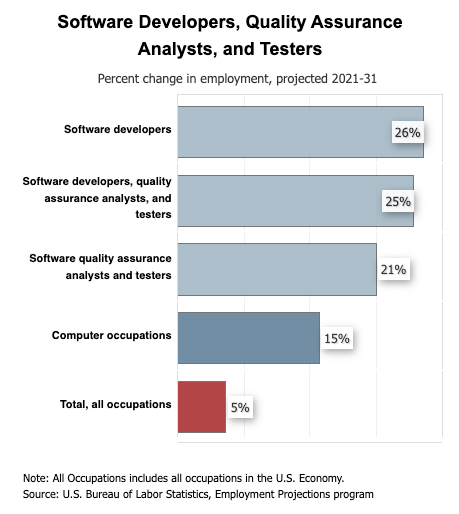
Contrary to the fears that stem from “AI taking over software development jobs,” the demand for software developers in all industries is strong and projected to grow.
- The S. Bureau of Labor Statistics (BLS)predicts a 25% increase in software developer employment over the next decade, surpassing the average growth rate for all occupations.
- According to the BLS, the median annual wage for software developers is $109,020 (as of May 2021), significantly higher than the median annual wage for all occupations in the United States.
This growing demand for software developers can be attributed to the widespread use of mobile devices and integration of technology across multiple industries like finance, healthcare, etc. Moreover, the rising field of artificial intelligence (AI) is creating new opportunities for machine learning engineers.
Similarly, Alan Fern, director of AI research at Oregon State University’s College of Engineering, argues that AI won’t affect the qualified development workforce. He says, “I think programmers will be employed for a long time, but the efficiency will improve dramatically.” Rest assured, those who embrace AI tools will be ahead of the curve in the ever-changing software development landscape.
Bottomline if you are a software developer: AI won’t replace you, but an AI software developer can…
So, what is the future of software development going to look like?
This calls for some visualizing.
Picture this: a future where software engineering becomes an exciting partnership between humans and artificial intelligence. The process can be split into two stages: creativity and delivery. In the creativity stage, AI collaborates with business analysts and software architects to gather requirements, solve business problems, create user experiences, design the architecture, and set acceptance criteria. This stage requires human involvement to train the AI on project-specific needs and the knowledge of stakeholders.
Next comes the delivery stage. Here, AI takes the lead in generating, testing, and deploying the code. It is worth noting that senior software engineers still play an essential role in reviewing and refining the code, but they can now focus on less-redundance and more complex tasks like fixing errors and improving performance. Quick and cool!
What’s new?
Prompt Engineering!
Prompt engineering is an emerging field that focuses on training and adapting AI tools to get the most out of new Large Language Models (LLMs). The main goal of prompt engineering is to optimize the performance of language models, ensuring they produce accurate and valuable results.
The demand for prompt engineers is growing rapidly. According to LinkedIn data, the number of job postings containing the term “GPT” has increased by 51% in the past year. Interestingly, some experts argue that prompt engineering is a short-lived field. As AI tools constantly evolve, the skills required for prompt engineering may become obsolete in a few years.
Our word on the job market: Fear not!
The crux is that the future of AI in software development is open, and it is likely to create new opportunities in fields just like prompt engineering. Much similar to the Dot-Com bubble, the Financial Crisis of 2008, and the more recent COVID-19 Pandemic, the rise of AI is likely to lead to some job losses in the short term. However, it is also likely to create new jobs and new opportunities for innovation and growth.
. . . . . Liked what you read? Check out Genetech Blog on Medium at https://medium.com/@learning_78604
Know more about Genetech here.


