avatarPierre Guillou

Free AI web copilot to create summaries, insights and extended knowledge, download it at here

6328

Abstract

explaining a phenomenon precisely (what is your definition of a mug?) But that does not come to prevent the deployment of a solution.</p><p id="bfb4">There are other limitations of AI that we need to be concerned about:</p><ul><li><b>bias in AI models on gender or ethnicity</b> when training data contains this kind of bias,</li><li>the <b>adversarial attacks on AI models</b> that are particularly impacting on the activities of a company or the economy of a country.</li></ul><figure id="c115"><img src="https://cdn-images-1.readmedium.com/v2/resize:fit:800/0*vXQ5Pj3-s2sZwDee"><figcaption></figcaption></figure><h1 id="9b7d">Discrimination / Bias</h1><p id="9a40"><b>Why does an AI model develop gender and ethnic biases? The origin of the problem comes from the training data which contain these biases themselves. </b>Take the example of the<a href="https://www.microsoft.com/en-us/research/blog/what-are-the-biases-in-my-data/"> research done by Microsoft</a> on a model driven from texts found on the Internet. We can see in the following slide that the model learns to represent relations between words in the form of vectors. Thus, the same vector that links the words “Man” and “Woman” connects the words “Computer programmer” and “Homemaker”, which means that another vector connects the words “Man” and “Computer programmer”… and by therefore “Woman” and “Homemaker” (…).</p><figure id="aaf1"><img src="https://cdn-images-1.readmedium.com/v2/resize:fit:800/0*yxEWyVDxwBDCqA5C"><figcaption></figcaption></figure><p id="e0e6"><b>As AI models are increasingly used, the fact that they contain biases is problematic.</b> For example, AI recruiting software could discriminate women on executive jobs, an AI facial recognition application might work better on light-skinned faces than dark-skinned ones if the training images were unbalanced in terms of classes and AI software for responding to a loan request could be biased against ethnic parameters.</p><p id="f4b0">Moreover, given the importance of search engines, we must be careful that their search results do not reinforce stereotypes, ie their AI models are not biased.</p><figure id="a8a2"><img src="https://cdn-images-1.readmedium.com/v2/resize:fit:800/0*VlL4o0Pz98rK2bG8"><figcaption></figcaption></figure><p id="2cd7"><b>The AI ​​community has already started to fight biases in AI models.</b> A technical solution is to modify the values ​​learned for certain words, which modifies the associated vectors. Another solution is to correct bias in the training data. <b>In addition, the more open the model is and the more transparent the audit process, the more people can detect — and possibly correct — biases. As a continuation of this idea, the more diverse the AI ​​team is, the less biased the AI ​​models will be.</b></p><figure id="8967"><img src="https://cdn-images-1.readmedium.com/v2/resize:fit:800/0*U6DHt0N0c0MarDZt"><figcaption></figcaption></figure><h1 id="c2a0">Adversarial attacks on AI</h1><p id="ce19"><b>There is a major and still unresolved problem concerning ML models and especially those using Deep Learning: they are sensitive to adversarial attacks, ie deliberate actions to fool a model.</b></p><p id="e3a4">For example, <b>it is possible by changing the values ​​of a few pixels of an image to fool a classifier while visually we (humans) can not detect the changes</b>. The explanation is as follows: a model of ML “sees” an image as a series of numbers that represent the brightness of the RGB grid (Red, Green, Blue). These numbers at the input A of the model will then go through a series of mathematical transformations (ie, calculations via functions learned during the training) to deliver a prediction at output B. By modifying the value of a few pixels, the result of the mathematical operations can be modified enough to give a false probability of the class of the image.</p><figure id="9be6"><img src="https://cdn-images-1.readmedium.com/v2/resize:fit:800/0*GADN1n9tX8_FBC_l"><figcaption></figcaption></figure><p id="37b1">It is also possible to modify a photo before it is evaluated at the entrance of a model of ML with sufficient visual information to fool the model on the nature of the photo while we (humans) will continue to see and detect the main information of the photo. <b>This is called physical attacks.</b></p><p id="b6f8">For example, a pair of glasses can modify the result of a facial recognition model (<a href="https://qz.com/823820/carnegie-mellon-made-a-special-pair-of-glasses-that-lets-you-steal-a-digital-identity/">Carnegie Mellon University research</a>) as stickers on a road sign (<a href="https://iotsecurity.engin.umich.edu/physical-adversarial-examples-for-object-detectors/">Michigan University research</a>) or a sticker placed next to a banana (<a href="http://v">search for Google AI</a>). <b>This added visual information actually hides important information for decision-making by the model and/or introduces new information that will fool the model.</b></p><figure id="ebbf"><img src="https://cdn-images-1.readmedium.com/v2/resize:fit:800/0*6T1WKB0jGAhLKToh"><figcaption></figcaption></figure><figure id="0e82"><img src="https://cdn-images-1.readmedium.com/v2/resize:fit:800/0*49Il02JPfpKRir83"><figcaption></figcaption></figure> <figure id="b321"> <div> <div> <img class="ratio" src="http://placehold.it/16x9"> <iframe class="" src="https://cdn.embedly.com/widgets/media.html?src=https%3A%2F%2Fwww.youtube.com%2Fembed%2Fi1sp4X57TL4%3Ffeature%3Doembed&amp;display_name=YouTube&amp;url=https%3A%2F%2Fwww.youtube.com%2Fwatch%3Fv%3Di1sp4X57TL4&amp;image=https%3A%2F%2Fi.ytimg.com%2Fvi%2Fi1sp4X57TL4%2Fhqdefault.jpg&amp;key=a19fcc184b9711e1b4764040d3dc5c07&amp;type=text%2Fhtml&amp;schema=youtube" allowfullscreen="" frameborder="0" height="480" width="640"> </div> </div> </figure></iframe></div></div></figure><p id="9310"><b>The field of research to counter adversarial attacks began in 2015 (adversial defense) but the solutions found to make the models more robust are not perfect and have consequences on the speed of calculations (ie, models with more parameters are therefore slower).</b> This is a problematic subject especially for all areas such as health, safety, self-d

Options

riving cars where the reliability of the AI model is a priority criterion (<a href="https://towardsdatascience.com/breaking-neural-networks-with-adversarial-attacks-f4290a9a45aa">article</a> to understand the mechanisms of adversarial attacks and the current solutions to combat them; competition launched by Google on the subject:<a href="http://ai.googleblog.com/2018/09/introducing-unrestricted-adversarial.html"> Unrestricted Adversarial Examples Challenge</a>).</p><figure id="13fc"><img src="https://cdn-images-1.readmedium.com/v2/resize:fit:800/0*fL9UY1jnKydLk-ZB"><figcaption></figcaption></figure><h1 id="a5b8">Adverse uses of AI</h1><p id="6d35">Beyond the corporate uses of AI, there are also adverse uses like:</p><ul><li><b>DeepFakes </b>(creating realistic but fake videos like <a href="https://www.buzzfeednews.com/article/davidmack/obama-fake-news-jordan-peele-psa-video-buzzfeed">Barack obama published by the BuzzFeed website</a>): AI models for detecting DeepFakes exist today but they must be regularly updated and the problem is that at the time of social networks, once a video has become viral, even though it has been recognized as DeepFake, a lot of people have already been affected by its message. What are the possible consequences for democracy and privacy?</li><li><b>false comments</b>: the automatic generation by an AI model of false comments on sites and social networks is now possible with objectives to harm politically or commercially. As for DeepFakes, there are AI models to detect these false comments, but it’s an endless race between forgers and authorities.</li></ul><figure id="9ca3"><img src="https://cdn-images-1.readmedium.com/v2/resize:fit:800/0*MQSAl_PD6SFLsgpi"><figcaption></figcaption></figure><h1 id="57c0">AI and developing economies</h1><p id="a040"><b>While countries have built themselves over time by creating new industries and ways of life based on their achievements, developing economies are skipping some developments through the use of technology created by others</b> such as mobile phone vs wired phone, mobile payment vs credit card or online education vs face-to-face education.</p><figure id="4d2f"><img src="https://cdn-images-1.readmedium.com/v2/resize:fit:800/0*Sxkx8M220ym4kuqk"><figcaption></figcaption></figure><p id="4211">AI can produce the same result. Indeed, if the US, China, UK or Canada are developed countries and a step ahead in the adoption of AI, <b>we are still at the beginning of this revolution</b>. <b>Andrew Ng advises developing economies not to redevelop what already exists as a Web search engine but instead to use AI in their specific industries (vertical industries)</b>, where it does not exist in the developed economies of specialized AI models. Andrew Ng also advises developing economies to <b>invest in public-private partnerships and AI education for their citizens</b>.</p><figure id="37cc"><img src="https://cdn-images-1.readmedium.com/v2/resize:fit:800/0*u_iZN8Zi1w5x9p2X"><figcaption></figcaption></figure><h1 id="e675">AI and jobs</h1><p id="91c9">The automation of activities by AI already has an impact on employment but as shown by a <a href="https://www.mckinsey.com/featured-insights/future-of-work/jobs-lost-jobs-gained-what-the-future-of-work-will-mean-for-jobs-skills-and-wages">McKinsey Global Institute study</a>, this movement will accelerate to certainly reach 800 000 million jobs (to read also: <a href="https://www.pwc.co.uk/services/economics-policy/insights/the-impact-of-automation-on-jobs.html">PwC study</a> and <a href="http://fortune.com/2018/09/17/machines-robots-work-software-wef/">Bank of England</a>). <b>However, what the study shows is that it will create a number perhaps higher new jobs</b>: drone traffic optimizer, 3D-printed clothing designer or in health, we will have custom DNA-based drug designers .</p><figure id="6aff"><img src="https://cdn-images-1.readmedium.com/v2/resize:fit:800/0*mmUOu_lOxStgHn9l"><figcaption></figcaption></figure><p id="31d1"><b>If you are worried about the possible replacement of your job by AI, ask yourself the number of tasks in your job that are automatable.</b> This is the methodology used by previous studies as well as that of the OECD (read the <a href="https://www.economist.com/graphic-detail/2018/04/24/a-study-finds-nearly-half-of-jobs-are-vulnerable-to-automation">study published by The Economist</a>) to estimate automatizable jobs and the number of people involved.</p><figure id="47a1"><img src="https://cdn-images-1.readmedium.com/v2/resize:fit:800/0*9_uREgW0GLZBR-Iv"><figcaption></figcaption></figure><p id="5037"><b>What solutions to this AI transformation of our society and way of life?</b></p><ul><li><b>The first possibility is to provide everyone with a minimum wage but conditioned (conditional basic income).</b> The idea is based on the universal minimum wage with incentives for those who continue to train and work.</li><li><b>The second is to change the way we learn to build a lifelong learning society</b> and not limited to our youthful years because to keep our jobs evolving through AI, we will have to learn new knowledge.</li><li>Finally, <b>there are political solutions to support the transformation of society and help citizens to keep their jobs</b>.</li></ul><p id="edb0"><b>On a personal level, we should all complement our current knowledge with an AI knowledge.</b> It is not a matter of choosing one or the other but of learning how to use AI to change our current jobs.</p><figure id="c38a"><img src="https://cdn-images-1.readmedium.com/v2/resize:fit:800/0*89o_iRAOBUUIKfGH"><figcaption></figcaption></figure><h1 id="6d81">Conclusion</h1><p id="1321">These 4 weeks of lessons have allowed you to understand what is AI, to know how to develop an AI project, how to transform your business into an AI company and finally to understand the impact of AI on society.</p><p id="7aec">Now it’s up to you to continue learning AI!</p><figure id="b70b"><img src="https://cdn-images-1.readmedium.com/v2/resize:fit:800/0*RFEJ0Ko59KMu2brI"><figcaption></figcaption></figure><p id="cf20"><i>About the author: Pierre Guillou is a consultant in artificial intelligence in Brazil and France. Please contact him via his <a href="https://www.linkedin.com/in/pierreguillou/">Linkedin profile</a>.</i></p></article></body>

AI and Society (week 4)
Andrew Ng’s new course: “AI for everyone” (week 4)

After 3 weeks of Andrew Ng’s new course (AI for everyone), you have gained a good understanding of what is AI, how to develop AI projects by driving Machine Learning models (and Deep Learning in particular) and steps to start using AI in your company (as well as in an association or public organization) to turn it into an AI business. In this week 4 (last week of the course), you will learn and reflect on the impacts of AI beyond the hype and on the impacts of AI on society.

This article is part of the “Deep Learning in Practice” series (also available in French and Portuguese).

List of articles “AI for everyone”

  1. AI for everyone (week 1)
  2. Building AI projects (week 2)
  3. Building AI in your company (week 3)
  4. AI and Society (week 4)

Introduction

Now that you have a general knowledge of AI thanks to week 1 of Andrew Ng’s new course (AI for everyone), that you know how to train a Machine Learning model through the week 2, and that you have acquired a methodology to use AI in your business to turn it into an AI business through week 3, you will learn and think about the impacts of AI beyond the hype and about impacts of AI on society in this week 4!

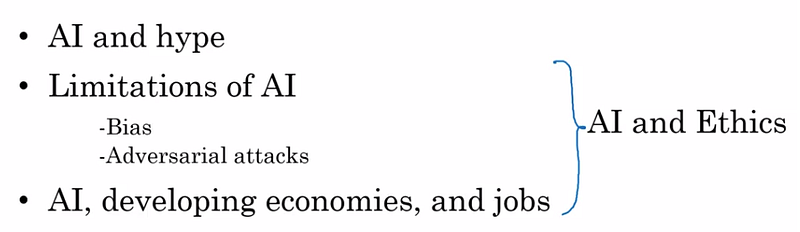
Indeed, based on his experience in the use of AI in the business world, Andrew Ng guides us in this week 4 in understanding the limitations of AI (bias, adversarial attacks, DeepFakes …) and its impacts on our daily lives (economic development, jobs …), especially in developing countries, as well as the ethical issues raised by the use of AI.

Andrew Ng emphasizes the importance of this last part of the course because any AI model developed by a small or large company can have a significant impact on a larger or smaller group of people.

The content of this MOOC is free and here are the key elements of the week 4.
Credit: all images in this article come from the Andrew Ng MOOC, AI for everyone.

Tips for a trainer

This week 4’s content contains all the essentials to understand the impacts of AI on our society.

The trainer must present the course content in a non-technical way based on studies and concrete cases. This method of teaching will help participants (especially those with no technical knowledge) to become interested in the course content.

Key points of the week 4

. A realistic view of AI . Discrimination / Bias . Adversarial attacks on AI . Adverse uses of AI . AI and developing economies . AI and jobs . Conclusion

A realistic vision of AI

AI is changing our society but we must not be too optimistic in the arrival of a super intelligence (GAI: General Artificial Intelligence) that dominates humanity (it does not will not happen before perhaps tens or hundreds of years), nor too pessimistic with the idea that since the AI ​​can not solve everything the investment in AI will stop (we see that the “simple” Supervised Learning models for predicting a B output from an input A data are already profoundly modifying industries).
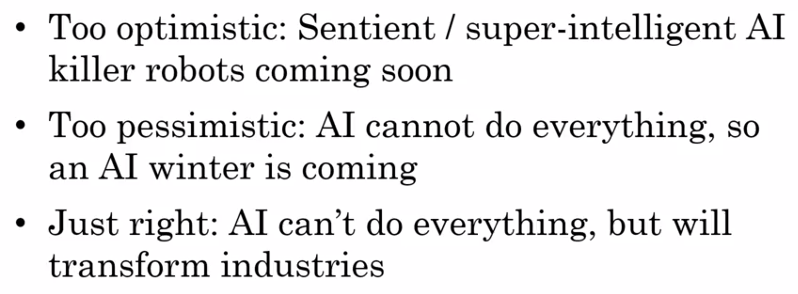
This is the reality of AI: despite its limitations (see below), it can already do a lot.

  • With little data, the performance of an AI is low and even with a lot of data, it is sometimes impossible to automate a process with an AI model with a high confidence rate. For example, it will be difficult to automate all the processes of a call center, especially natural language processing processes such as understanding an email and automatically create the text of the response to be made.
  • There is also the problem of the black box (explainability), the inability to explain why an AI model gives this or that prediction. This problem is the subject of important researches and solutions begin to appear as for example the possibility to visualize the zone of an image from which the model built its prediction (ie, its diagnosis if it is a radiology image).

However, if an AI team from the corporate world gives a sufficient explanation of how their model works, their deployment will generally be accepted (and especially if the performance of the AI ​​model is high). Of course, this approach concerns models with no direct consequences on vital elements such as health or road safety. In fact, this logic very often applies to human reasoning that sometimes has a hard time explaining a phenomenon precisely (what is your definition of a mug?) But that does not come to prevent the deployment of a solution.

There are other limitations of AI that we need to be concerned about:

  • bias in AI models on gender or ethnicity when training data contains this kind of bias,
  • the adversarial attacks on AI models that are particularly impacting on the activities of a company or the economy of a country.
Discrimination / Bias

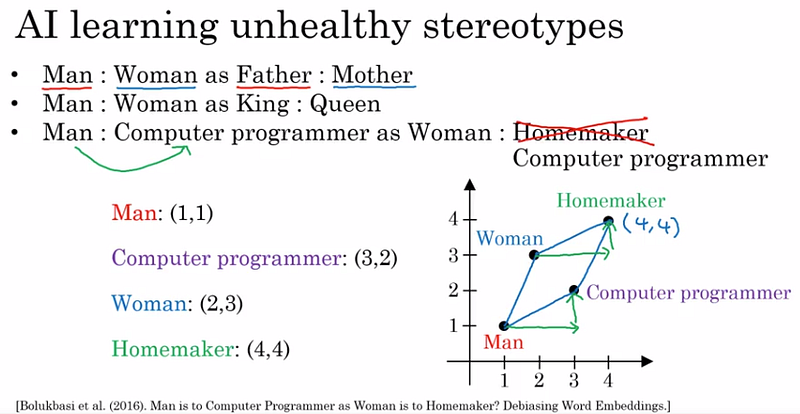
Why does an AI model develop gender and ethnic biases? The origin of the problem comes from the training data which contain these biases themselves. Take the example of the research done by Microsoft on a model driven from texts found on the Internet. We can see in the following slide that the model learns to represent relations between words in the form of vectors. Thus, the same vector that links the words “Man” and “Woman” connects the words “Computer programmer” and “Homemaker”, which means that another vector connects the words “Man” and “Computer programmer”… and by therefore “Woman” and “Homemaker” (…).
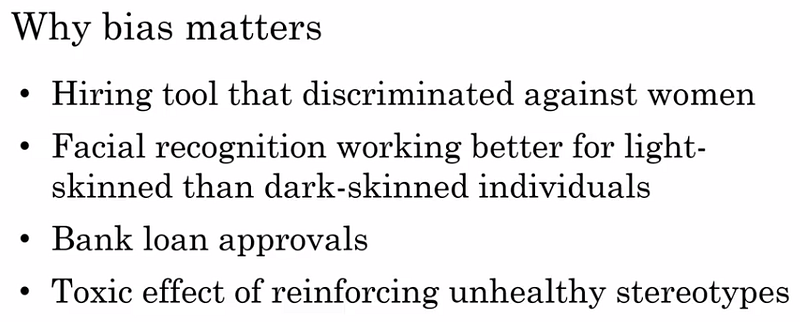
As AI models are increasingly used, the fact that they contain biases is problematic. For example, AI recruiting software could discriminate women on executive jobs, an AI facial recognition application might work better on light-skinned faces than dark-skinned ones if the training images were unbalanced in terms of classes and AI software for responding to a loan request could be biased against ethnic parameters.

Moreover, given the importance of search engines, we must be careful that their search results do not reinforce stereotypes, ie their AI models are not biased.
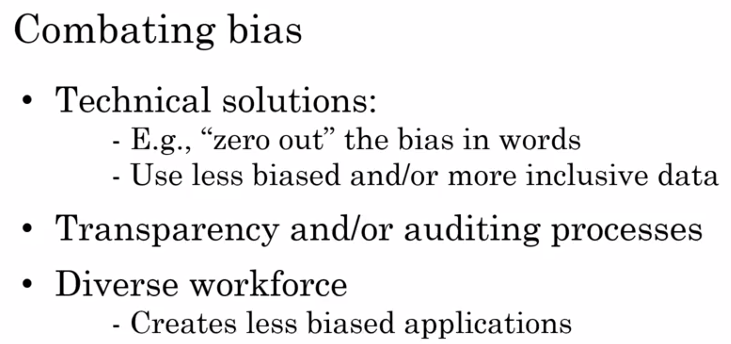
The AI ​​community has already started to fight biases in AI models. A technical solution is to modify the values ​​learned for certain words, which modifies the associated vectors. Another solution is to correct bias in the training data. In addition, the more open the model is and the more transparent the audit process, the more people can detect — and possibly correct — biases. As a continuation of this idea, the more diverse the AI ​​team is, the less biased the AI ​​models will be.

Adversarial attacks on AI

There is a major and still unresolved problem concerning ML models and especially those using Deep Learning: they are sensitive to adversarial attacks, ie deliberate actions to fool a model.

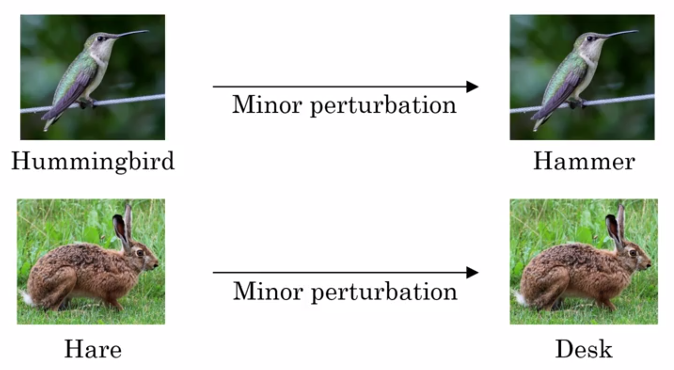
For example, it is possible by changing the values ​​of a few pixels of an image to fool a classifier while visually we (humans) can not detect the changes. The explanation is as follows: a model of ML “sees” an image as a series of numbers that represent the brightness of the RGB grid (Red, Green, Blue). These numbers at the input A of the model will then go through a series of mathematical transformations (ie, calculations via functions learned during the training) to deliver a prediction at output B. By modifying the value of a few pixels, the result of the mathematical operations can be modified enough to give a false probability of the class of the image.
It is also possible to modify a photo before it is evaluated at the entrance of a model of ML with sufficient visual information to fool the model on the nature of the photo while we (humans) will continue to see and detect the main information of the photo. This is called physical attacks.

For example, a pair of glasses can modify the result of a facial recognition model (Carnegie Mellon University research) as stickers on a road sign (Michigan University research) or a sticker placed next to a banana (search for Google AI). This added visual information actually hides important information for decision-making by the model and/or introduces new information that will fool the model.

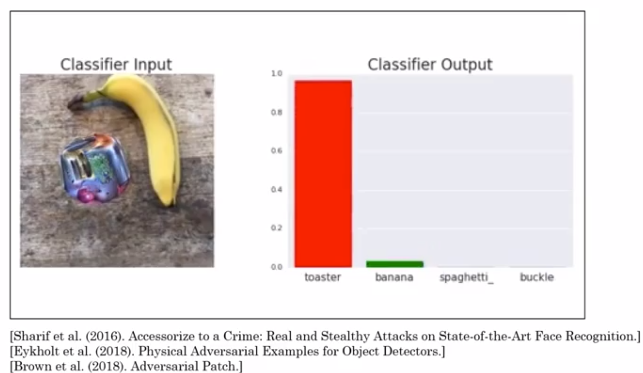
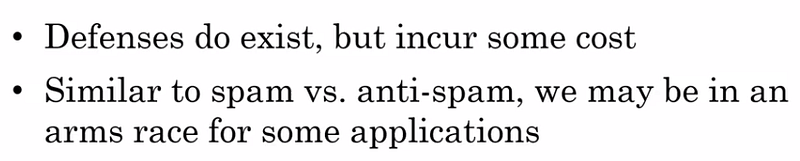
The field of research to counter adversarial attacks began in 2015 (adversial defense) but the solutions found to make the models more robust are not perfect and have consequences on the speed of calculations (ie, models with more parameters are therefore slower). This is a problematic subject especially for all areas such as health, safety, self-driving cars where the reliability of the AI model is a priority criterion (article to understand the mechanisms of adversarial attacks and the current solutions to combat them; competition launched by Google on the subject: Unrestricted Adversarial Examples Challenge).
Adverse uses of AI

Beyond the corporate uses of AI, there are also adverse uses like:

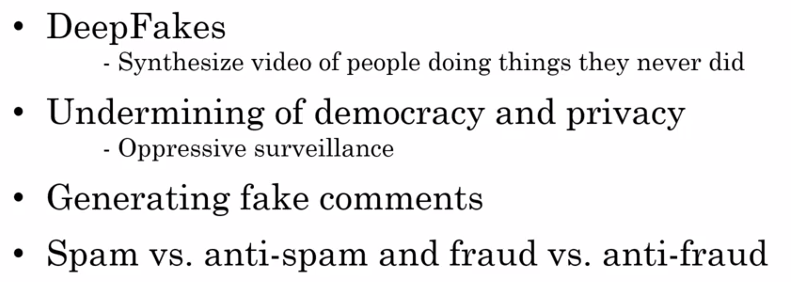
  • DeepFakes (creating realistic but fake videos like Barack obama published by the BuzzFeed website): AI models for detecting DeepFakes exist today but they must be regularly updated and the problem is that at the time of social networks, once a video has become viral, even though it has been recognized as DeepFake, a lot of people have already been affected by its message. What are the possible consequences for democracy and privacy?
  • false comments: the automatic generation by an AI model of false comments on sites and social networks is now possible with objectives to harm politically or commercially. As for DeepFakes, there are AI models to detect these false comments, but it’s an endless race between forgers and authorities.
AI and developing economies

While countries have built themselves over time by creating new industries and ways of life based on their achievements, developing economies are skipping some developments through the use of technology created by others such as mobile phone vs wired phone, mobile payment vs credit card or online education vs face-to-face education.
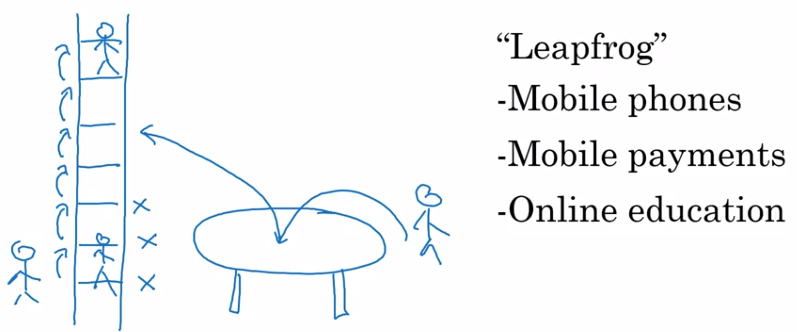
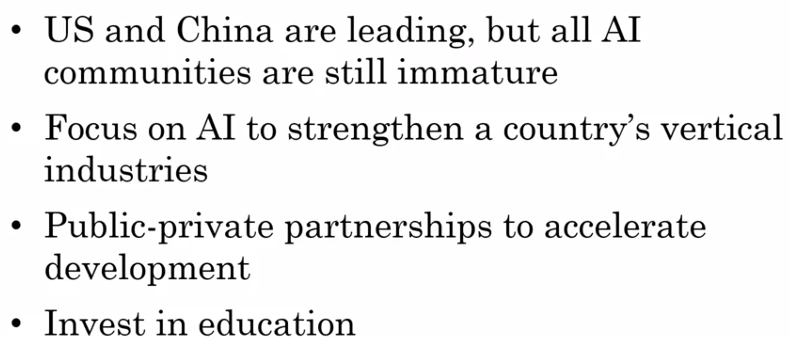
AI can produce the same result. Indeed, if the US, China, UK or Canada are developed countries and a step ahead in the adoption of AI, we are still at the beginning of this revolution. Andrew Ng advises developing economies not to redevelop what already exists as a Web search engine but instead to use AI in their specific industries (vertical industries), where it does not exist in the developed economies of specialized AI models. Andrew Ng also advises developing economies to invest in public-private partnerships and AI education for their citizens.
AI and jobs

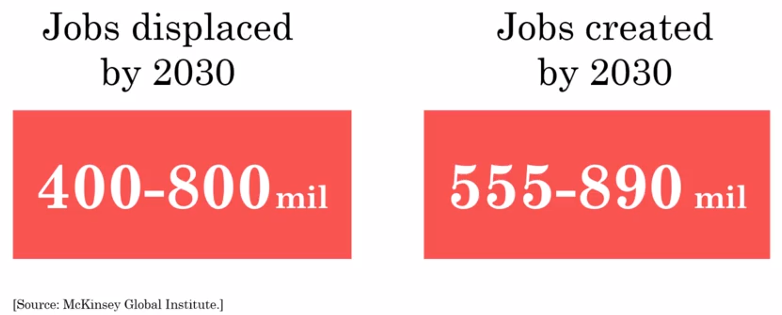
The automation of activities by AI already has an impact on employment but as shown by a McKinsey Global Institute study, this movement will accelerate to certainly reach 800 000 million jobs (to read also: PwC study and Bank of England). However, what the study shows is that it will create a number perhaps higher new jobs: drone traffic optimizer, 3D-printed clothing designer or in health, we will have custom DNA-based drug designers .
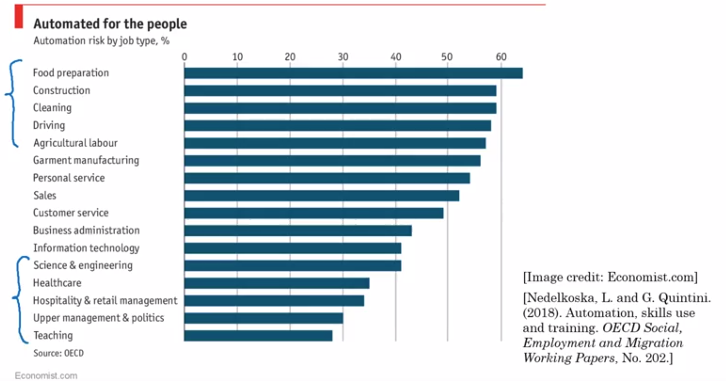
If you are worried about the possible replacement of your job by AI, ask yourself the number of tasks in your job that are automatable. This is the methodology used by previous studies as well as that of the OECD (read the study published by The Economist) to estimate automatizable jobs and the number of people involved.
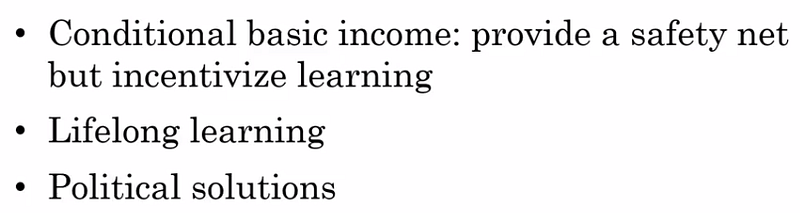
What solutions to this AI transformation of our society and way of life?

  • The first possibility is to provide everyone with a minimum wage but conditioned (conditional basic income). The idea is based on the universal minimum wage with incentives for those who continue to train and work.
  • The second is to change the way we learn to build a lifelong learning society and not limited to our youthful years because to keep our jobs evolving through AI, we will have to learn new knowledge.
  • Finally, there are political solutions to support the transformation of society and help citizens to keep their jobs.

On a personal level, we should all complement our current knowledge with an AI knowledge. It is not a matter of choosing one or the other but of learning how to use AI to change our current jobs.
Conclusion

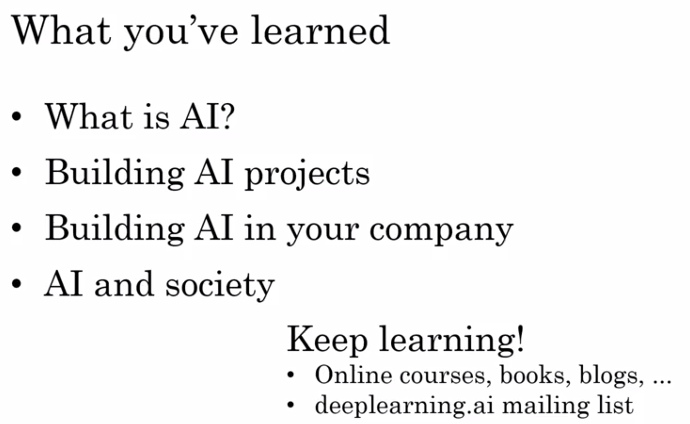
These 4 weeks of lessons have allowed you to understand what is AI, to know how to develop an AI project, how to transform your business into an AI company and finally to understand the impact of AI on society.

Now it’s up to you to continue learning AI!
About the author: Pierre Guillou is a consultant in artificial intelligence in Brazil and France. Please contact him via his Linkedin profile.

Machine Learning
Deep Learning
Artificial Intelligence
Society
Mooc
Recommended from ReadMedium