
Ahem, Peruvian Feminists and LGBTQ Activists — Race Matters, Too!
Are blackness and brownness not sexy enough to make it to the mainstream of social movements?
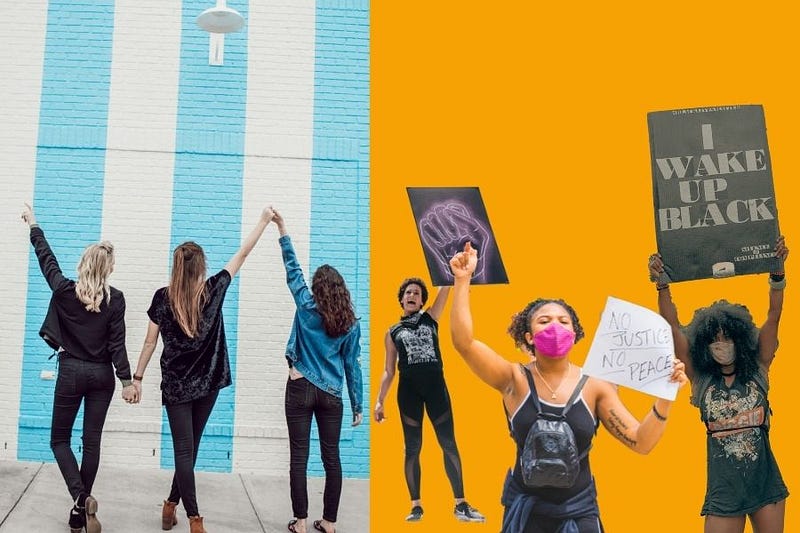
There’s a look. The feminist look. I expect you’re going to say I’m generalizing, but don’t kill the messenger. People who partake in trends start to look a lot alike. A fad takes hold, and before you know it, everyone’s toting bamboo fiber bags and cutting really shallow bangs. That’s how I feel about feminism in Peru.
I lived in Peru for nearly six years, and I noticed that feminism is a lifestyle of the upper middle class white educated woman, and for some “liberated” middle and upper-class white men. In Peru, they’d say for the pitucos. I’m going to focus on women because they dominate the feminist world here.
Don’t misread my dry tone for acceptance of sexism. I am all in favor of equal rights for women. Yet, somehow in Peru, people are ready to lay their cafe lattes down at the altar of feminism and in many cases LGBTQ equality.
However, if you mention the R-word, they yell ‘screw anti-racism’ or their eyes glaze over. Anti-racism plays third fiddle to mobilization against sexism, homophobia, and transphobia.
I can hear many people, especially white, elite Peruvians chomping at the bit to call me machista, or anti-LGBTQ for pointing this out. Not surprising, given the history of black women trying to bring race discussions into white spaces.
We get mischaracterized as “divisive” for pinpointing race. You see, women and LGBTQ people can be rich and white. Wealth and whiteness sit at the pinnacle of the social value ladder.
But black women and LGBTQ people can’t be rich and white. In fact, being black and woman and being black and LGBTQ gets you a swift kick on the rear end from the social powers that be.
Sadly, many brown people in Peru use anti-indigenous and anti-black racism as their ticket to prosperity and whiteness, but that is for another story.
Journalist and author Marco Aviles gives his idea of why racism is a topic left to its own devices in Peru,
“What has happened is that the most educated elites aren’t interested in building upon this discussion [of racism], and the media isn’t interested in bringing up discussions of racism from the indigenous, Afro-Peruvian communities” (Abate, 2021).
The elite isn’t interested in race because social mobility requires the rejection of African or indigenous heritage. Many mestizos aim to whiten themselves each generation. What’s the point of making a fuss when you won’t have to deal with that racism mess give or take a few decades?
Aviles also notes that the social “whitening” can be achieved by moving to the city or gaining higher education. Many folks avoid challenging racism because they can study or relocate their way out of it.
My boyfriend told me that a few of his friends, mestizos or mixed-race people from the highlands, were forced to break off relationships with dark-skinned women. Their parents would call the women “ugly” and “chola.” Eventually, the parents drove them apart because they feared a dark grandbaby and a farewell slap from social mobility.
Racism is oppression, but sexism is sexism
For five years, I was part of a drumming group of young folks in Lima. Mostly middle-class people. Mestizos, black, and white people. During feminist marches, Pride, and other gender and sexual orientation-focused events, the group bands together to protest against patriarchy, homophobia, and transphobia.
I get right down along with the protests because I agree. Down with those things. But, when it comes to racism, people don’t lift an eyebrow.
After five years of being in the drumming group, and five years of hearing people joke that members planned to “give” a black man as birthday presents for a “good time,” and other monkey and slave jokes about black people, I witnessed my one and only discussion of racism.
It took place over a group WhatsApp chat. Only two people got involved in the discussion, three if you count me adding my two cents in not-so-great Spanish.
One member belonged to the Racism Is Real camp. The other claimed that sexism exists, but racism doesn’t exist because it falls under the umbrella of “oppression.”
This argument went on for a few Whatsapp exchanges. The guy arguing that racism exists eventually got frustrated because the racism denier couldn’t see the contradiction that racism, oppression based on race, and sexism, and oppression based on gender, fall under similar conceptual rules.
He typed, “Hahaha, this makes no sense, hermano.” The racism denier wrote, “You’re using your masculine privilege to laugh at me. This conversation ends now.” And that was that. The rest of the 15 people in the group didn’t add a peep.
This is the same group that questions the use of feminine and masculine endings of words and strives to use gender-inclusive and less binary language. I am glad for their efforts in this area, but, darn it, can’t anyone talk about racism?
Racism silenced
I have heard people fault my “young” age as the reason that people treated me poorly when I belonged to a very white women’s organization in Lima.
I replied to their argument, “Well, age is a social category and race is a social category. Why would it be impossible that my race determines how people treat me if we are able to accept that age, another category, can make all the difference?”
People responded by chiding me, “No, that (they couldn't even muster up the word racism) can’t be happening.” They erroneously believed that our shared “womanness” punted out any racial differences between us.
White women wield more power than white men, in some ways
If white, affluent women ignored racism, it is even worse with lower-class indigenous and black men. My boyfriend is a Peruvian who is the only black person teaching at his university in Lima. His colleagues talk over him, ignore his comments, but anytime a woman (read white woman) makes a suggestion, everyone has to “understand her” and “not challenge anything she says.”
One of his coworkers, a white woman, continued to give him the gruntwork, order him around, and talk to him like he was stupid. During one of her tirades, he somehow mentioned that being black, he usually gets left with work no one else wants to do.
She changed tactics, stopped bullying him for the moment, and tried to express her “solidarity” with him by saying she is a “woman so I understand.” Her tone became sweet for a moment when she caught sight of her privilege, but that was short-lived.
I hate to say it, but I think white women in Peru are perhaps more powerful than white men, not as a group, but in interpersonal ways.
Remnants of sidelining race in Peruvian feminist movements
Historically, Afro-Peruvians have challenged mainstream feminism’s dismissal of racism for a long time. Women of Afro-descent have been facing this anti-black, anti-poverty mainstream approach to feminism for decades in Peru.
Even in feminist gatherings or encuentros, women of Afro-descent must raise hell to upend the anti-black racism and elitism they face even within their organizations (Sternbach et al., 1992).
“[The Latin American Feminist Movement] also continues to be a space of tension, contestation, and struggle for Afro-descendant women who belong to this movement as they constantly grapple with feminism given the on-going racist and classist nature of mainstream feminism that excludes and harms them” (Lewis & Thomas III, 2019, p. 22).
The feminist movement in the USA faced similar tensions, choosing to help white women advance in the corporate world, rather than disrupt class inequality that harmed poor women of color the most.
Angela Davis talked about how feminist movements have conceived of the word “woman” to mean white women, additionally pushing women of lower socioeconomic status, women of color, and black trans women to the margins (Lewis & Fisher, 2018).
In Peru, mainstream feminism is viewed as “hip” and “chic.” One of its main commitments is to help white elite women advance professionally in the name of “gender equality” while turning a cold shoulder on class and race struggles.
In my social service project, we see that when we interview, when we ask about people’s position on LGBTQ movements, and what they call here the “ideology of gender,” everyone has an opinion or has at least thought about it. People’s response to race is like a reflex, and they blurt, “There’s no racism in Peru,” or they say “………”
We need to occupy feminist and LGBTQ movements
To change this around, the Peruvian feminist movement and LGBTQ movement should study the playbook of the decades-long work of Afro-Peruvian women’s feminist organizations that tackle class, race, and gender inequality.
This will require Peruvians to give up their fascination with whiteness as the supreme social and spiritual good. Grad-school and universities should offer courses about racism, and leave no colonialist explanation of race unturned.
More publicity and awareness of the social movements in the media would help, too. Aviles says that racism is not discussed in the media because elite whites dictate the content, which denies black and indigenous people the chance to share their experiences (Abate, 2021).
In sum
Center Afro-Peruvian women and LGBTQ thinkers and artists at the helm, don’t push them to the margins. Feminists should not be enticed by power and personal social advancement at the expense of real structural change.
The point of feminism isn’t to give white women a larger slice of the man-pie. The point is to disrupt the status quo of injustice that privileges wealthy, white, and male people so that people of all gender, sexual orientations, and races receive a fair shot at a good life.
Thanks for reading,
~MJ
References
Abate, J. (2021, July 14). Marco Avilés, periodista peruano: “La columna vertebral de América Latina es el racismo”. Palabra Publica. http://palabrapublica.uchile.cl/2021/07/14/marco-aviles-periodista-peruano-la-columna-vertebral-de-america-latina-es-el-racismo/
Feldman, H. (2012). Strategies of the black Pacific. Music and diasporic identity in Peru. In Dixon, K & Burdick, J. (Eds.), Comparative Perspectives on Afro-Latin America (pp. 42–71). University Press of Florida. ProQuest Ebook Central, http://ebookcentral.proquest.com/lib/ucsd/detail.action?docID=906675.
Lewis, E & Thomas III, J. (2019). “Me Gritaron Negra”: The emergence and development of the Afro-descendant women’s movement in Peru (1980–2015). Journal of International Women’s Studies, 20(8), 18–39. Available at: https://vc.bridgew.edu/jiws/vol20/iss8/3.
Takehara, J. (2020, June 23). Marco Avilés: “Hay una tendencia de las élites a culpar a las personas más vulnerables de las desgracias del país”. IDEHPUCP. https://idehpucp.pucp.edu.pe/entrevistas/marco-aviles-hay-una-tendencia-de-las-elites-a-culpar-a-las-personas-mas-vulnerables-de-las-desgracias-del-pais/


