
After Life: A Beautiful Imperfect Journey
It’s not a perfect show but neither is the bitter life it’s trying to capture
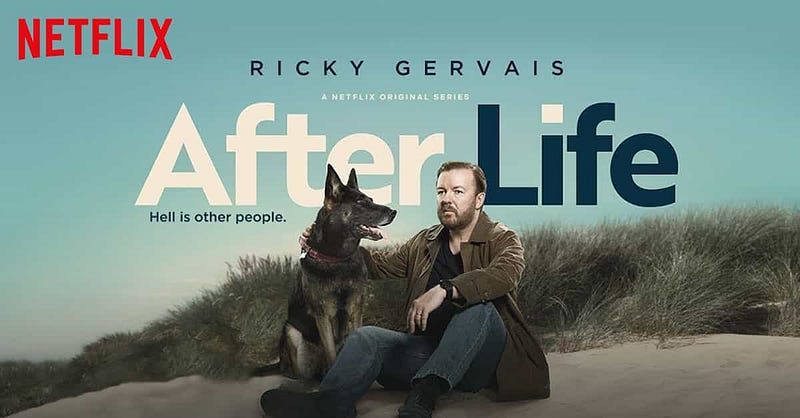
If there’s any truth to the notion that there’s a piece of each actor in the characters they create, then we’ve seen Ricky’s egotism in David Brent (The Office), his bewilderment of fame as Andy Millman (Extras), his depravity mixed with naivety as Derek and finally we’re treated to his tenderness in After Life. It’s not a stretch to say that each of these is a semi-autobiographical exploration mirroring Gervais’ own career or mood at the time of creation; The Office was a reflection of the fame he wasn’t receiving; Extras was his reaction to the star-studded status he exploded into as a result; Derek was an attempt to return to something more grounded and British after his stint in Hollywood; and now After Life gives what feels like a much more personal exploration behind the meaning of life once you hit a certain age.
From that, we’re bestowed a flawed but deeply endearing gem of a show. One that’s incredibly British and also decidedly more emotional than any other he’s written. It’s here, in these contained and intimate explorations of wounded characters that draw you in by virtue of their relatability as much as the humour, sympathy and desperation, where Ricky seems to have found his niche.
It’s in this unique setting where he’s able to combine his earlier creations and add something that wasn’t there before: redemption. Most of his previous characters do come face to face with their ugly lives by the end of the journey/series and decide to make a change for the better, whether deciding to relinquish his desperation to be liked in the Office or his desire to be famous in Extras and accept that they can be happier without. In After Life though, we get to see this struggle throughout, not just the finale. Life is escaping Tony by his own choice, and his growing attempts to redeem himself and the people around him endear us in a way that his other incarnations haven’t. It also doesn’t hurt that Ricky’s episodically heartfelt breakdowns (at least in the second season) offer more candour into his creations than we’ve had before. Because of this and the shows inherent hope, Tony feels like the most engaging character yet offered by Ricky and while his struggles are far from over, it’s a joy to watch him portray the complexities of grief and the rollercoaster life becomes as one navigates the waters of moving-on.
It also helps that he’s backed by a stellar cast whose small moments deserve more screen time next season and act as the earth to which Ricky’s more outlandish characters, lude interactions and crude depravity — often displayed at Golden Globe ceremonies — can tether. At times, I found myself wondering why Ricky didn’t go in greater depth to the lives of the unfortunate few who orbit his character and can only hope he’s saving their revelations for future series.
Even though the show has perhaps the most promise of anything Ricky’s done since breaking with writing partner Stephen Merchant, it does seem to be chasing its own tail somewhat. The first season’s hearty ending, a seemingly complete resolution, was upturned at the beginning of the next so more blood can be wrung from the Netflix shaped stone. Admittedly, while this does in some way mirror the manic twists and turns of real-life woes, it also belittles the catharsis earned by the character in the finale. Coming back for more isn’t exactly bad, but they have to move on so its previous ending doesn’t feel cheap.
Where I thought it was going and what I was hoping would happen in the latter half of the second season but didn’t, is a realisation from Tony that life is worth living not because of the love interest that knocks on his door or the small, daily gestures he makes to keep himself afloat but by bolstering the rest of his sorry colleagues and, by extension through their newspaper, the town. I was hoping he would begin to realise there’s meaning in helping others; not in focusing on his own attempts at happiness or avoidance of sadness but on telling the tales of the insignificant and forgotten many who quite clearly need him.
It’s a shame that the ending of the second season similarly offers no resolution to this. Simply adds another crisis which requires more and more seasons to explore. This isn’t to say that After Life isn’t worth watching because its veers in the wrong direction, but that its repetitiveness wears on you. What I’d like to see next season is Tony making steps, whether clumsy, accidental or desperate towards realising his life is worth it if it means continually finding joy in celebrating the mediocrity of his peers and townsfolk. Its arguable he’s heading in that direction anyway, though as the series grows in popularity and the Netflix demand for more becomes greater, the journey seems to juggle with inconsistencies that don’t quite add up.
Despite all of this, there’s a lot to like and find in After Life. Mostly because the writing and characters take on a personal feel that elevates them beyond the realms of the pathetic sympathy magnets of some of his past creations and into the infinitely more vivid pastures of simple people wrestling with everyday loneliness. In this way, we’re treated to Ricky’s best and most relevant work in a decade and if his character and town can find hope in their trivial newspaper, then perhaps there’s hope his progression as a character won’t be belittled by future serialisation and crass name-calling. Here’s hoping.


