
After 50 years of going to dog parks, I had to give them up.
Easier said than done.
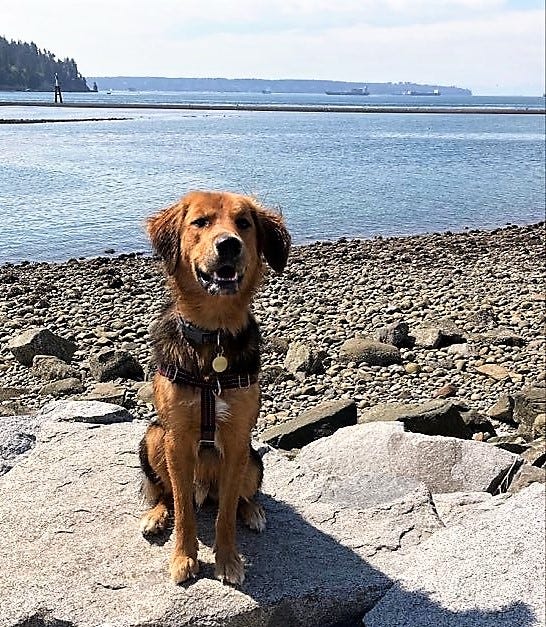
With its combination of sandy beaches, winding seawall, grassy fields, endless supply of sticks and amazing views, the off-leash dog park at Ambleside Beach in West Vancouver, Canada is like a Disneyland® for dogs! Pups dig in the sand, climb the craggy riprap, chase each other with dizzying enthusiasm and paddle in the salty drink as their humans sip takeaway lattés seated on chair-height logs perfectly placed along the shore.
I first started going to Ambleside as a kid in the summer of 1971, when our family got a Labrador puppy, we named Newfie. Every night as dinner was winding down, Newfie’s excitement would wind up, as he knew it was almost time for the dog beach.
Even though I now live an hour away (two in traffic) I often return — well I did — to Ambleside with my own dogs for a little nostalgia. I took my puppy Rover there for the first time this summer when he was about 10 months old. I was a little hesitant to make the trek as we’d had an incident a few weeks earlier that caused concern. A few actually. Can you sense my subtle state of denial?
Once Rover’s balls started to drop and his hormones began raging, he became a bratty teenager with other intact male dogs his age. It was a bit of posturing, a lot of raised hackles and puppy egos trying to claim dominance. Nothing too serious, or so I thought. I figured a simple solution would be to have him neutered sooner rather than later. It seemed to work. For a few weeks.
Then it happened. A dog attack. The worst I’d ever witnessed, at least I thought it was considering that half the onlookers were screaming in terror.
It was a hot, sticky night. The small park was crowded and I was tired — you’d be too if you were knocking on 60 and had taken on a cheeky, rambunctious largish breed puppy — so I was sitting on a bench as Rover and his big little sister Betty played. One minute Rover was licking the toes of an adorable baby who was on his parents lap beside me, and in the next, he’d latched onto the neck of a big black Labrador who’d strolled up to say hello, and wouldn’t let go. I pried my growling teenager off the innocent dog, who luckily didn’t fight back. But Rover was in what dog trainers often refer to as the ‘red zone.’ He was so fixated on getting this dog, I needed help removing him from the park. Luckily, the other dog wasn’t hurt; Rover didn’t bite him, probably due to good bite inhibition taught to him by his mother and littermates, but after that incident I never returned to that park.
That park. Doesn’t mean it would happen in another park right, right? It didn’t at Ambleside, so it must’ve just been a one off. Or so I thought.
The next time we went to a park after Ambleside, Rover pinned and bullied two puppies within 10 minutes of arriving. The first owner hardly blinked, but the second dog owner — after Rover broke from my grip and charged at the puppy again — told me I had no right to bring a dog like mine to a dog park. I didn’t even attempt to disagree with him, so I apologized after making sure his puppy was unharmed and left with my tail between my legs (Rover’s was still straight up.) and have never returned to that, or any, dog park. I even left the social media groups I was a member of to cut the leash clean so to speak.
But what now? I’ve got this unpredictable, potentially aggressive high energy dog that could possibly injure another, so how do I tire him out without putting other dogs at risk?
I considered rehoming. He was too much dog for me. Ironic, as all but one of my previous dogs had been strays I rescued and here I was considering abandoning one of mine. But I couldn’t do it. I joke how God (I’m not even religious) must’ve said “Give Joan all the difficult dogs, as she won’t give up on them.” And luckily, so far I haven’t. I’ve just had to, excuse the buzzword, pivot.
My fears about having a dog with aggressive tendencies were slightly relieved upon doing some research. A lot of dog trainers who practice positive-based training look to Dr. Ian Dunbar, a revered veterinarian. He talks about the bite/fight ratio in this short video. Essentially, if a dog starts 10 fights but doesn’t injure the other dogs in those fights, it’s not aggression. But it is bloody annoying for me, and extremely upsetting to the other dog’s owner! And admittedly, my fear of being outed and Karen-ized on social media was enough to keep me away from dog parks.
So I found a new daycare (Rover started a couple of fights at his old one and they suggested I bring him elsewhere) that provided training and also paired him up with appropriate dogs during play sessions (i.e. no puppies or intact males). For the other five days a week I discovered the dikes around my home where I could let him run. As long as I could see 200 metres in any one direction (to give me enough time to leash him up when I saw approaching dogs in the distance) Rover could have his freedom.
Rover’s made some great improvements. He still wants to attack intact males when we meet them on our leash walks, but he responds quickly to my ‘leave it’ command and calms down instantaneously … most of the time. A highly valued treat helps too.
Surprisingly, I don’t even miss the dog parks. When you think of it, they’re really the equivalent of going to a nightclub or bar for us humans — a meat market where you might pick up something nasty. Walking the dogs now and running into friends and meeting new ones (carefully), is like going for coffee at a relaxing café. Much more civilized. Rover has his close friends in the neighbourhood, and really, how many friends does a dog need?
Now, I just have to survive the remainder of puppyhood. Hopefully in about 20 months I’ll have a well-balanced, obedient, friendly adult dog. Standby.