
After 140 years, we finally know how giant “spiders” from the depths of the Antarctic Ocean reproduce
So-called sea spiders, especially those from the Antarctic region, are among the least studied animals inhabiting the oceans. However, the latest groundbreaking study sheds new light on their method of reproduction.
Oceans cover over 70 percent of the Earth’s surface. According to researchers, life on our planet originated in water. To this day, water remains a crucial condition for the survival of humans, animals, and plants. We depend not only on drinking water but also on the oceans’ regulation of the climate.
Seas and oceans are also home to countless species of flora and fauna. Scientists claim that we still do not know more than half of them. And that probably won’t change soon, although we discover new ones every year. Just because a species is known to researchers doesn’t mean they have satisfactory knowledge about it. Some marine creatures are seen once every few years or even less frequently.
This is how sea spiders reproduce
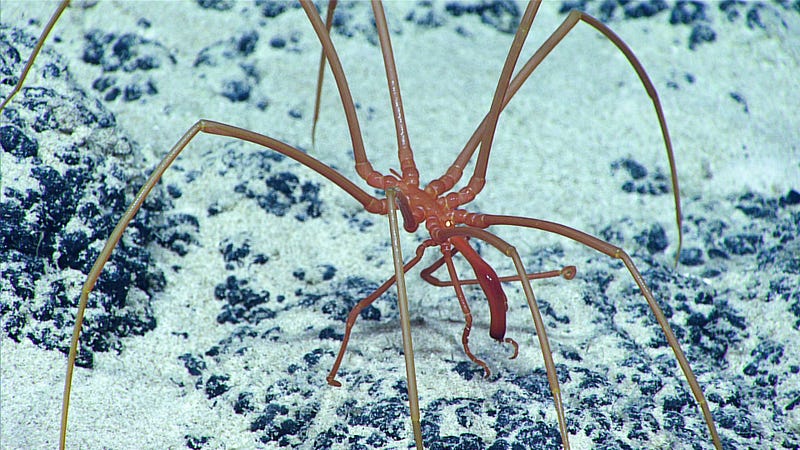
Of all parts of the oceans, we know the least about the depths. That’s because conducting research at great depths exceeds the capabilities of even the most advanced equipment. Therefore, every new piece of information about little-known inhabitants of the waters is particularly exciting. This time, after 140 years, scientists have managed to determine the reproduction process of sea spiders. These are arthropods also known as “sea spiders.” They inhabit, among other places, Europe (the Mediterranean Sea basin), but the authors of the latest research focused on specimens from the Antarctic Ocean (since 2021, the area has been called the Southern Ocean).
The reproduction of Colossendeis megalonyx has long intrigued researchers. This is because they have seen nothing about the embryology or larval development of this species, as well as others from the Colossendeidae family. The breakthrough came during an expedition by a team from the University of Hawaiʻi at Mānoa. During it, researchers managed to observe some reproductive behaviors of these sea spiders for the first time. First, they gathered groups of giant sea spiders, which apparently formed pairs, and then observed them in laboratory conditions.
The breakthrough discovery after 140 years of observation
Two of the studied groups released thousands of tiny eggs in a gelatinous cloud. The new generation developed slowly, which is characteristic of cold-adapted animals inhabiting Antarctica.
Interesting conclusions also came from observations of adult individuals near the eggs. One of the males (presumably the father) spent almost three days appearing to care for the gelatinous cluster. During this time, the eggs condensed and attached to the rock. The first larva hatched eight months after the eggs were laid.
This changes our knowledge about ocean inhabitants
The authors of the article published in “Ecology” assure that caring for non-hatched embryos after spawning is an exciting discovery.
“This may represent an evolutionary strategy intermediate between broadcast spawning and paternal brooding exhibited by most other sea spider groups,” the research description reads.
“We were fortunate to be able to see this. The opportunity to work directly with these amazing animals in Antarctica allowed us to learn things no one suspected,” comments doctoral student Aaron Toh.
The first study of the reproductive strategy of C. megalonyx is extremely important, even groundbreaking, for understanding the biology and natural history of the species and others similar to it. Especially since they inhabit one of the least explored parts of the ocean.
Attention all readers!
As content creators on Medium.com, we face minimal compensation for our hard work. If you find value in my articles, please consider supporting me on my “Buy Me a Coffee” page. Your small contributions can make a big difference in fueling my passion for creating quality content. Thank you for your support!


.jpg)