
The Invention of ‘Jaywalking’
In the 1920s, the public hated cars. So the auto industry fought back — with language.
This is the story of how, in the 1920s, the auto industry chased people off the streets of America — by waging a brilliant psychological campaign.
They convinced the public that if you got run over by a car, it was your fault.
Pedestrians were to blame. People didn’t belong in the streets; cars did.
When pedestrians ruled the roads
It’s one of the most remarkable (and successful) projects to shift public opinion I’ve ever read about. Indeed, the car companies managed to effect a 180-degree turnaround.
That’s because before the car came along, the public held precisely the opposite view: People belonged in the streets, and automobiles were interlopers.
If you travelled in time back to a big American city in, say, 1905 — just before the boom in car ownership — you’d see roadways utterly teeming with people. Vendors would stand in the street, selling food or goods. Couples would stroll along, and everywhere would be groups of children racing around, playing games. If a pedestrian were heading to a destination across town, they’d cross a street wherever and whenever they felt like it.
“They’d stride right into the street, casting little more than a glance around them,” as Peter D. Norton, a historian and author of Fighting Traffic: The Dawn of the Motor Age in the American City, told me when I interviewed him for Smithsonian a few years ago. “Boys of 10, 12 or 14 would be selling newspapers, delivering telegrams and running errands.”
Here’s what New York’s Mulberry Street looked like in 1900…
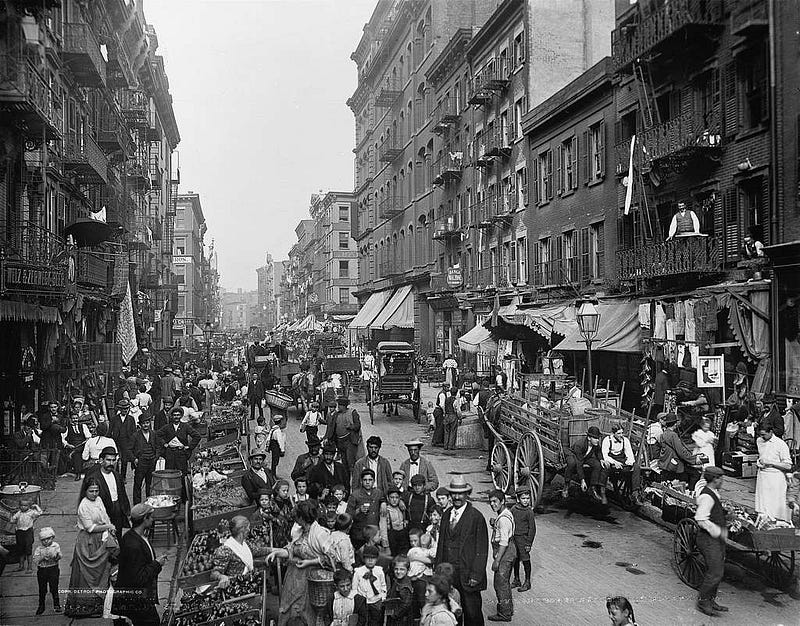
Not a car in sight! And tons of people.
Those streets were pretty safe for pedestrians. Sure, there were horse-drawn carriages and streetcars, but those moved comparatively slowly (and predictably, in the case of streetcars, on tracks). You had time to get out of the way.
But once private citizens began piloting cars down city streets, things got dangerous quickly.
Cars were heavy and a lot faster; the Model T, released in 1908, could hit 45 mph. Few rules or protocols for the use of cars existed, and pedestrians weren’t looking out for them. Why would they? Pedestrians had ruled the streets, worldwide, for centuries.
So the death toll was astounding. In cities of more than 25,000 people, cars were a leading cause of death by 1925. In the 1920s alone, car drivers killed over 200,000 Americans.
When cars and car drivers == ruthless, selfish killers
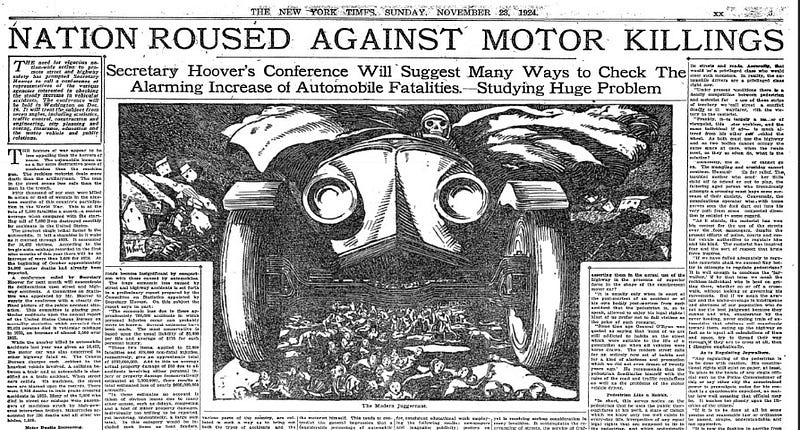
The public was furious. They saw cars, and car drivers, as violent interlopers on streets that rightfully belonged to pedestrians. Newspapers ran headlines like this, with graphics portraying cars as the grim reaper…
Some argued that the top speed of cars should be dramatically capped with “governors,” an idea espoused in this 1923 story in the St. Louis Post-Dispatch…
This dreadful slaughter must be stopped. If necessary, regulations severe and searching enough to do it must be adopted and enforced… If reasonable safety of life and limb can only be had by impairing the motor car’s efficiency the motor car will have to pay that price.
Milwaukee held a “safety week” competition to draw the best poster depicting the dangers of automobiles. The winner showed a grief-stricken woman holding the bloody corpse of her child; the second place was a woman trying to comfort her daughter, who asked about how badly her father was hurt when he was killed by a driver.
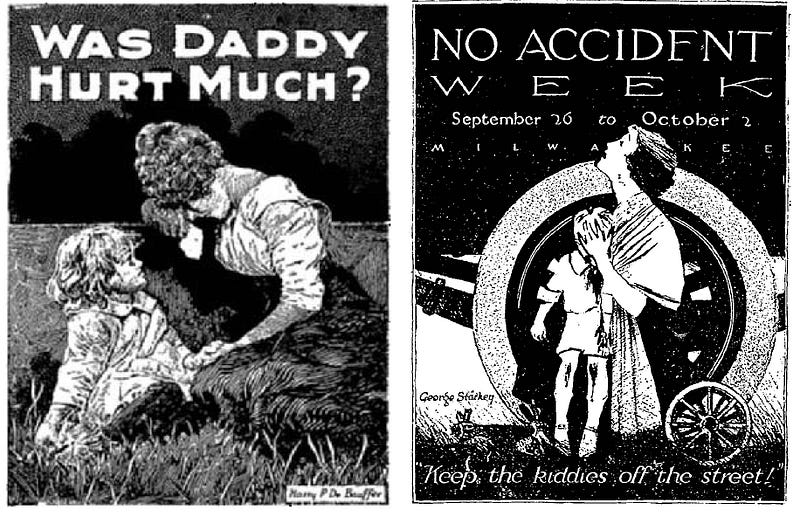
The public was particularly horrified by the number of children killed by car drivers. In 1925, fully one-third of all traffic deaths were children, and half of those kids were killed on their home blocks. During New York’s 1922 “safety week” event, 10,000 children marched in the streets, 1,054 of them in a separate group symbolizing the number killed in NYC car accidents the previous year. When a driver went to court for a fatality, juries and judges were harsh.
Basically, car drivers were seen as selfish cretins who sociopathically risked slaughtering their fellow Americans just so they could arrive at a destination more quickly. Few pedestrians respected cars. Cities installed crosswalks, but people ignored them. When police officers in Kansas city tried to keep women out of the street, “women used their parasols on the policemen,” as one safety expert reported.
Public opinion against cars became so sulphurous that, after years of car sales increasing, in 1924 sales went down by 12%.
So the auto industry realized it needed to fight back. It did so using an incredibly clever gambit: By convincing pedestrians that traffic accidents were their fault.
The invention of “jaywalking”
Key to this strategy was the epithet “jaywalking.”
It’s not totally clear who invented the phrase, but it was a fiendishly clever portmanteau. In the early 20th century, the word “jay” mean an uncultured rube from the countryside. To be a “jaywalker” thus was to be a country bumpkin who blundered around urban streets — guileless of the sophisticated ways of the city.
The brilliance of the concept is that it weaponized urban snobbishness against itself. “What,” it coyly asked, “do you want to look like some sort of hayseed?”
If the auto industry could just lovebomb “jaywalking” into existence, then urbanites’ own anxieties about looking cool would do the rest. You wouldn’t need police to keep pedestrians out of the street if the pedestrians policed themselves.
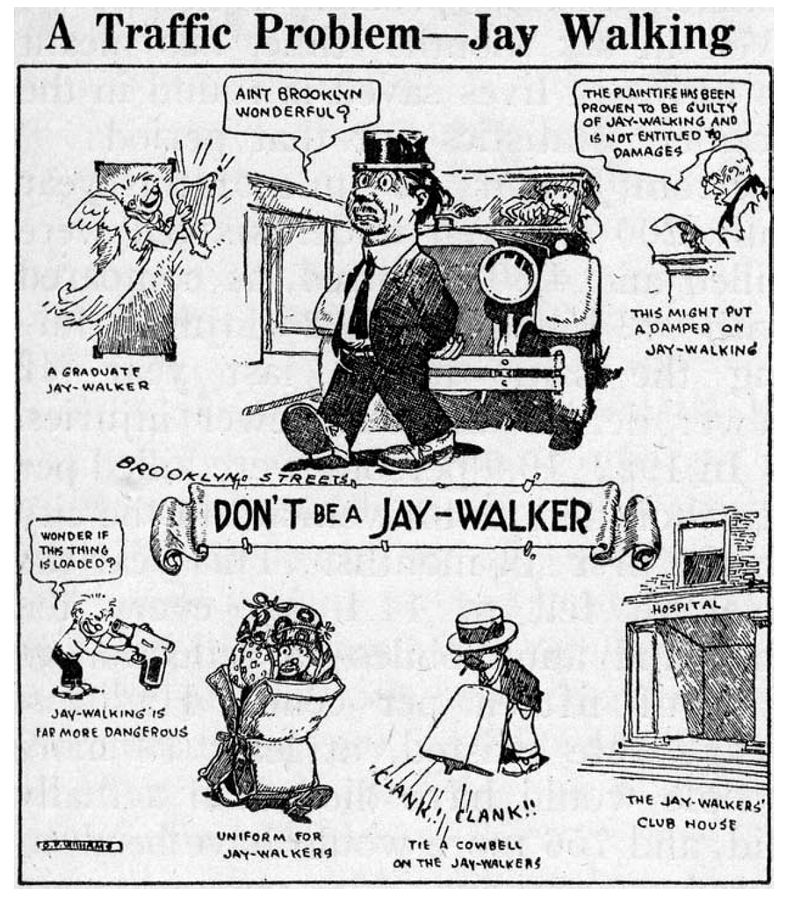
Newspapers helped popularize “jaywalker,” in part because as the 1920s wore on, car advertising had become a gold mine. Newspapers began switching their allegiance from pedestrians to drivers, and they ran cartoons mercilessly mocking jaywalkers…
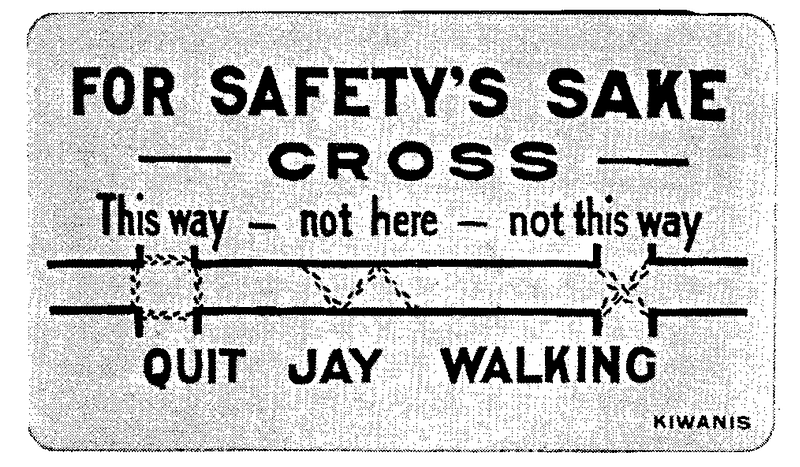
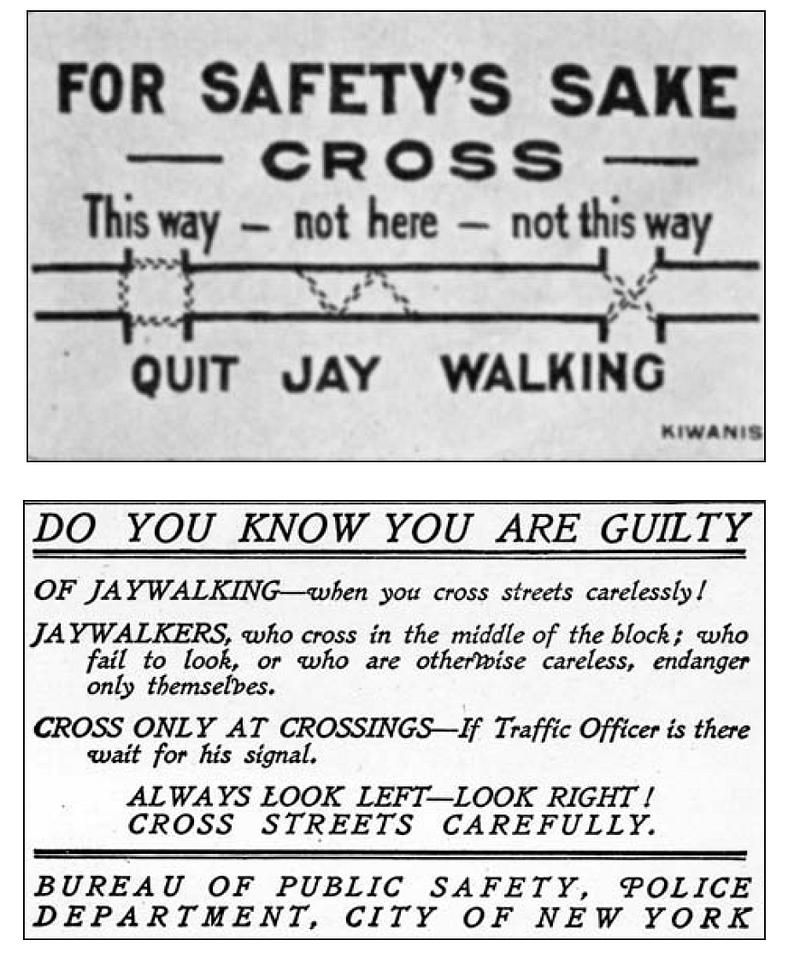
The Boy Scouts got in on the action too, standing watch at roadside and handing out cards to pedestrians — printed by cities or groups like Kiwanis — cautioning them against jaywalking. Two of those cards are below…
“Jaywalker” was a catchy term, and it caught on. Pretty soon city “safety councils” began holding events teaching pedestrians that it was their job to watch out for cars and not to jaywalk. They’d hire clowns to perform in safety parades; in one 1924 New York parade, a clown went down the street followed by a car, getting rear-ended by it over and over again. Only true idiots would allow themselves to get hit by a car, right?
By 1924 “jaywalking” was in the dictionary: “One who crosses a street without observing the traffic regulations for pedestrians.”
Car sales exploded in the late 1920s, and by 1930, the fight between cars and pedestrian was over — with cars the decisive victor.
Ever after, “the street would be monopolized by motor vehicles,” Norton tells me. “Most of the children would be gone; those who were still there would be on the sidewalks.” By the 1960s, cars had become so dominant that when civil engineers made the first computer models to study how traffic flowed, they didn’t even bother to include pedestrians.
(I drew much of my information for this essay — and these terrific images — from Peter Norton’s excellent paper “Street Rivals,” which you can read in full here. His full book, Fighting Traffic, is a great read too.)
This grim little tale resonates far beyond cars, by the way.
In our contemporary age, many firms employ very much the same trick: Evading responsibility for their products by claiming it’s our fault if we get harmed by them.
Social networks like Facebook and Twitter craft their feeds precisely to reward hot emotionality and anger — then claim to be baffled why so many users are angry and hotly emotional. Online services require us to cough up endless personal data and then say it’s okay because “nobody cares about privacy, you can tell because they keep on giving us their info.” Car companies create huger and huger vehicles, creating an arms race where individual owners feel they basically have to get a massive vehicle so they’ll feel safe in the face of everyone else’s wastefully huge rides.
We’re jaywalking all over the place now, it seems.
Clive Thompson publishes on Medium three times a week; follow him here to get each post in your email — and if you’re not a Medium member, you can join here.
Clive is a contributing writer for the New York Times Magazine, a columnist for Wired and Smithsonian magazines, and a regular contributor to Mother Jones. He’s the author of Coders: The Making of a New Tribe and the Remaking of the World, and Smarter Than You Think: How Technology is Changing our Minds for the Better. He’s @pomeranian99 on Twitter and Instagram.


