
Aesthete
Oscar Fingal O’Flahertie Wills Wilde (1854–1900)
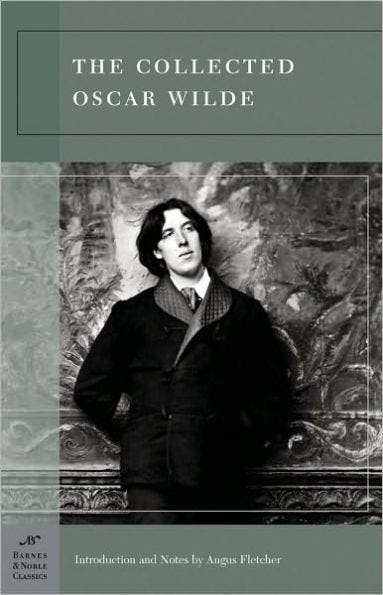
“I can resist anything except temptation.” (one of my favourite quips from one of my favourite authors, Oscar Wilde)
Biography
Oscar Fingal O’Flahertie Wills Wilde, born in Dublin, Ireland in 1854, is an extremely famous man for a variety of reasons. He was an intellectual, poet, playwright, essayist, ‘dandy’, aesthete, socialite and rapier witted quipper of the split-second epigram.
However, many also know him as a homosexual man who was convicted for “acts of gross indecency with another male person” and held in Reading Gaol for two years hard labour (1895–1897) for the ‘crime’ of loving the son of the Marquess of Queensbury (yes, that one).
“‘The love that dares not speak its name’ in this century is such a great affection of an elder for a younger man as there was between David and Jonathan, such as Plato made the very basis of his philosophy, and such as you find in the sonnets of Michelangelo and Shakespeare. It is that deep spiritual affection that is as pure as it is perfect. It dictates and pervades great works of art, like those of Shakespeare and Michelangelo, and those two letters of mine, such as they are. It is in this century misunderstood, so much misunderstood that it may be described as “the love that dares not speak its name,” and on that account of it, I am placed where I am now. It is beautiful; it is fine; it is the noblest form of affection. There is nothing unnatural about it. It is intellectual, and it repeatedly exists between an older and a younger man, when the older man has intellect, and the younger man has all the joy, hope and glamour of life before him. That it should be so, the world does not understand. The world mocks at it, and sometimes puts one in the pillory for it.”
— The Trials of Oscar Wilde — Making Queer History (speech made in court by Oscar Wilde, in defence of relationship with Lord Alfred Douglas)
He died in Paris from meningitis in the year 1900, not too long after being released from prison — having never again seen his wife, Constance, and two sons (Cyril and Vyvyan)
Aestheticism
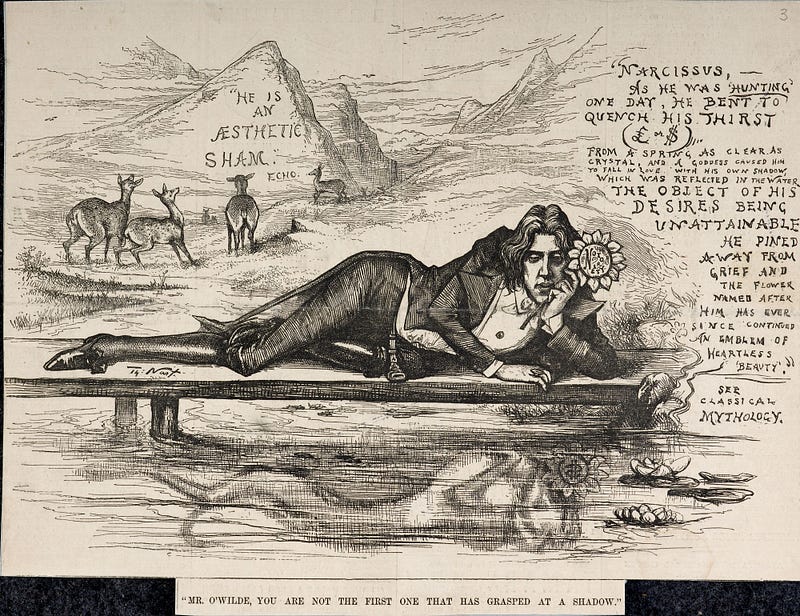
“This cartoon, by the American Thomas Nast (1840–1902), was presumably inspired by the publication of six prose poems by Wilde in the magazine The Fortnightly Review of July 1894. One of them, The Disciples, is told from the point of view of the pool in which the Greek character Narcissus gazes lovingly at his own reflection.
Wilde is shown as Narcissus, looking on adoringly at himself. He wears an extravagant flower labelled ‘Notoriety’, and the Narcissus story is quoted on the right. In another classical reference, the voice of Echo from the hills states ‘He is an aesthetic sham’. The name he is called in the caption (‘Mr O’Wilde’) is a dig at his Irish origins.”
Whilst attending Magdalene college, Oxford, Wilde became intrigued by the teachings and social criticism of John Ruskin, himself heavily influenced by Thomas Carlyle; and Walter Pater, a critic and essayist, particularly his work ‘Studies in the History of The Renaissance’ (1873)
“Art for Art’s Sake”, from the French slogan “l’art pour l’art”, embodies the decadent, scandalous, style over substance Aestheticism movement which Wilde became the ‘poster boy’ for during the eighteen eighties and nineties.
Aestheticism was loosely related, in joint antithesis to Victorian morality and the mechanisation of the Industrial Revolution, to the Arts&Crafts Movement, subscribed to by the likes of William Morris, who believed that:
“Have nothing in your house that you do not know to be useful, or believe to be beautiful.” — William Morris
Other leading figures of the Aesthetic movement included Aubrey Beardsley — author/illustrator, who illustrated Wilde’s ‘Salome’ (1893/4) — and Edgar Alan Poe (author of ‘Murder At The Rue Morgue’, 1841 and ‘The Raven’, 1845 among others) — who lost his position at ‘The Yellow Book’ after Wilde’s arrest 1895 and also died France, in 1898, aged only 25.
Books
Oscar Wilde on books:
“There’s no such thing as a moral or an immoral book. Books are well written or badly written. That is all.”
“It is what you read when you don’t have to that determines what you will be when you can’t help it.”
“The books that the world calls immoral are books that show the world its own shame.”
(All three of the quotations above are taken from Wilde’s work ‘The Picture of Dorian Gray’, 1891)
‘The Picture of Dorian Gray’ is a gothic novel, which was much reacted against by contemporary reviewers because the titular character lives the life of a hedonistic libertine; it’s tone of its commentary on art/artists, society and beauty; and the inclusion of homosexuality, in the form of painter Basil Hallward’s obsession with the beauty of his subject.
In this book, Dorian Gray experiments with every vice he reads about in a French novel given to him by Lord Henry Wooton, but any ravaging signs of age and lifestyle only appear upon the painting. This encourages a moral decay into sadism and crime, as he feels free of any consequences showing upon his face.
The novel throws up some interesting questions. Does human nature tend towards a person performing any action they feel will have no consequence? If religion is supposed to teach us morals, gives us rules to follow; and laws are also set in place around societies to guide us all in separating acceptable behaviour from unacceptable; why is it that so many people are willing to break these rules if they think they can get away with it?
Morality and ethics are not something which can be imposed upon a person’s psyche. Often, with adults as with children, declaring something forbidden only increases its allure. The cookies in the jar placed high upon the kitchen cupboards are not safe from pilfering little fingers, that high position provides only a problem to be solved, a mountain to climb, a challenge to accept, or not.
Art merely reflects back what is already there. People are always so quick to try and point the finger, find something to blame for wicked behaviour. Video games will be blamed for gun violence, particularly that perpetrated by young people, teenagers, in schools. Violence in films and tv programmes. Every new form of entertainment has been ascribed with terrible warnings of how it will warp an audience’s mind and moral character — even books.
However, it is my opinion, that in order for something in our art and culture to inspire us towards undertaking evil deeds, that inclination must always have been there within us to start with. Perhaps our choices of favourite, art, books, films, video games will stimulate that tendency — but why were we drawn to them in the first place? Like Dorian Gray’s portrait, our art can only imitate and reflect that which is already inside us.
Poetry
Wilde certainly wrote poetry of his own, but his early work was considered rather unremarkable and certainly derivative.
‘The Ballad of Reading Gaol’ (1896) is of much higher quality and standing.
“I never saw a man who looked With such a wistful eye Upon that little tent of blue Which prisoners call the sky, And at every drifting cloud that went With sails of silver by.
I walked, with other souls in pain, Within another ring, And was wondering if the man had done A great or little thing, When a voice behind me whispered low, ‘That fellow’s got to swing’.”
— ‘The Ballad of Reading Gaol’ (Oscar Wilde, 1898), lines 13–24. (see: Oscar Wilde — The Ballad of Reading Gaol | Genius)
The recent BBC programme ‘Prisoner C33’ was an excellent piece of theatre in which Toby Stephens depicts two versions of Wilde (one the prisoner, one the younger aesthete) in conversation with each other during the author’s incarceration at Reading Gaol. I highly recommend watching it.
However, it is probably the verse which was quoted and referred to at Wilde’s trial which is probably best remembered in connection with him.
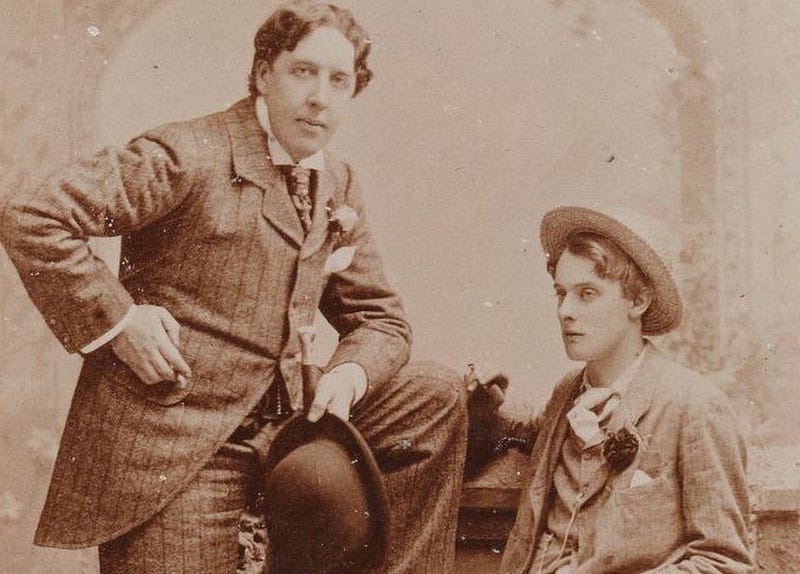
This poem was not one of his, however, but in fact written by Lord Alfred Douglas (‘Bosie’ was Wilde’s affectionate pet name for him).
It concludes:
“I fell a-weeping, and I cried, ‘Sweet youth, Tell me why, sad and sighing, thou dost rove These pleasant realms? I pray thee speak me sooth What is thy name?’ He said, ‘My name is Love.’ Then straight the first did turn himself to me And cried, ‘He lieth, for his name is Shame, But I am Love, and I was wont to be Alone in this fair garden, till he came Unasked by night; I am true Love, I fill The hearts of boy and girl with mutual flame.’ Then sighing, said the other, ‘Have thy will, I am the Love that dare not speak its name.’.”
— ‘Two Loves’ by Lord Alfred Douglas, which was written during the September of 1892 and published in the Oxford magazine, ‘The Chameleon’, during December, 1894.
Plays
I’ve been an admirer of Wilde’s writing for a long time. So much so that I wrote my university English Literature dissertation about the social commentary he wove through the comedy of his drawing room dramas:
- ‘Lady Windermere’s Fan’ (1892)
- ‘A Woman of No Importance’ (1893)
- ‘An Ideal Husband’ (1895, published 1898)
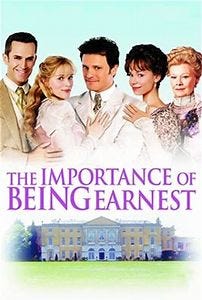
- ‘The Importance of Being Earnest’ (1895, published 1899)
“In each of these elaborate “modern drawing-room comedies with pink lamp shades,” as Wilde termed them, one finds recurrent character types: puritanical figures of virtue (wives in Lady Windermere’s Fan and An Ideal Husband, an heiress soon to be a fiancé in A Woman of No Importance), mundanely fashionable hypocrites, and exceptional humanitarians of two types — the dandified lord (Darlington, Illingworth, and Goring) and the poised and prosperous “fallen woman,” two of whom (Mrs. Erlynne in Lady Windermere’s Fan and Mrs. Chevely in An Ideal Husband) go in for wit and the other of whom (Mrs. Arbuthnot of A Woman of No Importance), though equally unrepentant, specializes in good works. Clever, epigrammatic conversation is what these characters do best; guilty secrets and the situational intricacies they weave are the strings for Wilde’s verbal pearls.”
— Analysis of Oscar Wilde’s Plays — Literary Theory and Criticism (literariness.org)
Very like comedians of today, Wilde wrote social, domestic comedies throughout which he wove sharp criticism about the hypocrisy, inequality and superficial standards of Victorian England.
Children’s Stories
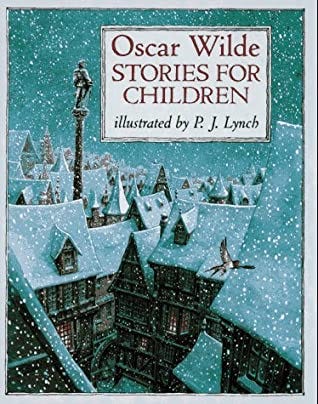
Wilde wrote over a wide array of genres. Along with his novel, plays, poetry, socialist essays and all, he also wrote some marvellous, sensitive, children’s stories.
Some of the best include:
- ‘The Selfish Giant’
- ‘The Happy Prince’
- ‘The Nightingale and the Rose’
- ‘The Devoted Friend’
These all appeared in ‘The Happy Prince and Other Tales’ (1888) and are not light, fluffy, ‘happy ever after’ fairy tales. Wilde’s story-telling style is magical, but it is melancholic and has a message. You could probably expect more tears than laughter when reading these, despite the authors injection of his own dry, satirical humour.
Some modern-day readers comment that these are not suitable for children at all, but they are as suitable as the original Grimm’s stories are. Fairy tales were originally written as a vehicle with the purpose of getting a message (often a warning) across to young children. They are often frightening, or have a sad outcome, because so does real life.
Another story written by Wilde would be a perfect story for a dark night, lit by fire and candle light. Halloween, or round a campfire. It’s a little scary, a ghost story after all, yet the humour and pathos changes and lightens the tone so much that, by the end, it is almost more of a fable than a horror story.
‘The Canterville Ghost’ (first published in ‘The Court and Society Review’ in1887) is a story I absolutely loved as a child. I didn’t realise it was written by Wilde until I was in my teens, when reading some of his other writing and deciding to borrow a ‘complete works’ from the library.
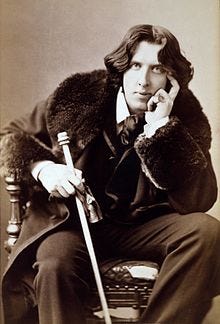
On the whole, it’s fair to say that there was so much more to Oscar Wilde than we tend to see. Not just the irreverent, fancy dressing, boy fancying, epigram quipping aesthete — though all of those things were very much parts of his character and as such completely worthy of celebration. Alongside, perhaps behind, all of these things there was a very serious, sensitive person and writer.
One of the first pieces of this author’s writing that I read was ‘The Soul of Man Under Socialism’ (I was a very serious teen) which is an:
“… essay 1891 essay by Oscar Wilde in which he expounds a libertarian socialist worldview and a critique of charity.[1] The writing of “The Soul of Man” followed Wilde’s conversion to anarchist philosophy, following his reading of the works of Peter Kropotkin”
In my mind, this embodies the serious side of Wilde, which finds it’s expression through lighter-seeming work so often.
I love Oscar Wilde’s writing; his passion and his compassion; and the subversive, countercultural, vein which runs through everything he wrote. If you haven’t already, read him. There’s something in his catalogue which suits everybody’s tastes — and I really don’t think you’ll regret giving him your time.
Thank you for reading. If you’ve enjoyed my writing, but aren’t yet a member of Medium, consider signing up here: