
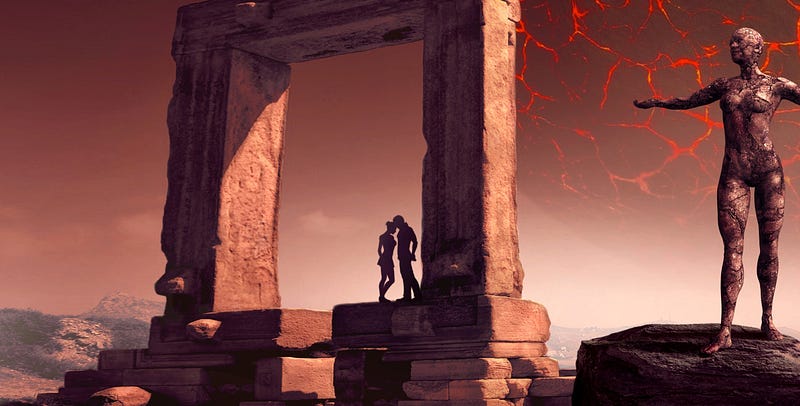
Adrift Among The Stars — Part Six
The Secret of Life is Revealed
“I’m as ready as I’ll ever be,” El’ban said, as she shouldered a heavy pack three days after the crash landing. The Captain had directed that each of the women would make a single trip down to the warm valley carrying all they owned and a share of the ship’s cargo. The men would make as many trips as necessary to transport everything else.
Ka’rail and three women picked up lines to drag a section of the ship’s titanium hull. The Engineer decided the primary generator was still operable, and he had devised a plan to transport it down the mountain. Sections of the starship’s hull had been cut away to build a bridge over the rocky region of the route. Ka’rail and the women were tasked with dragging one section.
El’ban picked up a fifth line.
“Are you sure you should do that?” Ka’rail asked. “Is it safe?” He was referring to their child, but he didn’t say the words.
She snarled. “I’m not an invalid. I can do what any other woman can do.”
Through the morning they slowly traveled across the snowy plateau. The exertion kept them warm. They deposited the hull section where an assistant engineer designated, and then completed the trek down the mountain. They reached the temporary encampment and joined their friends in the late afternoon.
Dy’low said, “A team of three men left this morning for the seashore. It will be a delight if they find edible aquatic life.”
The four friends were munching protein bars.
Og’cun brushed something dark from the fabric of her jumpsuit. “We’ve discovered the planet is not entirely uninhabited. There are several varieties of insects, and if you stay still too long they will take an interest in you. It’s not been determined that they are entirely harmless, so be careful to avoid them.”
Ka’rail and El’ban dropped their gaze to the ground around them, but saw nothing.
“That’s actually good news,” Dy’low continued. “It makes it more likely that aquatic life exists. The insects could be a food source for animals we can eat.”
“When do you leave?” El’ban asked, changing the subject.
Ka’rail, Po’cal, the Astrogator, and two other men were slated to return to the metal artifact. The keys had been made, and they were going to attempt to enter the obelisk.
“The day after tomorrow,” Ka’rail answered.
“It’s really quite exciting,” Dy’low said. “I wish I were going back.” However, he was tasked with returning to the starship. The Engineer was trying to repair the damage to the shuttle with the hopes it could be made to fly again. While it didn’t have the power to achieve orbit, it could be very useful exploring their new home.
“What does the inscription say?” asked Og’cun.
Dy’low continued, “The language is actually quite similar to a dialect used on Eddan, one of the other known human colonies. That cinches it; the people who used to live here were humans. The inscription says, ‘From this site, people from the planet Earth first venture to the stars. We do this to fulfill our destiny of exploration, and to escape our failings. To our decedents, we urge you — don’t repeat our mistakes.’ Of course, the Captain is eager to learn what mistakes it is talking about. He hopes there is more information inside. The existence of a door implies there is more inside.”
“Why aren’t women allowed to explore?” El’ban asked, with a huff in her voice.
Ka’rail hugged her. “It’s because women are so incredibly valuable and men are quite expendable.” He spoke the words with a jocular tone, but he was dead serious. The fledgling colony required only one man to procreate with all of the women.
On the prescribed day, Ka’rail kissed El’ban goodbye. “Watch after yourself,” he commanded.
“And you too,” she responded. “Be careful.”
The team of five men arrived at the mountain top obelisk a few hours later. They immediately set to work applying a lithium lubricant to the lock mechanism. The door sprang open when they applied the keys.
Once inside, the team projected their light beams around the interior. The bottom hundred feet of the artifact was hollow; above that, the obelisk was solid. There was no means to ascend in the hollow space, indicating the designer left nothing up there to be discovered. In the center of the room, a spiral staircase led downward.
The interior walls contained sections of artistic murals with plaques bearing more inscriptions.
“Can we read those?” Ka’rail asked.
The Astrogator held up a portable computer, and answered, “Yes, I’ve prepared a translator. Actually, I only had to make small adjustments to the translator already stored in the Brain’s memory. It seems, this has been standard programming for starships since we first visited the Eddanites.”
The group moved across the room to the mural on the right side of the doorway through which they had entered. The wall painting had a large starburst in the background with several planets in the foreground.
Using the translator, the Astrogator read the inscription. “In the years before the Great Escape to Elysium, scientists were interested in studying the origin of the Universe and life itself.” He glossed over a short version of the creation of the fabric of space-time, and thus, the Universe from a single, huge explosion. “All matter in the young Universe was hydrogen, and this condensed to form gigantic stars. Stars create their heat and illumination by releasing energy created when hydrogen atoms are squeezed together to form a helium atom. Being so large, these stars consumed their hydrogen fuel quickly and became unstable. They exploded as depicted above.”
The Astrogator paused to draw a breath and examine the starburst painting.
“In this explosion, the pressure in the core of the star was so immense that atoms were squeezed even tighter together. Here, other atoms such as carbon, oxygen, and iron were formed. In these star explosions, all the elements were created and dispersed in clouds, called nebulae, into interstellar space where new stars were formed. In the young Universe, generation after generation of stars were born and died in these explosions. Gradually, smaller stars formed. These were more stable and could last for billions of years. They merged together to form our Milky Way Galaxy and all the other galaxies we see in the Universe.”
The group shifted to the right and illuminated the next mural. This painting was of an ocean teaming with indescribable creatures ranging from tiny animals to great beasts. Ka’rail wondered if these represented the aquatic life they would find in the nearby ocean.
The Astrogator continued reading, “In the beginning, the Universe was devoid of life, consisting of only stars and nebulae of other elements.
“The great star explosions released bursts of energy into the nebulae. This energy pushed atoms together to form molecules. The most abundant molecule is water, which consists of hydrogen and oxygen. Then there is carbon-dioxide, followed by a host of other combinations, mostly hydrogen and carbon with some other elements. As the generations of early star explosions continued, more complex molecules were created and dispersed through the expanding Universe. Eventually, after untold billions of years, a molecule was created which could reproduce itself. This molecule could use the light-energy from a normal burning star, and the free elements passing through the nebula, to create a copy of itself.
“This molecule would become the foundation of all life which subsequently formed in the Universe.
“Once the stable stars formed, and planets formed around these stars, the molecules rained down on the planets. In those places where it found a favorable environment, even more complex molecules evolved from the early beginnings. After billions of years, actual living creatures were the result of this development.”
The visitors to the shrine moved to the next mural. Here they saw a scene of cavemen hunting. They were doubtlessly humanoid.
The Astrogator continued, “A few billion years after the early life, intelligent animals evolved into existence. Slowly, each generation built upon the experiences of its ancestors. The more intelligent the animal, the more likely it was to survive. Thus, new species evolved, leading to primates, and then to our early human ancestors. On the order of a hundred thousand years ago, humans very much like you and I, began to populate the Earth.
“It took billions of years for stable stars and galaxies to form. The self-replicating molecules took ten billion years to form. It took three billion years for these molecules to evolve into intelligent beings. And, only a hundred thousand years ago our ancestors first walked the Earth.
“Life for these early humans was harsh. Each day was filled with a constant struggle to feed themselves, and to protect their families from ravaging beasts. The strongest, most aggressive survived. Yet, they eventually conquered their environment.”
Ka’rail asked, “You know where we are, don’t you?” He spoke with a quiet, reverent tone.
“Yes,” the Astrogator answered, “when these people use the word earth, they are not speaking in the generic sense of land or ground. This is The Earth, the place were humanity began.”
Po’cal said, “I thought that was just a myth.”
“So did I,” the Astrogator mused. “So, did I.” He moved to the next painting, a large, busy city, and read, “Unfortunately, as humans created a civilization, they were unable to shed their aggressive survival instincts. As humans spread across the planet Earth, most of them lived close to nature — call it a Stone Age existence. However, a knot of technology formed in one location. This area was known as Mesopotamia. Here humans first learned to farm, and thus, to control their environment. One innovation blended into another. One new tool created another. In this single localized area, humans moved from the Stone Age, to the Bronze Age, to the Iron Age. With each new level of technology, these humans spread farther from the seat of their origin. Eventually, with the Industrial Age, these humans dominated the entire planet.
“This expansion was not cohesive. As the technological humans moved into an area, they were shaped by the geography of the area, and by the primitive humans who were absorbed or replaced. Thus, the planet Earth became a heterogeneous patchwork of nations. Each nation warred with the other to obtain resources.
“They built great cities. They created powerful machines. They thrived on more and more technology to free themselves from the struggle to survive, and to separate themselves from nature. However, their lives did not get easier. They became slaves to their need for more technology. Instead of working their days to provide food and shelter, they worked endless hours to buy more things. The most intelligent of them were the creators of the technological machines, and these people amassed great wealth as they sucked the resources from the multitude of humans. No one forced the technology upon the population; they warred with each other to obtain more and more. The machines came to own them.”
The mural representing the next phase in human history was a patchwork of symbols.
“The Industrial Age gave way to what was known as the Information Age. The multitude of humans remained dominated by the machines created by a few people. However, this new generation of machines did not perform physical work for the humans. Rather, they created a network for humans to communicate and share knowledge around the globe. This worldwide network, on the surface, appeared to be a salvation which would unify the discontinuous nations which had been created during the Industrial Age. However, this was not to be the case. Humans now had a physical existence confined by their nationality, and a virtual existence. In the virtual realm, or what was known as the cloud, people could redefine themselves and could interact with anyone on the planet.
“While on one level, this seemed to push humans into a form of unity, but it had the adverse effect of making their lives more dependent on the technology. They struggled harder to obtain funds to buy the newest, most powerful information networking machines. The few people who developed and controlled the technology grew richer and more powerful than the governments of the physical nations.
“As we near the end of the human story, twelve people possessed the vast majority of the resources of the Earth. Of course, these were in fact twelve huge corporations, each having thousands of shareholders and employees. But, each corporation was headed by one powerful person.
“The planet had a seething population of nearly ten billion people — the vast majority of these suffering humans were indebted to the twelve. In what became a war of the ‘haves’ versus ‘have-nots’, they openly rioted against the wealth and control of the twelve while continuing to pay them more and more money for newer technology. It is easy to see this civil unbalance could not be sustained. Like the fast burning early stars, this civilization was destined to explode in worldwide violence.”
Solemnly, the group of explorers turned to the next mural. This scene painted on the wall of the shrine was of a beautiful blue-green planet as seen from space. The outlines of large land masses were clearly visible.
“Now, it is time to study the Great Escape to Elysium; the people’s dream to find paradise and escape the hell they had made for themselves on Earth. This is a most confusing time in human history. Apparently, the root of the mechanized evil became the salvation for humanity.
“During the transition from the Industrial Age to the Information Age, humanity experienced a brief period of relative peace among the nations. Their interest stretched beyond their planet. This could very well have been a first attempt to colonize the other planets of their system. They built powerful rockets, and sent men to land on other worlds. They developed orbiting satellites to stretch their ability to communicate around the globe. This was the root of the international network which was to come.
“However, resources soon dwindled, and the conquest of space was forgotten. Yet, the need for the communications satellites expanded as the Information Age bloomed. With the national governments no longer allocating resources for the development of space technology, the twelve needed to supply their own means to launch satellites into orbit. These satellites were the essential backbone required to maintain the network cloud which had encompassed the Earth and entrapped its people.
“One of the twelve, a man known as Noah Abrams, invented the Gravity Engine. With this engine, space exploitation became economical. This led to greater profits for the twelve.”
Po’cal interrupted. “That sounds a lot like our hyperspace generators.”
“Indeed,” the Astrogator agreed, and then he continued, “This engine emits gravity waves. The gravity waves, not rocket propellant, were used to launch satellites into orbit around the Earth.
“Now, the civil explosion began. Politicians led the people in a revolt against the twelve giant corporations, claiming corporate greed was responsible for the people’s woes. Thus, the Great Escape to Elysium began.
“The twelve industrial leaders were very intelligent, and they foresaw what was to come. They assembled a vast collection of resources in this remote location. This was the last remaining bastion where the technology had not consumed the lives of the humans. This was where the twelve sought refuge from the rioting masses — refuge in a place where the technology they created did not exist. Here they collected the world’s resources and built twelve starships to send humans to the stars.”
They moved to the final mural depicting their galaxy.
The Astrogator continued reading, “Noah Abrams learned how to use his gravity engine to bend the space-time fabric of the Universe. This allowed the emigration ships to travel faster than the speed of light. Each new ship was larger and more powerful than its predecessors. Each new ship was able to travel faster and farther.
“The starships carried thousands of people chosen by the twelve. These people were among the shareholders and employees of the great corporations. One of the exhibits among the artifacts is a star chart depicting the destinations of the eight known ships.”
Ka’rail asked, “What artifacts?”
The Astrogator turned his attention to the stairwell. “Somewhere down here is a document detailing where the twelve starships went.” He projected the light from his flashlight into the depths beneath the obelisk and descended. “We can be sure we already know about four of them.”
The room under the monolith was much larger — a hundred feet on a side. This was a museum of artifacts representation of the Escape to Elysium.
The Astrogator stood before a portrait of Noah Abrams. “This is the beginning of life as we know it,” he said. “We should be careful not to disturb this place.”
Ka’rail began recording the entire chamber. Individual artifacts were examined, cataloged, and returned as they were found.
At the end of the day, the jubilant, but exhausted team sealed the entrance to the obelisk and returned to the settlement.
The group of thirty people from the crashed starship circled around the Astrogator. “It will take lifetimes to examine all we have found today,” he said. He then related what the team had discovered in the obelisk.
“So,” El’ban asked, “if there were ten-billion people living on this planet, and only a few thousand left in the Escape to Elysium, then what happened to everybody else?”
The Astrogator shrugged. “There is no information about them in the obelisk. Since most of the planet is covered with ice, I suppose the answer to that question is buried under the ice. In the millennia to come, our ancestors will probably discover the remains of the ancient cities. If I had to guess, I would suggest that the wars escalated, culminating in a global atomic war. Most of the major cities had fallen to one or more atomic explosions. The dust and toxic gases from the explosions polluted the upper atmosphere, blocking the sunlight. A prolonged winter followed. This initiated the planet’s descent into a global ice age. No one has the expertise to evaluate the myriad of feedback effects within a planet’s complex climate system.” He swallowed. “But, of course, there are a variety of natural catastrophes which could have resulted in the same climate collapse.”
After a long silence, Ka’rail lamented, “Unfortunately, what all this means, is that the past inhabitants have stripped the planet of all its resources. We’ll find nothing but the most primitive fuels and materials. Our children will be forced to live in what the obelisk described as a Stone Age existence.”
The Astrogator touched Ka’rail’s shoulder. “Don’t be quite so despondent, young man. The opposite might be true. We have a bright sun and we can capture its radiation for power. Additionally, the previous human inhabitants will have left a great deal of mined and refined iron and other metals within easy reach. We can expect our ancestors left many technological secrets in the artifacts under the obelisk. We know, for example, they had starships which could travel much faster than ours.” He stood and pointed at the first star to be seen in the twilight. “I say, in the deep meaning of The Great Circle of Life, our children will soon be building starships and exploring this segment of the galaxy.”
THE END
***
Copyright ©2023 by S. M. Revolinski All Rights Reserved
Thank you for reading my story, I hope you enjoyed it. Check my profile for more stories for you to enjoy. I have more stories and books published on Amazon and other ebook retailers for your reading pleasure.


