
Adrian Lamo: The Boy Inside the Man
He was among the first celebrity hackers, a genius to some and a traitor to others— a spy who tried to come in from the cold but found little warmth.
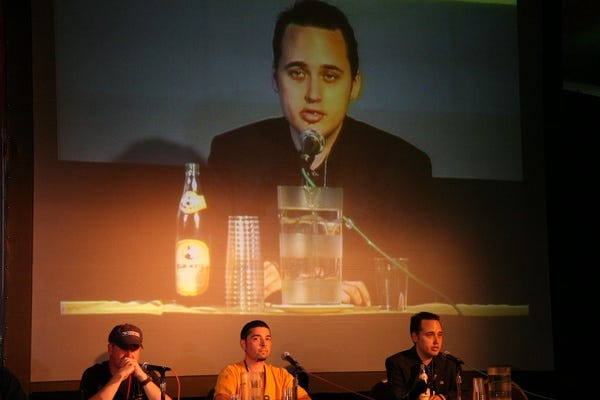
The Small Picture
I was the Assistant Principal at Adrian Lamo’s high school. He came to us as a sophomore after some difficulty with computer use policy at his first school, a conflict that activated his reluctance to accept authority and blindly follow rules. I read the notes about the transfer, saw his college-level proficiency in two languages, read his statements declaring that he would never harm anyone but insisting that he had a right to challenge any rule.
I thought, OK, he’s right — in the big picture. But high schools are not always big picture places. Students have theoretical rights but they are not always supported when adults feel students are questioning the general hierarchy of authority. Agreeing to hear a student’s grievance could make me suspect in the eyes of other educators: Why open that door? We have rules, students follow them, when they don’t — you enforce them. Why complicate it?
Ironically, the answer is simple: Because human beings are complicated; multiply that by a complicated world and we get exponential complexity. And 16 year-old Adrian Lamo was among the most complex souls I ever encountered.
We had a conversation when he first arrived. He came into my office to complete the registration paperwork with a bemused, slightly arrogant look on his pleasant, open, curious face, as if he knew we were about to have one of those conversations about behaving appropriately, respect for authority, and the consequences should he not go along with the program.
‘So you read about what happened at my last school?’ he began.
‘I did,’ I told him.
‘What do you think about it?’ he probed, and seemed surprised when I answered. I was allowing him to interview me.
‘I think …… you’re a smart guy. You should have known that you were going to upset people. If you want to do that, then no amount of threatening is going to help. We’ll see those same issues surface in an hour.’
He responded: ‘I am not going to surrender to an authoritarian state.’ His attitude now was slightly combative. I sensed this could escalate easily. He seemed equal parts fierce and vulnerable.
‘I’m not an authoritarian,’ I informed him.
He smiled slyly, his eyes reflecting a boyish mischief. If only it had been that simple, I was to think later. But Adrian Lamo had his sights on bigger things. I sensed that, even then. He was enjoying this banter: it was on his terms.
‘You’re not, are you?’ he asked rhetorically, seeming to agree with my self-assessment. ‘But you work for authoritarians.’
‘I work for a system with rules and they expect you and me to follow them. I have some play within the boundaries,’ I explained, ‘but that can get pushed too far. You need to come to me if anything is brewing. Do not get into public battles with teachers or administrators. There are points past which I can’t help you.’
‘I assume the computer teacher knows all about me,’ Adrian realized, thinking through his circumstances. His mind worked feverishly to figure out what he would face. His brow furrowed; his lips moved slightly, tracing his thoughts.
‘That would be a fair assumption,’ I responded.
Then he stood, a bright smile animating his face. He had gone from a brooding victim to a personable teenager in a flash. He reached out to shake my hand, did so vigorously.
‘I think I can work with you,’ he said. ‘Time will tell.’
‘It usually does,’ I said, and he was off to sophomore English.
The High Tide of History
The sophomore English class turned out to be a tough challenge for Adrian, and it wasn’t about the curriculum. The teacher was brilliant, inspiring, as demanding and rigorous in the Honors classes as anyone with whom I had worked — but she could be inflexible and punitive, part of a cadre of teachers who banded together to protect their school from rebels and indifferent students and malcriados, a word Adrian heard someone had used in reference to him, and which bothered him deeply. At its most extreme, malcriado would translate, to my non-native Spanish ear, as something like bad creation, or bad seed, and I found myself resenting the word and its implications as well, a label that seemed to allow for no growth, no transformation, no coming-of-age reconciliation where a boy as brilliant, and sensitive, and caring, as I had already known Adrian to be, could come to be part of the world and find peace and joy in it. It seemed to want to cast him out permanently.
Adrian was a boy trying to grow into a man, and I knew that territory, personally and professionally. He was devoted to a brother who needed him, he spoke emotionally of his parents, and of his native Colombia, with a wistful air that would normally be associated with a man much older, my age, say, which was 41 at the time — his tone came off to me as world-weary and profoundly wounded. At 16 Adrian possessed a range of emotions and a sense of the grand sweep of life that I recognized because I had it too at his age: to feel that sweep, to be caught up in its overwhelming power, to be cast out from the tribe and tossed around by history was a disorienting experience. They had called me something akin to malcriado…… I recall my fifth grade teacher telling another child’s parent, Keep your son away from him. He’s headed for a bad end. A bad end? I was 11 years old; the end was nowhere in sight. But it haunted me — how bad would it be? How bad was I?
To be tossed around by history …….. that’s as apt as any description of what was to happen with Adrian. He went right for the center of the action. Somewhere in this era he was appointed by the San Francisco Board of Supervisors to a Youth Commission post. Adrian Lamo, 17, perhaps 18 years old, was advising civic leaders on youth policy. I imagine they would have seen the fierce intelligence and limitless potential in Adrian, would not have worried about the rebellion and the breaches of protocol.
But we weren’t there yet on the afternoon we sat in my office late in that school year. Adrian was angry, on the verge of raging; he needed time to settle down, to let his quick and resourceful brain pick his way through the emotional minefield of teacher disapproval and find his way back to the central battle that he had no choice but to fight: the academic benefits of school. We all had this goal for him: he was going to finish high school and get into a good college, where I was certain he would excel and find himself. His curiosity, his unique angle on everything, the elegance with which he carried himself even at 16 — all added up to a grand, intense life that was out there for him, that he could surely seize when — if — he was ready.
That he was eventually to choose a more solitary path, a murky tunnel with many dangers in the shadows, was also not known that afternoon, yet I sensed he carried the possibility of great drama and fiery confrontation within him, angry and helpless in the aftermath of a conflict with the English teacher and remembering the name he had heard applied to him. There were tears in his eyes; his body was so tight that he couldn’t unlock his throat to speak. He was tapping his right foot very forcefully, grinding his teeth, occasionally emitting a rumbling growl ……….. I talked him down that day, brought him to a place of wounded, but calmer equilibrium; school had already been out for an hour when he finally felt able to stand and leave. He wanted to go home to see his brother.
As he departed, he looked at me with a pained expression to let me know he was still hurt. ‘They can’t keep doing this,’ he told me. ‘They just can’t.’
I almost said, ‘Yes, they can,’ but instead I advised him: ‘Act like they can,’ meaning protect yourself.
To this he responded, the sarcasm not hidden: ‘Good, sound advice, very practical,’ disdainful of me as if to offer such compromised counsel was an insult, or futile, or a demonstration of my limited ability to understand life beyond the walls of the school, or life inside the terremoto that was Adrian Lamo.
He went home then, as did I much later, drained, as if I needed to be protecting myself as well.
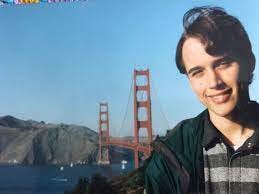
That school year ended, and the next year, Adrian’s junior year, would normally have been his toughest academically, and in response to that Adrian went in the opposite direction, tried to sign up for the new computer teacher’s 9th grade word processing course and also to be his student aide a different period. He had argued with the counselor about it and the counselor and a cohort of teachers were pressuring me to take action. Adrian was moving fast that year, always on a computer, around after school as well, a more dangerous unsupervised time. He was beginning to manifest his obsession with cyber-security, button-holing people to tell them about their risks. Teachers were suspicious, suggesting Adrian was a threat, piggy-backing on the gang fears of that era; juveniles were going to jail over angry outbursts at teachers, often labeling the explosive rages they helped incite as terrorist threats, a police term. But Adrian rarely interacted with the core faculty; once we settled into the school year other matters took center stage. We had some personnel changes in the works; it was to be the principal’s last year, some key teachers were moving on — the stuff of life, but amplified in a school, where endings and beginnings were built into the culture.
Adrian was not there when school opened up that next fall. High school could no longer contain him: he was on the road with his rogue cyber-security agenda and secret missions, already attracting attention for his intuitive espionage abilities and off-the-cuff style: equipped with a Kinko’s generic wifi code, a phone and a website address, Adrian Lamo could obtain access to anything. He was already becoming a legend, and a network of like-minded hackers supported him as he made his way across the country, without funds or income. Adrian became known as the Homeless Hacker. His name grew big quickly.
His first big clash was with the The New York Times, who put their massive resources behind prosecuting a breach of security Adrian created as a warning. That began a new chapter of this saga — Adrian as the hunted. He was playing in the big time now, and all the gloves were off. He eventually pleaded guilty to a felony in 2004.
At the millennium I became a school principal, but not before my view of Adrian was cast in a new light. In the spring of 1998 a scandal rocked the school that I won’t go into here, except to say that it made national news. The incident was uncovered right after spring break. I received the initial report, and became the lead in the investigation, beginning the long process of the expulsion of the perpetrators, handling the victims’ lawsuits, the media frenzy, the follow-up services, the drafting of new policies to prevent future occurrences, and dealt with the controversy engendered by my refusal to label anything zero-tolerance on general principle, when of course that’s what everyone wanted ……… it was a high-pressure cauldron that had me up all night writing reports to keep central office informed of each day’s developments.
One morning, in the midst of a crisis associated with the incident, I had just hung up the phone at the main secretary’s desk when Adrian Lamo, who I had not seen in many months — now tanned and fit, well-dressed in a dark blazer and white shirt — came through the front door of the main office and stopped abruptly when he saw me, a knowing smile on his face. ‘The embattled school administrator,’ he said. ‘I just had to see it.’
I stopped for a moment and looked at the young man who stood before me — taller, his thin frame filled out, an inner power emanating from him. I had not seen him for a while and in the interim he had grown into a person of substance and import. I knew something about Adrian then that I could not tell from newspaper articles and third-hand reports. In some ways he had moved beyond all of us. He could view his time with us as a chapter from his childhood. The school at that moment seemed impossibly small. His manner was worldly and enlightened: he had glimpsed a dark secret that few others had, and it seemed that he had a certain comfort level in the darkness. And with all of this he had come to see me, to reach out in a supportive way, thinking I was embattled — what the outside world would call me, how other adults may have referred to this — but no high school senior would have used that phrase. Adrian had seen embattled people, had been embattled himself. It would come his way again, in a larger package than any of us could have imagined.
We had only a short visit that day. He commented on my refusal to spout zero-tolerance nonsense. ‘It’s hard to take a stand,’ he said, and it was clear that he was referring to his own difficulties as well.
“I said once that lies have no rights against truth. I was wrong. In daily life, it’s the truth that’s disenfranchised. What fits the popular narrative, what makes an observer happy with the consistency of events, is what is believed.” (Adrían Lamo with Mario Lamo, Nadie Se Muere La Víspera
)
Moment of Truth in Real Time
I heard from Adrian off and on through the years. Once I spoke to him when he was unable to leave his parents’ home in Carmichael, outside Sacramento, as he was placed on some form of house arrest. He was in his mid-twenties by then, undeterred from his mission to enlighten the world about cyber-security.
The fact that he was not after monetary gain — I don’t believe he saw a penny from any of his forays into corporate and government databases and 401k plans — had to be frightening to the elite of any political persuasion. If not money, if not motivated by greed, what sinister and obscure morality drove him to violate what he knew were the boundaries set by powerful players in the biggest arena on earth — the security of the western world? The New York Times, the Pentagon, AOL, Microsoft, the FBI: he was playing on some big stages. And when Army Specialist Bradley Manning, a soldier with access to classified records, contacted Adrian from his post in Iraq in 2010 to enlist Adrian in the cause of outing the American military’s brutality in the conduct of the Iraqi campaign, Adrian struggled with a decision that ultimately led him to exile and the last chapter of this compelling and tragic drama: to report the soldier to a government contact. Specialist Manning had crossed the line that Adrian had always held — no harm, no violence, no use of the challenge for personal gain. “I remain confident in my 2010 decision. In that time and circumstance it was needful. It was cold, but it had to be made then and there. Her (Bradley became Chelsea in the intervening years) actions endangered lives, and would have cost lives without advanced notice …..”
I did not meet either of his wives, Lauren Fisher or Jenna DeVille Taylor, but they both come off in their public profiles as strong young women, bright, engaged, fully capable of holding their own in a relationship with a whirlwind like Adrian Lamo. I find myself smiling when I think of him as married: so unconventional in so many ways, living on couches, pacing the night-floors of the various places he stayed across the country, insomniac, dazed and alone in the dark hours of truth where a man must face himself and not even a spouse can follow. It is curious that he would want those relationships to have that extra stamp of societal approval.
But in considering it, I realized that in many ways Adrian was an institutional man. His early computer experiences and public interface were with the AOL watchdog site, and later he was to play out his ideas and develop his talent engaging with the N.Y. Times, Microsoft, Wiki Leaks. Adrian knew that his ultimate success, failure, chance at greatness, ability to make any kind of difference, was to be on the stages where these institutions played out their own drama. His battles took place in early social media cyber-space, as well as traditional forums: the print media, courtrooms, newscasts, even a rogue film or two, and ultimately in the war rooms of the Pentagon, the FBI and the CIA.
To illustrate the level his expertise had reached: Asked to demonstrate his talent during a network taping of a news report on hacking, Adrian nonchalantly broke into the network’s database while the tech crew was setting up, shocking everyone and setting in motion a panicked reaction that brought the network’s legal team into the mix.
This little episode never made it to the airwaves, nor did Adrian as part of this broadcast. Network Legal stepped in, ushered the underground star out of the building, and purged his name from the show’s credits. They were fearful that they had enticed him to break the law and were themselves liable, and in possession of the damning evidence. Adrian could have that effect on people.
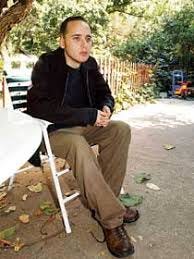
In his own way, Adrian Lamo made it to the top. His name is among the first that comes to mind when the question is asked about the most influential hacker of the early tech years. He never used the term hacker, telling the media: ‘I just do what I do. You label it.’ Hacker evokes a crude, artless destroyer, a hungry lout tearing at the Thanksgiving turkey with his hands. What do you call the man who finds himself without the usual tools and presents that turkey beautifully sliced and arranged, having done it all with an old car key? Resourceful, clever, and elegant come to mind — but Adrian chose not to define himself, knowing it was more powerful if others were to define him. But I don’t think he was troubled by the rough edges implied in the hacker label. He may have secretly enjoyed the slightly intimidating connotation of hacking as indiscriminate slashing and gouging. The world had treated him harshly for as long as he could remember, and while he was unapologetic and could be brutally honest about the effect the world’s judgments had on him, his passion was equal parts rage, disdain and intellectual curiosity as to how the world at large protected itself, or didn’t, and how quick and decisive he could be in exposing its threadbare cover. Hacker fulfilled the rage part of the equation.
It was to Adrian Lamo that U.S. Army Intelligence Specialist Private Chelsea (neé Bradley) Manning went when they wanted to spread the word about their electronic espionage. From that encounter we came to learn about Adrian Lamo, the man. An unabashed rebel, a cryptic contrarian, an unconventional thinker, a man ticking to his own inner clock, a convicted felon, a secretive erratic man who dabbled in spy games, espionage, leaks, system infiltration, mysterious codes and dark powers — a man who no one would have considered an American loyalist — how could we have known what was important to him in the moment when he realized what Private Manning was telling him? His internal code had not been tested in this way before; he had never been forced to choose between life and death in such a stark manner, facing potential responsibility for death should Private Manning’s actions go unreported.
Who has considered what Adrian Lamo was struggling with in confronting these questions? As we were to see very quickly, the entirety of the hacking community had a tribal reaction to an abstract concept: the sanctity of data acquisition, about which no eventual outcome of the content of that data, no matter how destructive or how likely to occur, could allow the acquisition itself to be compromised. By this code, if you knew of a military strike about to occur against anyone, even your own country, and learned of it through hacking, it could not be reported. ‘The minute you take a political position,’ a hacker said publicly at the HOPE conference where Adrian’s choice was the ever-present subtext, ‘you cease to be one of us.’ There was a general assumption that this was a shared value, and Adrian’s allegiance to it was believed to be a given.
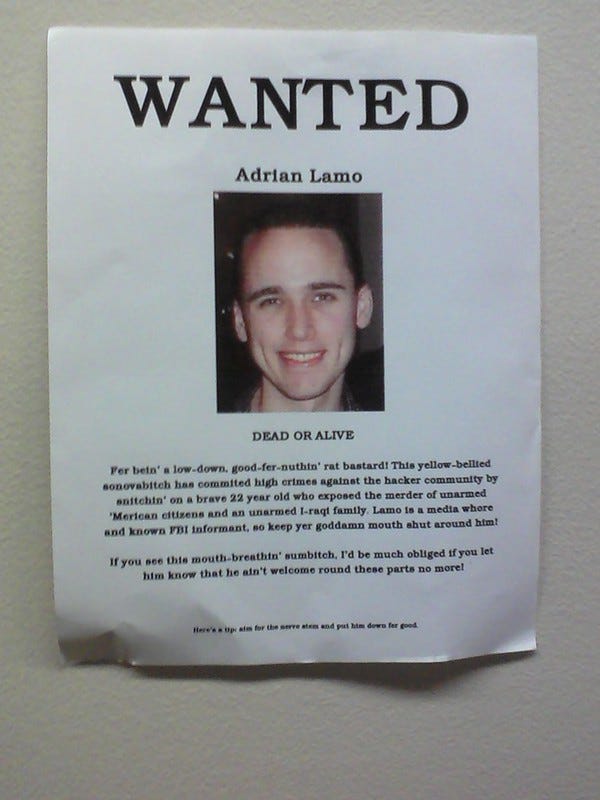
Except that it wasn’t. The same independent spirit that put him at odds with authority as a high school student had him evolve beyond the orthodoxy of his own tribe. Words like traitor, treason, betrayal, snitch; actions like spitting, throwing objects; forums and films where the central theme was his departure from the tribal norm — shows again the nature of groups, any identifiable and named group, their development of a narrative that speaks to their origins, to their creed, and reinforces a bond that is expected to be paramount, over and above any consideration of war, of life and death of outsiders, of anything at all.
In that 2010 moment, as he listened to Bradley/Chelsea Manning, he must have recalled the defense he gave when accused of the cyber-crimes in his past: I harm no one. My methods may be unorthodox, but there’s no intent to steal, or acquire personal wealth or gain property, defame anyone — my aim is to inform, illuminate and assist in gaining reparations for victims where possible. He would not be true to that tenet if he let the Manning leaks go. And so he picked up the telephone and made that call.
For that single phone call, Adrian Lamo was exiled, ostracized, shunned, threatened, defrocked — the scarlet letter was upon him. His marriages were over, friendships strained, finances non-existent. He paid for his act of conscience. He lost his standing in the community of independent cyber-mavericks, but he had expected that the logic of his position and the belief that the government would endorse and praise his actions would surely win over any doubters — but that did not happen. Logic did not come into play and patriotism was not a quality the government chose to ascribe to Adrian Lamo.
Yet we could, when examining the circumstances, call Adrian Lamo an American hero. Because of his rebellious nature and unconventional means of demonstrating his deep convictions, it is difficult for conventional authority to recognize him in this way. Yet he put the safety of combat forces and American citizens above his own well-being at a critical time, and there is no doubt the resultant exile contributed to the decline of his health. He had taken on his role in cyberspace at a very young age with the core value that he was only in this game to serve and solve problems. Twenty years later, when faced with a crisis of massive proportions, he acted in line with the values he professed to hold. That is a rare and precious legacy.

The Desolate Heart of America
And so we come to the gravel road in the desolate heart of America, the last outpost for Adrian Lamo in exile. He was 37 years old when he was found dead in his room at the Senior Center outside Wichita, Kansas on March 14, 2018. Out of options, a friend’s parents had found the spot for him. The cause and manner of death were listed as Unknown, and remain so to this day. There were medications in his system, but no toxic amounts of any particular substance, although some fatal interaction between various chemical elements is a possibility. There was no evidence of foul play, but neither was it ruled out. The dramatic saga of a reluctant patriot had come to an unexpected end in a strangely unremarkable and anticlimactic place, with a piece of the mystery unsolved. The exile in the heartland was a quiet interlude for a man who in his adult years had been the subject of intense scrutiny, surrounded by noise and thunder, and had been a key and misunderstood player in some of the largest issues of our time.
The 16 year-old boy who arrived at my school in 1997 and who optimistically said, ‘I think I can work with you,’ became a man of conflicted loyalties and forced choices of the most challenging nature. His mercurial and unpredictable personality led him down some interesting roads. Lauren Fisher, his first wife, has recounted the time they spent all day trying to return a wallet they had found. This was a signature Adrian Lamo quality: he was the master of the random, transforming it into poetic odyssey and human connection.
He came to see me when he thought I was in trouble, and how vibrant and purposeful he seemed then, like a young man on a mission. Perhaps that mission hadn’t fully taken shape; perhaps it never did. It was, in the most literal sense, security analyst that he was, as if he were protecting America from itself. As it happened, the scope of his activities was so large that the forces he unleashed were beyond anyone’s capacity to contain or fully understand. He thrust himself into the maelstrom of millennial America, and when he had to make a choice, he made it at great sacrifice to himself.
I was a member of the United States Air Force from 1976–1980, and it was never lost on me that Adrian Lamo may have saved military lives by making that phone call after hearing from Private Manning in Iraq. Mere months ago, when U.S. citizens huddled in the airport in Kabul as the Taliban closed in and the danger intensified by the hour, not many were thinking of Adrian Lamo and the possibility that the Taliban could have been even more empowered and dangerous had the United States been compromised by the decade-old leaks.
Adrian’s story was too non-linear for it to register with most people as a hero’s story, even for those intimately involved with the issues and affected by the safety risks Adrian tried valiantly to mitigate. Adrian was a brave and wonderful boy, and a brave and transcendent man who pierced the armor of the mighty and spoke truth to power, as they say. We can only hope they were listening.
Adrian Lamo was my friend, and I will remember him with great fondness and respect, and even with a bit of awe. In his brief time with us he fulfilled the promise of his youthful brilliance and uniqueness. There could have been, should have been, even more. He reached high, to places thin and brittle. He challenged all of us to take a step back, to gain some clarity and try to make sense of it all. If we fail to find that clarity, it is not for the efforts of Adrian Lamo, efforts for which he paid with his life, a man who lived trying to show us something we may just have been too confused and distracted to see.
“It’s my job to play this role that I’m cast in to the very best of my ability, the same as any other actor. You can’t possibly be yourself in the public eye. All the little things that make us human don’t stand up under the scrutiny of the camera.” (Adrian Lamo)