
FUTURE|TECHNOLOGY|EDUCATION
Adopting Immersive Learning Tools Will Have A positive Effect On Education
The Augmented Reality (AR)and Virtual Reality (VR) as educational tools will transform education in the future by making learning more effective
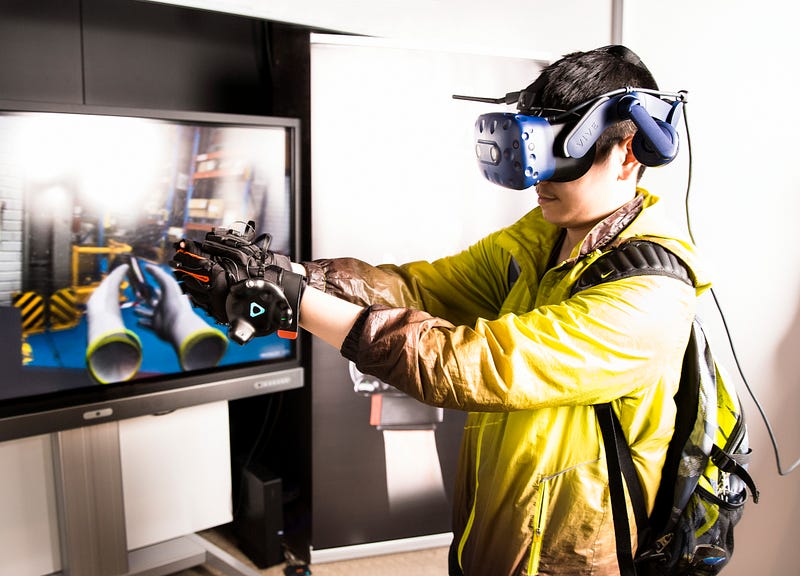
What are immersive learning tools? How are they going to benefit the learning process in the future? Do they have potential in education? These are some questions that we need to explore.
Let us first understand that Augmented Reality(AR) and Virtual Reality (VR) are important immersive learning tools and they are going to be very useful in the future world of learning and education.
What is Augmented Reality (AR) and Virtual Reality (VR)?
AR and VR are the digital tools that are used to make learning more effective. They help in bridging the digital and real-world and are widely used since 2017.
Augmented reality (AR) is a technology that is implemented through a camera or a phone. It adds digital elements to a live view. It makes things look better and beautiful.
Examples of AR are that we can see right in front of us a football match or flowers swaying in the wind right in front of us. We can also see cats teasing dogs and chasing them. People moving in the space.
AR makes the experience of the real world as though it is with you, in your own space. AR opens up new ways for your devices so that you can experience digital content in the way you would actually experience the world.
AR enriches the real-world experience by supplementing it with text, audio effects, and graphics.
AR allows you to search things visually, by pointing your camera at them. It can put answers right where your questions are by overlaying visual, immersive content on top of your real world.
AR uses a real-world setting. It can be accessed with a smartphone.
Virtual reality (VR) is an immersion experience It shuts out the physical world. VR devices such as HTC Vive, Oculus Rift, or Google Cardboard, are used for transporting real-world and imagined environments. It can show you a snake charmers show or an aquarium with colorful fish.
VR is a completely virtual setting. It requires a handset for accessing
VR creates a stimulating effect that can be experienced from the home. It can virtually transport goods and people from one country to another
AR and VR can further be extended to Mixed Reality (MR) and Extended Reality (ER)
Mixed Reality (MR) combines the elements of AR and VR, real-world and digital objects interact. Microsoft’s HoloLens is one of the mixed reality apparatuses used for combining the AR and VR experience.
Extended Reality (XR) uses AR, VR, and MR technologies. to cover all of the technologies for enhancing the views. They give an extended view about the actual world or unreal, simulated worlds for us to experience.
How will AR and VR have a positive effect on the learning and education of students?
Digital technologies are creating a space in education so that students are positively impacted in their learning process. AR and VR will definitely have some positive effects. Let us see how it will help in the education field.
#1. Effect on memory: Since AR and VR both have digital effects it is visual it will help in the retention of knowledge in their memory.
#2. A self-learning form of education: Each student can log on at any time and see things from the comfort of his home. This encourages self-learning and makes learning fun and personal.
#3.Simplification of concepts: The text, animation, and graphs added to the theory make it fun to learn and enjoy. It also simplifies the concepts making things more relatable and identifiable. The focus is on visual forms that make it easy and enjoyable for students to learn.
#4. Effect on imagination and creativity: Students have more horizons to explore. It enhances their creative juices making them interested in being innovative and more creative.
Thus we learn that there are several benefits with AR and VR for learning not only for students but employees of corporate organizations.
How to develop AR and VR Programs for learning?
#1. The world of AR and VR is a special field: To develop AR and VR a person has to become a specialized developer.
#2. Interest in video games: Those who are excited about AR and VR should not only have an interest in the required field but also be able to work with video game engines such as Unity or Unreal. These platforms permit you to recreate environments in 3D.
#3Computer language is a must to develop a program: AR/VR developers must be able to understand programming languages such as C++, C#, JavaScript, or Swift.
The takeaways
- AR and VR are very useful in the learning process and they have to be developed for the purpose of making it real to be useful in various fields, such as literature, history, health, robotics, geography, business, and so many others.
- AR and VR have wide applicability and have to be developed properly to be of use for learning. The developers have to be selected after a proper analysis. Subject material has to be given to them for developing the program by a person who is specialized in the subject.
- The AR and PV tools have great potential but clearly, we should know what is their similarity and their differences. They are useful when they are used together through the system of Mixed Reality.
- AR and VR are very useful for remote learning as the person can learn in his or her own free time and enjoy the experience as well.
- People who find it difficult to learn theoretical concepts can now easily understand them through pictures, graphs, moving items to give a real experience.
Conclusion
AR and VR leverage the same types of technology, and they each exist to serve the user with an enriched experience.
AR and VR technologies enable experiences that are becoming useful for depicting of entertainment industry.
They also have great potential in transforming the medical field by making remote surgeries a real possibility.
AR and VR are different as well. Augmented Reality has an inverse relationship with Virtual Reality. AR depicts virtual elements as a decoration to the real world. VR on the other hand is a digital recreation of a real-life setting. Together they have a great potential not only for education but in the real world as well.
Adopting techniques of AR and VR are important immersive tools for a future new world in its applications. It will transform education and make learning more effective.
©Dr. Preeti Singh, 2021.


