
Micro-Aggressions in Literature
The Grishaverse provides yet another great example of fiction mirroring reality
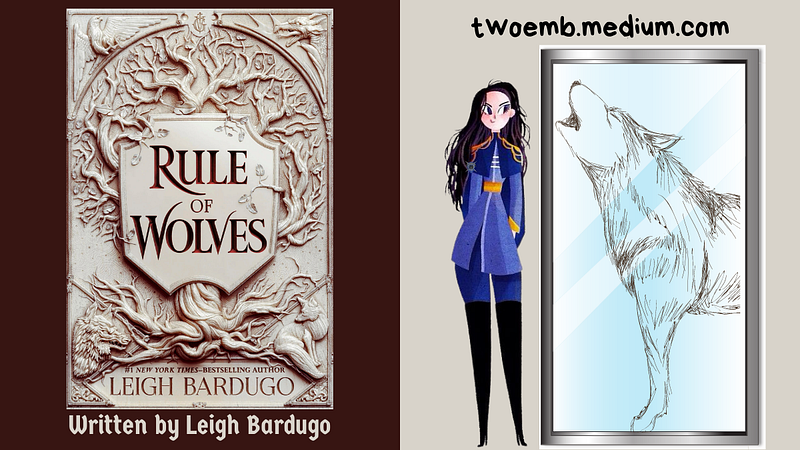
I recently wrote about how the Grisha in Leigh Bardugo’s novels are a lot like Neurodivergent people. I had been reading The King of Scars, the first in a duology. I am currently reading the second book, Rule of Wolves.
Despite these being fantasy-fiction novels, there are many parallels to real life.

Spoiler alert
The passage I will reference is near the end of the second book in the King of Scars duology, Rule of Wolves.
The revelation is not earth-shattering, and won’t spoil the book for anyone, but if you plan to read this book, you may want to wait and read this article later.
So, as I was saying…
Last night I was reading a passage wherein Zoya reveals to Nikolai she is Suli, an ethnic group which has been marginalized and oppressed in the city of Revka where they live.
Later, Nikolai asks Zoya why she had kept this a secret for so long, when she knows Nikolai would never think less of her based on her heritage or ethnicity.
Zoya agrees, but as Nikolai’s general, she oversees the commanders of his armies. Zoya has much authority and responsibility. She asks Nikolai if he really believes the commanders would treat her the same knowing she were Suli and not Ravkan.
Nikolai insists he would make sure of that, threatening to dismiss any commanders who would are defy her authority.
Given Zoya’s position offers her privilege and position, she is sure the commanders and their armies would not directly insult her or show blatant prejudice against her. Instead, they would engage in subtle racism, wounding her with micro-aggressions rather than overt bigotry.
“They don’t come at you with hate. They come at you with pity. I passed because it was safer…” — Zoya Nazyalenski (in Rule of Wolves, by Leigh Bardugo)
Safety in passing
This is how many neurodivergent people feel when they mask their traits in an attempt to blend in to the neurotypical majority.
For many neurodivergent people, especially those who are already part of a marginalized racial or ethnic group, marginalized genders, etc., masking is a mater of keeping themselves safe.
This is especially true when under duress. A person who is both visibly disabled and a visible minority can be in great danger if they behave in a way perceived as threatening in public.
Ableism and racism make people assume someone who is neurodivergent, disabled, and a visible minority is threatening simply by existing in the first place. The disabled person’s actions will be seen through a racist lens, as onlookers’ prejudgements lead them to attribute the worst possible intentions to otherwise neutral behaviours.
“When feeling distressed, the person must not appear distressed… the costs for not passing can be quite high… Passing serves as a mechanism to police and erase disabled people’s identity as disabled.” — Jennifer Natalya Fink
It’s not only that we mask as a matter of self-preservation, it’s a societal and cultural expectation that we mask in order to behave “appropriately” in public. Even when a behaviour is completely harmless, if it is seen as “weird” or unseemly, then we are judged and looked down upon.
This expectation that we hide our disabilities or differences as much as possible amounts to a nullification of our identity. Our differences are a very important part of who we are, being expected to suppress the very essence of our beings is akin to having our entire existence ignored and denied.
Plausible deniability
Micro-aggressions are hurtful enough to make an impact, but subtle enough to offer plausible deniability.
“They don’t make it easy to fight them,” Zoya continued.
Micro-aggressions are a double-edged sword. They’re hurtful enough to make an impact, but subtle enough they give the speaker (or writer) plausible deniability.
“I was just kidding,” they might say, “you needn’t be so sensitive, don’t you have a sense of humour?”
Sure I do, I just find wit much funnier than ableist bullshit.
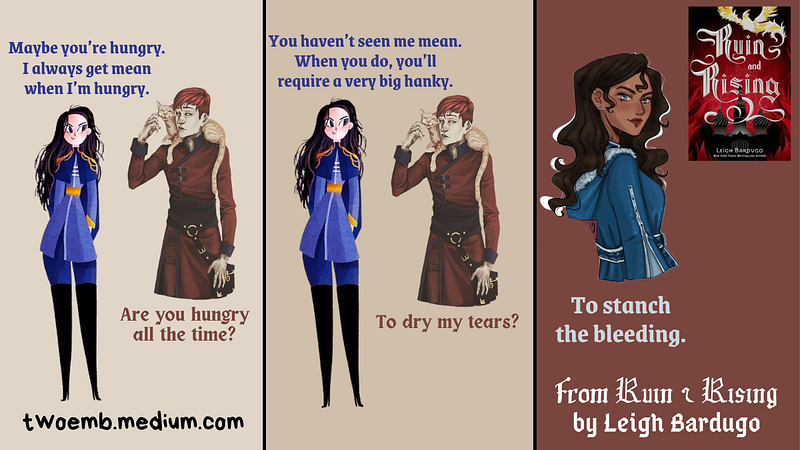
“Maybe you’re hungry. I always get mean when I’m hungry.” — “Are you hungry all the time?” “You haven’t seen me mean. When you do, you’ll require a very big hanky.” — “To dry my tears?” “To stanch the bleeding.” — Zoya Nazyalenski (in Ruin & Rising, by Leigh Bardugo)
© Jillian Enright, Neurodiversity MB

When you join medium, as a member you’ll have access to unlimited reads for only $5 per month. If you use my referral link, I’ll earn a small commission, and you’ll earn my undying gratitude.
Related Stories
References
Bardugo, L. (2021). Rule of Wolves. Orion.
Bardugo, L. (2019). King of Scars. Imprint.
Bardugo, L. (2016). Crooked Kingdom. Orion.
Bardugo, L. (2015). Six of Crows. Henry Holt & Company.
Fink, J. N. (2022). All Our Families: Disability lineage and the future of kinship. Beacon Press.


