
ADDICTION UNCOVERED
Addiction: Possible Solutions
Our Society: Addiction and More Uncovered Ch 49

Solutions are not easy.
Cucumbers and squashes are most of the time easy to grow. Just like kids, most of the time there is no problem. Cucumber and squash are very healthy for people, it grows, it grows many people pick them, eat them raw or cook them, and make them into a salad. It makes a cheap healthy food option. Normally, that is, plant the seed, and water, and pick the vegetable.
That does not happen all the time. Moving to a new area about 5 years ago and trying to grow cucumbers, squashes, and zucchini that normally grows crazy, the vines did grow crazy, but as soon a little squash appeared when it was less than an inch it started to rot. The garden is not huge, and the vines took up a lot of space with no results. It was not a good environment or not the right seed. Genetics gives us a predisposition to things those are the seeds that we come with as a person. Then the environment, like the soil, rain, sun for the squash, housing social-economic status, parents, food, education, support, and love for a child.
Then we all get what we get. For me, it took 4 years to be able to create a change for my squash and cucumbers to be happy. And it was not just me. I gave up and gave seeds to a friend who started to grow them in her greenhouse, then another friend mentioned she grows her mini squashes climbing up instead on the ground. My friend asked me every time if I want to take and try some cucumbers and squashes after all they are my babies, my seeds. I said no many times before deciding ok. One more time will try this new method. Just took a few plants, created strings, and trained the vine to go up instead of on the ground. Watered, watched. The vine grew. Then cucumbers and squashes appeared. A lot of them. And they were happy. It took others to care, it to me to keep being open and try, and it took my friend to keep encouraging me when I was ready to give up. Kids need the right environment to become happy, healthy adults and not to turn to drugs and alcohol or games or to any other addictions to be happy, just like my squashes and cucumbers. Still, when they are in trouble a child, youth, or an adult person needs someone to get that string and help train the vine to go up and stand in the right direction instead of laying down and rotting on the ground.
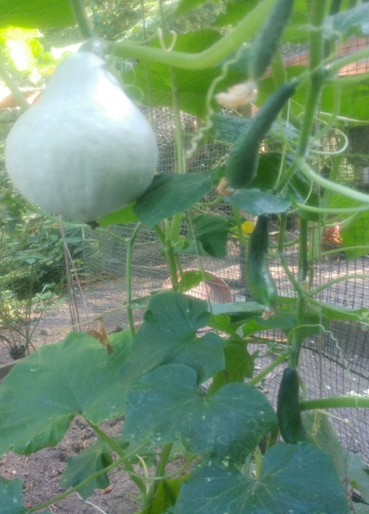
One of my squash become a 16.3 lb. giant. The biggest squash I had ever grown.
What could be possible solutions for addiction?
There are so many problems embedded in our society. Can we fix some of those issues? Could we tilt the scale? Can we create a more positive and caring world? Education? Training? Free care?
Kayla told me she thinks it takes a multi-dimensional approach to treat addiction. Nutrition is one of them, it will help us feel better. We want people to care about what they put in their body said, Kayla.
If they learn to care, then they might decide not to put drugs like cocaine in their body anymore. Beth believes in education, education, education. She is always about education. Getting the word out there, through advertisement, radio, education, and billboard signs. Education and support. Do not enable the person who is addicted.
AA, NA, ALNON, provide resources and maybe create something new, a more up-to-date group, a more modern group, a group for tomorrow. More resources and get people there.
Beth was asking me: how do you get people there? It is only once a week. Not enough.
More advertisements where the meetings are so they can be found easier could be one solution that Beth recommends. Fewer pot shops she said. Educate in grade school on what is right and wrong to put in our bodies.
Would more education help? Would fewer pot shops help?
Exactly what type of education and whom to educate? Addicts? Their family?
People before they become addicted?
Youth? Parents before they become parents?
Sheila describes that having people to talk to has been helpful for her. People who are friends or dealing with similar issues and are non-judgmental, understanding how others feel. They won’t put others down if they fail and have to restart the recovery process. Treatment. Beth told a story where we can see treatment can help, it helped her husband. It was too late for her brother, unfortunately. She emphasized to me that she will not support the habit of addiction and she made this clear to her nephew. Beth does not believe in relapse. She puts it this way: Relapse is just another excuse to die.
“I do not believe in relapse. Period. I had made it clear to my husband and I made it clear to my nephew. I do not believe in it. Relapse is just another excuse to use and another excuse to die”. — Beth
When Beth went into treatment with her nephew a counselor told her it is ok to relapse. She got really upset. Shae said: “do you realize that this kid is using heroin?” It’s not ok. Talking to Beth was emotional. She felt that with relapse her husband and her nephew could die the same way her brother died. In her mind she decided this is not ok, it cannot happen. Beth believes we need more mental health and education in schools about addictions. When I asked Beth what one thing she would change, she would make it that Narcan be more easily available. She was a little unsure, if it would be a good thing or not. She feels that if Narcan would have been available for her brother he could have lived. It could have saved her brother. Beth emphasizes that no matter who the person is or where they go, they will know somebody with addiction. She was wondering if drugs would be harder to get would that help, if alcohol costs more maybe. Getting to the root of the cause and dealing with the disease.
Beth believes that the best thing to do is to be educated about addiction. Also, talk with our children. Talk to them about peer pressure.
“Own your own mind”- Beth
Even if someone could do drugs it does not mean that they should. Be mindful of the mind and what other things using substances can cause. Think about the money that can be saved. Beth likes the security of money. She grew up poor. Beth once tried to tell a patient how much money he could save by stopping smoking. The patient got very angry; she does not do this anymore. The patient was very mad at her. When we get stressed out:
“Count backward, take a walk, try mediation, try other things, other coping mechanisms before you have that cigarette or drink alcohol next time”. — Beth
Beth stresses the importance of adequate education, more addiction treatment services, and more information out there. She was uncertain if it is even possible, maybe educate young people. The next generation. Live by example, set a good example. Spreading the word, start a conversation. She said:” buy this book and share a story”. Education is a huge part of prevention, intervention, and understanding of addictions, their causes, and learning coping skills.
I asked Mary what she thinks a solution could be, and she laughed and said, well abolish capitalism. Wonderful changes are happening in the world regarding LGBTQ populations and being more open. Mary describes other movements like black life matters and Me-too movements, she feels that the more that people feel empowered and say this is enough. The more people are willing to collaborate and talk about hard things, reducing shame and support self-regulate one and other, connection, collaboration. Meet people where they are at. Some people might want to use the harm reduction model, then support them, and offer people opportunities for hope. Rehabilitation while learning skills and being with other people like working on a farm, while rebuilding the mind and body. Learning people’s capabilities to reconnect to one other and our earth were some ideas we talked about. Even if someone might not be able to do farming, they can find some way to build connections. Help other people like a peer support model. We are a social species we need these things to prevent suffering she adds.
There is hope if we can continue to support a movement of connection and collaboration between human beings and fight against separation and oppression.
Mary feels like addiction is a disease of lost hope, it is a disease of despair so showing a way to people that they can somehow contribute provides hope and maybe creates a willingness to change and have a purpose.
Edward described genetics testing as a possible solution and letting people know that they have a genetic predisposition to addiction.
Education about avoiding certain chemicals. Edward also suggests that doctors need to know this information as well. It might help subscribe to fewer opioids and prescribe pain killers differently. He feels that maybe we can do a little and can’t solve a problem. It is not an easy situation. Working on the prevention of any disease is the key. Once the disease is there, we can work on the treatment options. It is much more difficult to cure something as complex as addiction, would be better to prevent it. Addiction is so widespread; that we have to work on both prevention and treatment. Looking at the genetic predisposition could be a preventative method just like we use it for any other diseases like cancer.
Edward also describes just being supportive of people who are trying to be sober from alcohol. If they don’t want to drink don’t ask why, just let it be and respect their decision. I asked Edward what he would personally do if he meets someone dealing with addiction and what would he recommend for them. He thought professional counseling would be the way to go. Have a clinical intervention, and let the professionals decide what is the best.
I asked Dr. Tedd Levin what he thinks we can do to prevent addiction. He said it is a great question and a very difficult question. He describes programs like AA and NA as being there to prevent relapse, not to prevent addiction.
Dr. Levin feels that we would need a lot more education in the school system, peer group support, targeting people according to risk factors, make it a routine for preventative health maintenance.
One of the problems is the dysfunctional health care system where the doctors are rushed. I have heard this from multiple people. Fifteen minutes is not enough to address major problems. Why is the big rush? Is it just to make money? Could health care providers see fewer patients and spend more time?
Talking to Angel she felt that coping skills should be thought to kids from preschool.
The first 3 years of life are when kids develop the social and emotional skills that help them to be healthy people. It has to start at the very beginning. Angel feels that as a parent we have to empower our kids to feel things, figure out things, have the power to know that they can fix things, and every tiny experience can help. She gives an example when a mother was trying to fix a seat belt for her 14-year-old son in a go-cart. Angel told him to let him be he will figure it out. It might seem small, but the only way kids will learn, parents want to provide guidance and they cannot be there all the time to teach kids how they can figure things out. Empower children, so they can be strong in the world and they can believe in themselves. Be there as a safety net of course. Sometimes they have to fail, which can be difficult to see as a parent. Angel asserts it is ok to fail sometimes. This is how they learn. This will create the power to get up and start over again.
Empower our children, so they can get up on their own when they fall. Life is going to knock you down and make you start over again, that is just the way it is. — Angel
Life can throw people down a path that they had no idea how and where they will end up. People have to have the strength and ability to get through tough times. Angel believes that all parents generally want their kids to be happy and healthy. They might not think that how their current action might affect their kids as adults. Treatment is not accessible for people who do not have insurance or money, in a rural county it is very difficult to get help. — asserts Angel.
Make treatment affordable and available to people regardless of where they live.
Stop blaming, not helpful. Teach kids that it is ok to struggle sometimes, not everything will be great all the time. Work on removing the stigma from mental health conditions like bipolar, anxiety, or depression for example. People should not have to hide their mental health issues from other people. Ultimately, there is a lot we need to do and a lot we can do.
What is it that we can do? I asked. Having conversations, she said, having conversations like this is the first step.
Make ourselves a little vulnerable, and uncomfortable, and volunteer, supporting people and organizations that are doing good work.
Putting pressure on our politicians: “this has to be a priority and we need to take care of each other”. — Angel.
Engage and talk about addictions. Help whatever the help looks like. Stop kicking the can down the road thinking that someone else will fix this, it is not going to happen. Teach our kids how to be healthy, how to eat healthily, and how to take care of themselves because the body is one big interconnected system. Be empathetic and just be there for those people who are dealing with addictions. Let them know that people are there for them. Don’t blame me, nobody makes this choice. Help each other makes us better as people.
Paige thinks we need more mental health services to be available. Services should be quicker when people are ready. Have counseling available. Paige feels that time laps make people feel like they are not worthy. Keep talking to kids, keep telling them real stories. Not just one story, but many. Stories will tell kids that even people who were stubborn and thought they were super strong got taken by the drugs. Tell them how it started. She feels the stories could tell kids don’t even try it does not worth it. There might not be a simple fix, but need to have more discussion about addiction. Telling stories can be very powerful.
Giving examples of what happened to others can send a message to watch out, be careful, don’t try to fit in by using substances it is not worth it.
Chief Jason felt that having more readily available treatment options for any type of addiction is very important. Additionally, supporting people, not judging people, and having the understanding that addiction is a sickness. Find the humanity inside, separate their actions from being who they are. People with addiction might do horrible things like stealing, robbery, or assault. They are also someone’s daughter, son, family, or friend. They are controlled by the addiction no matter what type of addiction it is. Jason mentioned gambling, alcohol, and drugs.
Chief Jason stated: “treat the beast that is inside them, that is not who they are”.
Do not feed into it. He saw that sometimes families either ignore what is going on or are enabling by giving money to their loved one who is dealing with addiction. He cautions families not to fall for lies when their loved one said they need it for food it is probably not for food but to buy drugs or alcohol. Jason recommends that if a family member is asking for money buy them what they need or go with them to the store. This is what he did with his mom. Then families will know that they are buying food or hygiene items for example.
Create support by strengthening education, building stronger families, building stronger influences at the schools, and teachers paying more attention to things going on behind the scenes.
Kayla described solutions that can include enough mental health care providers whom people can go and talk to, and having more education and awareness about addictions. Have healthcare. Urgent care for mental health and addictions so people can go and talk to someone if they need to talk to someone. Kayla also felt that there is not as much information out there as there should be about where people can go if they need help. She does not know about the resources, and if she does not then maybe others do not know the resources as well.
Rory compares solutions to a measles outbreak, even if it is deadly there are still people who do not vaccinate.
Even with evidence that there is no risk, there are people who don’t vaccinate, and their kids get sick and die. He feels we are not going to change people’s minds. He said quite frankly we are not. He describes the family culture of use that goes back generations. He describes people’s parents as heavy drinkers for example. It is just what they do. It is very hard to change these cultural norms. He brings up smoking as an example as not a lot of success because now the young generation just uses a new product. Honestly, he feels that these things just live on an assigned wave, they peak then go down, peak, and go down again. Maybe try to get messages out ahead of time before the next peak, he did also feel that he does not have any answers.
Is there a solution? Do we just let it be? Is it just part of a cycle? What about other diseases? Do we just let them be?
Rory feels that we should just do what feels right no matter what it is. If it is the just say no campaign or the DARE to be off drugs, good. Whatever it is. He describes an experience when he was working on the AIDS project. Trying to convince people to use condoms.
He said: “just put a baggie on it”.
They would not do it. For lots of reasons he said, and he had to respect that, had to respect their choice. We had a conversation about at what point it is someone’s choice and at what point it is not because the “brain is hijacked” by drugs or alcohol. It is very fluid and changes Rory’s feelings. A complex issue for sure. No simple solution but it is certainly interesting what different people come up with. Maybe we can all find solutions together. It is certainly not a one size fits all problem. We are all unique individuals with a unique set of issues and pasts. There is no golden ticket.
Tracy felt that education is key.
Education at an early age. Having resources out there. The person also needs to want help. Tracy does not think we can help someone who does not want the help. Have places where people can get help with addictions. Make it accessible, and affordable. It is not affordable now- asserts Tracy. Tracy has clients who would like to get help, and their insurance does not cover the help they need. Making help more accessible and friendly for moms and families. Tracy brings up the example of where would the children go if mom needs to go to treatment? Sometimes there is no other family member who can take care of the kids. There might be programs now, and still, it does not look at how the whole family is affected by the addiction. Tracy gives examples of parents going into treatment and how that affects the children, grandchildren, and spouses. Having a system out there that is more supportive for a whole family unit would be helpful. Housing for recovery where families can stay, and therapy that is built-in. Help people get connected to jobs. There are some programs like that out there, but not many.
Diana feels like people need more programs where they can go by choice. Allow people to talk about their addiction, and listen to them. Sometimes the law is the only way. Having trained people to help with addictions. I asked Diana if she could make one change to help people with addiction what it would be. She said to start with the drug companies. Restrict who they are selling to and what they are selling. Diana feels that the schools need to talk more in their health classes about what drug addiction is, how to prevent it, and be upfront with the kids. Don’t circle it. In the end,
Diana said: “We basically all need to take care of ourselves”.
It helps if people have the tools to do so if there are family and friends who support the person dealing with addiction. If someone is already deep in addiction this can be hard because the brain just not working right. Chloe feels we can only help people if they want to be helped. Some people don’t want help, they want to keep their addiction. If someone does want to stop, help them or guide them toward support. She gives examples of being there for someone and clearing their house from alcohol. Allow the public to have better facilities for treatment of addictions, and easy access to reach out when they need help.
Joel talks about finding out the vulnerability that is causing the need for people to turn toward addictions and have a multitude of approaches for prevention and support.
What are the stressors, that are helping people to decide to use substances?
Joel thinks our culture is very fractured and we need to find out the causes that drive people to hide out in a video room or use alcohol or drugs to feel better. Joel feels that maybe admission is the first step and the recognition that whatever it is the cause it is making people turn to unhealthy ways to try to feel better.
Provide universal health care of course she adds. It is a right; it should not be based on how much money we make. Fundamental right.
Joel also talks about advertising and how when companies are trying to sell something gets into our brains that now we think we need to have this thing whatever it is. We don’t need all those things that are advertised to us and we might think we need them. Then our conversation ventured to trees, planting more trees instead of cutting them down. Trees, especially evergreens produce a calming chemical for our brains. Spending time around nature and trees can be very helpful to create a balance in life. Creating quiet spaces where there is no constant buzzing in our environment.
Janett likes to be proud of the fact that she made a conscious choice not to do what her mother or grandmother did. She had the opportunity. She describes herself as lucky, maybe she did not get the addiction gene. She was very aware of where substances could lead her, and she worked very hard not to go down that road. Janett only drinks if the occasion is very special, it is difficult or awkward sometimes for Janett and her mom to go to parties where there is alcohol, and everybody is drinking. She describes people bringing a bottle of wine when they moved into their new house. Then what we do when we end up with 5 bottles of wine for our housewarming party and we don’t drink. She brought it up that I asked her about her dietary restrictions before bringing something to her house.
Others don’t and people just think it is ok with everyone to bring wine. Well, it is not. Not to any house or place where anyone struggled with addiction before.
One solution can be is just to be mindful of others, and be mindful of what we take to someone’s house. Ask before. Try to bring something healthy.
Something that everyone would want to eat, drink or feed children with. Janett recalled her wedding and other weddings where they just have champagne for the toast, and they don’t have anything else. She instructed people at her wedding to put 2–3glassess of sparkling apple ciders on the tray too, it did not happen of course. They did not do what she wanted. She was 3 months pregnant and not drinking and they gave her champagne. She asked them for the sparkling cider, but they did not bring any out. She tells the story to illustrate that things like this happen all the time. No other thing is offered in an event just alcohol. She made sure at her brother’s wedding they had a sparkling cider for her mom so she can have a toast.
Bernadette thinks teaching emotional intelligence at schools with coping skills can help.
Having more social workers, nutritious food, and yoga classes in schools to support the next generation. Bernadette does feel hopeless around this topic of addictions. Uncertain what could be the right solution. Here is so much that we can’t control. Can’t control what people do at home. She feels many people do not want to get better. Providing safe jobs, and safe and affordable childcare for women could help. Support parents better. After my magic wand discussion with Chelsea, some laughter, she asserts this is not realistic she feels.
Stopping drugs, and changing brain chemistry and genetics would be her wish.
Making education and mental health more part of daily life not something that is weird and has to go seek it out.
Bill feels the need for affordable housing.
He had met people who are struggling to get on their feet and had no options for housing. He does not want to be in the housing business. He still does want to help people in this need. He gave me an example of a carpenter who lost everything because of addictions, except his truck and tools, now he is better he got his job back. He does not have stable housing. He feels like housing is the natural next step for this person to feel like a contributing part of society and have his self-esteem back. He tells me we all have to look at ourselves and see what is it that we can do to help. He wishes he could offer more than what he can now. He feels that when it comes to people who are on the streets begging give or don’t give it is up to each individual. If someone does not want to give or can’t then treat that person with respect and at least say hello, and wish them a good day.
Give respect, a smile or wave, whatever we can give. Give the gift of respect. He talks about hospitality. Just be kind. If someone can buy a breakfast sandwich for somebody who needs it, does it. Without strings attached.
Albert feels that making possession of drugs a felony does not help. Oregon is better, they did change the law most single-dose drug possession is not a felony, or at least not at the first time. It can become eventually. He feels that stigma follows people for a long time and it makes it hard for people to get jobs. Once someone is a felon, they cannot get certain jobs, can’t get into certain apartments, can’t get into schools, hunting, fishing things people like to do, it can mess with people. It can stigmatize them and kick them out of society. Keep them on the edge of society. Sometimes people can get felonies removed, it is depending on what was the charge.
Usually, a person has to have 3 to 10 years of staying out of trouble, and sober time before a felony can be removed. Albert feels this creates hopelessness, why even try? There has been in some progress making drug possession misdemeanors or making them less prosecutable for certain possession crimes, he feels that we should do more of that. The felony tag hurts people a lot.
Brenda thinks education can help. Reaching kids early in elementary and middle school. Before the drugs reach the kids. Helping them understand the choices they might be faced with.
Helping kids understand how quickly they can become addicted to substances whether that is including meth or alcohol for example. Reaching out and teaching kids how to cope with anxiety in life. Now, Brenda tells me kids get out of school and have no coping skills. It is easy for them to fall into drugs and addictions to cope and get some life satisfaction. Brenda grew up in California in the San Diego area the police went out to elementary schools and talked to kids about saying no to drugs, this could be one element that could help. Health care workers, people well known in the community, and the movie starts need to pick up the prevention piece and support their community. Maybe it can be done in community forums. There is a lack of funding, maybe through grants.
Thinking out of a box with new ideas.
We need to go out of the box on this one and use every tool we have in a box as well as invent new ones to prevent addiction and help those who are already addicted. In her community, if Brenda would have a magic wand, she would collaborate with people including businesses build a small collaboration, and brainstorm how we can get this message best received in the schools and start with the elementary schools. Go out do programs, and small giveaways, help kids understand that it is positive to be drug-free, fill them with positive things, and teach them how to say no and deal with their emotions. It needs to start young Brenda asserts because by junior high or high school they already have to make that choice. Brenda feels that if they are not taught how to say know they will just fall right into it. Not giving up on people. Build connections and support around people. People might fail but is important to be there and support them, so they keep coming back. Providing persistent support for them.
Bob feels like education could be helpful for people to learn more about addiction prevention.
I asked him where he would see it if the education existed. He felt there could be marketing and events, organized series of events to interest people, incentivize people, and make it like a social thing. What a good incentive would be. He thinks for a while. Then he said maybe just the event itself, maybe it could be something like a concert, a place people would want to go. Work the education into the event.
There is a stigma about addictions. Need to get people to want to go and do something find a compelling reason to want to go and get informed. Were he would advertise it? Social media, snap chat he adds.
Please let me know what you think would be possible solutions when it comes to addiction?
Previous chapters of Addiction Recovery can be found here
More about Gabriella
If you like my writing please follow me here, Subscribe to the Medium platform using my link here, Buy me a coffee here . My Books are available on my website here, Amazon here and on Barnes and Nobles here, Draft2Digital here
This book is dedicated to the memory of Bagóczky József my uncle who died at age 19 — alcohol-related car accident and to everyone else who has been hurt or lost related to addiction
Many people had been supportive and inspiring to me so I could create this book. Both of my wonderful children told me, just write that book, mom. My mom. I could have not done this without all the stories provided and the encouragement love and caring from my family and friends, nurses, doctors, counselors, teachers, professors, friends who are dealing with addiction and staying sober; and children, wives, husbands, mothers, fathers, sisters, brothers of people who are dealing with addiction currently. Thank you for speaking up, sharing your stories and life experiences. Thank you to all the people who read this book while in progress to provide feedback, ideas, and encouragement for me to continue writing. I would like to say special thanks to my friends and family for believing me and encouraging me to go on.
Our Society: Addiction and More Uncovered. Hear the voices of everyday people — a collection of stories and experiences.
Copyright @ 2020. 1st addition on Amazon KDP. 2nd addition Jan 2021 Barnes & Noble. Gumroad December 2021. By Dr. Gabriella Kőrösi. All rights reserved. Dancing Elephants Press.