
ADDICTION UNCOVERED
Addiction Explored. An Impactful Story From Violet: A View From A Mental Health Provider
Our Society: Addiction and More Uncovered Ch 31
Violet and I talk on a phone for about an hour and a half. Violet is a provider in mental health. She has some wonderful experiences in the mental health field. We discuss struggles in rural mental health. She shares some stories about her family. Addiction runs through Violet’s family.
Violet’s grandfather was an awesome man when he was sober which was about 10% of the time. He was very violent at other times, there was a lot of domestic violence in the home, a lot of poverty, a lot of emotional and sexual abuse. It was all related to alcohol use. Home was never a safe place and there was a lot of trauma. Violet asked her mom if it was so bad why didn’t they just leave? Her mom looked her and laughed.
Violet:” you don’t understand this was the 1950’s in America”.
Nobody could leave, women could not hold a credit card, women could not own land, could not get an education beyond high school, if they did work the jobs being available were to be a teacher a nurse or working in a shop. Women were home and took care of the family. They did try to leave. They went to the neighbors, he hurt all of them, then they went to family, he hurt all of them. Then they went to the church and he hurt the preacher.
There were no laws against domestic violence, women were pretty much property. They could not get help, there wasn’t public assistance there were no shelters. They were stuck. Violet’s mom was adamant about telling her that there is alcoholism in her genes and don’t test those waters. It is there. She did test those waters through college. Now she would occasionally have one or two drinks, she knows not to have more.
She had training in mental health and in her master’s program in their addiction course the teacher was begging the students to please work in addictions even if it was just in their internship. The teacher wanted them to see how much addiction and mental health intertwined. Violet added anything to the addiction list that is maladaptive including gambling and sex addiction. She got trained in seeking safety which is a dual diagnosis program. It is a beautiful program, she adds. It talks about trauma and the addiction and the cycle it comes with it. If someone had trauma and uses addiction to cover it up, they are more likely to be traumatized again.
Nine out of ten times law enforcement is involved when there is a physical altercation or sexual violence including alcohol. Violet’s first job in Utah was working with co-occurring disorders. She learned more there than anywhere else in her career. When Violet did her first group and listened to stories that people were telling her she realized that the only difference between them and her is that they got caught. She had 2–3 drinks before and got behind the wheel. It could have been her.
A jail commander told her that people can drive 200 times drunk on average before they get caught. Even if someone got behind the wheel once drunk it could have been them who got incarcerated, got the legal charges against them, that ended up with a felony. Violet has her private practice now.
She worked with clients who have difficulties because they are required to work, do probation, do UAs. They can’t drive, and things are far from each other and it puts them into an impossible situation especially if they are on parole in more than one county. Violet feels that there is much shame and judgement and disparity in our criminal justice system around substance use. It would be nice to simplify things for people who just made one mistake to help with all the hoops they have to jump through.
There is a difference between a person who just has one DUI and one who had many she adds. Failing can create more stress and lead to more drinking. Violet feels that substance abuse is a symptom, it is how people are trying to function and manage things. It is a coping skill. Not a good one. Many times, the only one people have. It becomes the matter of finding someone a better crutch then the one they had before. We cannot just take the crutch away she adds, people will fall. People need a comprehensive recovery map.
She tells me a metaphor: the ditches on the side of the road and the roads themselves can be dangerous and people need to know what to watch out for. This way people can be more prepared for their life and what it brings to them. Some of the addictions are related to intergenerational substance abuse. Violet’s grandfather’s grandfather also was a drunk. Things get passed through time including the good things, and the challenging ones. In her master program the same professor who was telling them to work in the addiction field told them that not everyone has the same expectation about life.
Some people are thought by their families that they are going to graduate from high school and go on and get a degree and do something meaningful, save money, and others were thought that we go to prison and fight the system or use substances to manage the stress in life. Having law enforcement and CPS in their lives regularly is just what happens in their lives. Violet adds that if we could all acknowledge that that we don’t all get the same upbringing that our culture, our background and our generational differences play a part then we can start to look at what we want to change.
Violet also worked with Native Alaskan populations for about 15 years. She tells me this was more “proof in the pudding” that when people get targeted, labeled, alienated, abused, displaced and come away from the goodness and the fabric of their cultures and families things get more challenging and people tend to move toward addictions. Providing culturally appropriate and meaningful care is profoundly important. She became really aware of the disparity in care that was available. This also goes for other areas as well especially in rural communities. She tells me if someone needs mental health services it might or might not be there. If a person needs substance abuse services insurance may or may not cover it.
People need to choose what to: do they move to a new place, leave home, family, job so they can get treatment then come back to the same environment or do they sit tight and stay under the thumb of addiction, legal issues and crime. Violet describes that part of her work became transferring skills and identifying areas in people’s lives that are working. It is not all a loss even with substance abuse.
“Man, if you deal drugs you got some serious skills”.
Including building a community, networking, math, understand timing of business and organization and if someone can transfer all these skills to something healthier, legal, more productive they don’t have to start over. They can use their life experiences and build on them. Great examples of this are some of the stories in this book including Kevin’s and Doug’s story. They worked hard and turned their lives around. Don’t throw the baby out with the bathwater so to speak she adds. People make mistakes and they can pull from it.
Learn from it, be resilient and move forward in a meaningful way. Violet recommends the work of Brené Brown on shame and vulnerability. In substance use shame is a huge piece. “you are an addict, you are a felon you are a criminal, you are an abuser” — all these labels that we can slap on people who are having problems creates shame that attacks the identity of the person — Violet adds. It hits people in their core, it makes them feel stuck and they don’t know how they can change now.
Violet’s advice: Instead of I am a mistake have a healthy sense of guilt that I made a mistake.
She tells me about the separation of people feeling that they made a choice that was a mistake versus the feeling that they are the mistake. Violet tells me more about Brené Brown’s work and positive thoughts instead of societal judgment. Lot of this sound familiar to the findings that are collected in this book based on people’s stories and experiences. Judgement is a huge piece, and it is everywhere. If we could just stop judging people, right? Violet tells me about pieces of our lives and how we can pick them up and restore them despite of whatever mistakes we made. When she tells me this, I imagine a forest and some of the trees died and some of the trees are fallen down, some rotted as well, and there are new young trees growing and there are some bushes and old growth trees.
We are a forest of old and new growth and all of us have some pieces of our past that is not so green and not so beautiful. I had talked and met so many people in my life who had done some horrible things in their past and now they have beautiful pastures growing and young trees that are not just beautiful for themselves they also support others when their forest is in a dark place. Violet gives me an example of gambling and addiction and if someone loses all of their money. That can be looked upon as they made a mistake instead of them being a total failure and I am out of this friendship or relationship.
Violet had worked in the crisis system in the last decade. She had learned a lot about addiction and suicide. Shame can play a huge role in suicide. A lot of people who gamble end up killing themselves. People who are getting so many charges that they are feeling that life is over and end up killing themselves or attempting to kill themselves. There is a lot of life savings that can be done in treatment, she adds. Violet is passionate about saving lives and working hard to support people in need as a provider.
I ask Violet specifically about her experiences working in the Native American community. She shares some beautiful stories with me. She had seen how people can suffer when they are ripped away from their culture. She tells me about a young woman who was born with fetal alcohol spectrum disorder. In Alaska there is a big effort and movement to educate about FAS (Fetal Alcohol Syndrome) because there is a high rate of alcoholism. People use alcohol for coping skills for depression, darkness in a mal adoptive way. Some of it has to do with a lack of other options including treatment and meaningful activities.
In some places in rural Alaska the only options are something that has to do with a religion, which may or may not resonate with people. Another option was to go to a bar. It is a factor in a community and what people choose to do. There has been a huge focus on nature and having nature help the healing process. In Native American culture carving canoes, carving totem poles, painting them getting out and doing canoe journeys can be helpful. People used to canoe from village to village to trade, connect with others and to marry and intermingle. Water is a huge part of Alaskan living, getting out to fish, crab and berry picking. It is incredible there- she adds. She tells me how different that is from a city life where people may or may not see a tree or may or may not walk on grass.
“If people would just get back outside” — Violet adds.
This is a huge piece, the connection to each other as human beings, to nature, animals and plants in our environment.
Violet talks about blueberries, collect them all day, eat them while collecting them, then go home and make blueberry syrup and blueberry pie, blueberry muffins and blueberry pancakes and dry blueberry fruit leather and that keeps people busy. During winter when people are eating these things, they think about all the time they spent out in the field. Violet has been reading articles about this generation being called the inside generation because literally they are not accessing the outdoors. She tells me about Native Alaskan videogame that has the culture in it, it is beautiful it looks like an artistic movie. If it is there, the games she adds how we can make them that it would show our history and pride and it is meaningful.
Alaskan life is rich she adds, she had learned so much there. She had worked with one young woman who had FAS and was living with her mom who continued to drink alcohol after giving birth and made some challenging choices, some out of necessity, out of fear or just out of what is familiar. Familiar is not always good or healthy it is just what we know. It can in a false way feel safe. Familiar is not always safe she adds. Her mom would drink and would bring abusive men in the home and this young woman was molested by multiple of her mother’s partners. This young woman become profoundly angry and compulsive. She was a high risk for substance abuse because of the trauma and FAS disorder combination. It is all she known. She had multiple children with multiple fathers all of them being removed from the home a few weeks after being born. She had continued to perpetuate the domestic violence that she had known and experienced. It is one of those cycles that many others described during our conversations. Violet worked with her on impulse control and seeking safety.
Violet describes addiction as survival brain:” I don’t care about the consequences I want to feel better now”. Violet thought her a lot of very good breathing exercises. “If we breathe deeply, we are taking ourselves out of flight of flight response”. The brain measures threat from an actual threat to a perceived one by the amount of oxygen flowing through our blood stream. Violet gives me some examples of real threat like a tiger attack or perceived threat like stress from city traffic.
Violet recommends:
Simply learning deep breathing and taking 10 breaths with moving your belly in and out as you inhale and exhale you bring enough oxygen to your brain that it tingles. It is almost like a high. It tells the brain it was a false alarm, there is not really a threat. — Violet
Once people are relaxed, they can synthetize and make choices. They are out of the flight or fight zone of their brain. It allows people to see a big picture. Violet did education around this and provide practical tools around breathing. Build up coping mechanisms. Violet tells me that at first, she does not need to know what the trauma is the person had to help people develop healthy coping skills. The young women she worked with first focused on diet, exercise, nutrition, reconnecting with culture and art. She was phenomenal in beading. She beaded things that Violet’s jaw just dropped. Violet makes me laugh by saying she could not crochet a straight line to save her life. The things this young woman could make were beautiful ornaments, trinkets, key chains, wraps and the stiches and patterns were specific to her culture. She did this with a lot of pride.
Violet worked at the South Alaska Native consortium for health and that was a profound experience. They offered a sweat lodge, a talking circle, drum circles and a basket weaving group. Women could get together and talk about their coping while developing a very culturally important bonding with each other. They would take their woven baskets home as a reminder of the support system they have. They also did beautiful regalia that were specific to their clan. All these programs were already present when Violet was there, she did not create any of them she referred people to them. The young women got better, she got one of her 3 children back and now keeping her 4th child. The other 2 are staying with their father and it is a good, healthy thing she adds. She has her coping skills now; she draws on them when she needs them. She needed to find ways to cope. She cannot go to family for help and support. She lost weight, she got healthier.
Violet tells me it is possible to heal and not to lose hope.
“A big piece of recovery is reestablishing awareness and trust in our internal resources”.
A lot of people with addiction feel that they cannot trust themselves, they cannot trust their intuitions. If something does not work the sooner someone can admit it, the sooner they can change to do something that does work for them. Sometimes we shut that down because of what we are familiar with or what we have thought. Intuition tells us it does not feel good. She does not know why. She feels that it is just as a human being reaching for something else that feels better. Reawakening that personal drive for achievement and creative living. Choosing to draw on what is healthy and available and create something that people can do from there. It is not simple of course; true recovery is a lifetime event. Even addiction aside we all are recovering from quite a few things. We are recovering from our government failing us, from funding a programing not working, having too much plastic in our environment.
Humanity tries to create solutions for things. Plastic cups were created because we felt that we were destroying too many trees with paper ones. Sometimes we make errors trying to fix errors. If we can decrease the chaos and increase how connected we are within ourselves, we can make those active steps to make good things happen. Connections are lost many times in today’s society because our society is very individualistic. People get lost in it. It is too much. Violet feels that addiction means that people are trying the best they can with the resources they have at the time and with what they are familiar with to make sense of connecting with the world. Trying to feel safe and comfortable, happy, loved and connected. This came up over and over again through the crisis work that Violet had done. We can label people all we want, like they just want attention she adds.
She saw a post recently stating:
“if you shift your own label for a child from attention seeking to connection seeking- see how that impacts your perception”.
Things like that, she adds, blows her mind, the difference one-word can make. The power of our speech and thought. She feels this is profoundly important in our work.
Addiction is that:
” I got far away from myself or maybe I never even knew myself. I still wanted and deserve to be connected she adds. I will do this the best way I can”.
If people feel isolated and awkward, so much of addiction comes from wanting to fit in socially, to have a connection. Feeling of boredom, awkwardness and embarrassment. Violet had seen some very powerful movement with youth. She herself has a 14-year-old and thanks God that her child so far did not seek drugs for thrill or excitement. Finding more meaningful and fun things to do is important. She tells me about the adrenalin rushes available. If people have the means and they want to do skydiving, it is a big one.
Trying new experiences, surfing, horseback riding or any other experience that teaches the brain in a healthy way that fun can happen without substances. It does not have to be expensive; it could be a new hike in the forest. She feels that exercise is a big piece of that. When we use substances, it is because we just want to feel good.
All the natural endorphins that make us feel good get released through exercise.
Getting people engaged in physical activity and artistic pursuit and anything that is thrill seeking can all help. She tells me about a commercial that advertised beer for breakfast. She was appalled. Why are we teaching in public television that this is ok? Why do we even have alcohol and smoking, and vaping advertised in television? Why is there a cotton candy flavored vape? Who is that targeting?
Next, Violet tells me about the show Patriot Act on Netflix. The show highlights some of the discrepancies in society. There is one episode about related to opiates. It is so sickening she adds. The major company that created Oxycontin and ended up being slammed and fined for it also created Suboxone. Basically, they created the sickness, perpetuated it by getting doctors to prescribe even getting doctors things like lap dances. We discuss Suboxone and its own set of problems. Violet tells me about a family friend who lost his life. He used heroin. He got off of it, got on Suboxone, he quit the Suboxone abruptly, went back to the same dose of heroin he had initially used. He overdosed and died. It is so common for people to do that, she adds. It is an epidemic and she is glad that there is some funding, but the funding is not enough.
She tells me about Fentanyl. Now the same company who developed Fentanyl is working on a drug that is 10x stronger than Fentanyl. I wonder why on earth we need such a strong pain medication? Not enough people died already? Beyond any comprehension. It is horrifying Violet adds. We are seeing a wave of deaths with Fentanyl already, and people are not knowing they are getting it, or they know, and they are getting too much. Violet tells me that law enforcement has been touching Fentanyl without knowing and dying from it. She feels this profoundly affects people whether they are users or not. It impacts us.
Violet tells me about all the potential that is lost related to addiction. It leaves devastation. People don’t just lose their life. Each person had several loved ones, several different facets of life, people who knew them. A lot of people get affected.
Violet feels that addiction in a way is a commentary on money, power and influence. The more we can speak up about it, destigmatize addiction, make treatment programs readily available, accessible and understand the truth the better — she adds. The fact that with like the needle exchange just as many family people are driving up in their suburban vans as homeless people walking up.
She brings up her favorite topic and gives me the example of diabetes as many other people before. People with diabetes get their treatment simultaneously with counseling. Nobody tells them shame on them come back when they are ready to quit sugar. MD’s would lose their license if they do that. So why is it that with addiction we don’t to do the same? This is a disease; this is a struggle. It is not a choice. People still think addiction can be a choice. How about diabetes, is it a choice? Does somebody want to be a diabetic? I don’t think so. The same way nobody wants to be an addict. Yet, we don’t punish people eating sweets and cakes and becoming a diabetic.
Why are we punishing people who become an addict?
It is ridiculous she adds. She tells me the difference between people who get addicted. It is like if we were on a boat and we would sink, and some people had a life preserver that others didn’t. Then the people with the life preserver have a much better chance of living. Even if they get hypothermia probably, they are not going to die. On the other hand, she adds some don’t have a chance because they don’t have the protective factor in place. In this case the life support. Do not blame the person if they did not have the life vest. Someone can’t just say why did they get on the boat without life vest. People have to look at things from a different angle.
She jumps back to Fentanyl and asking the question: “why doctors are even prescribing it for anything more than terminal patients”. I do not know. It was never meant for anything else. Violet got a lot of training in Alaska for alternative therapies for pain instead of pain medications. She describes pain as something we can’t see or measure. Even a scale from 1–10 can be very different in accuracy for people.
Is 10 what people thinks now really the worse pain?
Is someone at the point that they cannot walk, and they must have a surgery and the doctors all agree and they are in the hospital?
If not, let’s not call it a 10. What is a 9, 8 or a 7?
How can people learn to cope for the next 20 minutes?
Tried alternative methods like walking, ice pack, and elevation?
Pain does exist, and it is also ok for some level of pain to be there. Violet feels that people can get very dramatic with pain. She feels very specific measuring tool is needed for pain with nonpharmacological interventions at first. This can also work for other things like depression, she adds. What can someone do for example in the next 20 minutes to feel better. She gives me an example how this scale could be used for addictions as well. She also tells me about harm reduction and the lesser of two evil sorts of speak. She does not care if somebody is playing a video game if they stopped taking opiates. Find what works and capitalize on that. Give ourselves credit even just making for the 20 minutes. Even if someone uses after 20 minutes, she adds, it is not a failure. They attempted a coping skill, they thought about it. It is a step into the right direction. It might be 40 minutes next time, or the person might smoke opiates and not inject it by IV. Good for the individual that they were able to do that instead. Giving people credit. Helping people to see small victories, she adds, because we can’t just say people are failures that does not take us anywhere.
A big piece of addiction and working through it is not setting people up to fail. Letting people know, they will not be going to get through all of this in a month, or 6 months. This is a lifestyle and a lifetime of finding to be present. Violet feels we get so far from being present. Very true. We try to look to the future or the past and compare things instead of focusing on the right here, right now. Violet quotes someone she used to work with, and they described addiction is an attempt to create a shortcut to enlightenment. Violet just thought that is it.
People want to feel Nirvana, want to feel peaceful and blissful and connected and aware and one with a universe. It is all have to do with love and connection. Instead of doing whatever that hard work is to create it we go for the quick fix. She tells me the example of food. She adds that she is so guilty of that. She had been in McDonalds in the last few weeks. Survival brain being hungry, angry or tired. We want to feel better right now, so we don’t care what we are putting in our body. We don’t think about that we just want to feel better. If we would start to normalize this and educate around it; it would be helpful.
Violet brings up the example to have an emotional intelligence class in high school. We need to start emotional intelligence classes before kindergarten and keep teaching more every year. There are so many people still today who I met, and they think that if another person in their life is angry or behaving a certain way it is about them not about the other person. We can’t control how others behave. We can only control how we behave. We need to arm kids with knowledge on emotions and how to control them and cope with them is a wonderful idea.
Violet tells me a study about hunger. The study looked at domestic violence perpetrators and about 78% of them had low blood sugar when they acted out, based on the answers. When we are hungry, we are going into a different part of our brain. This is where food comes in, she adds. If we are in a place where we don’t feel safe, we overeat. Back in the cavemen days people ate everything in site because they did not know when they get to food next, we still have this instinct today. Violet adds that this and flight or fight does not excuse the behavior, yet it is part of the puzzle, part of the explanation.
Part of therapy is how to get out of that fight and flight brain and make better decisions. Violet also does a lot of couple’s therapy. She tells people to check in with themselves are they irritable, tired or hungry? If they are, it is not a good time to have a conversation.
She brings up people who smoke.
Ask them: why do they smoke?
Is it to build connection and community it others?
Is it to have an excuse to take a break and go outside?
Is it just to do something?
She recommends people who smoke to create a new activity, not smoke during their break, instead take a breath through a straw, have a popsicle or blow bubbles. Do something else with their mouth instead of smoking to please their oral fixation. Get outside and take 20 deep breaths. Violet believes we can heal and fix a lot though doing things intentionally and meaningfully. She loves things like this, and she is highly passionate about this topic. Wanting to connect, wanting to feel love and wanting to find what works. Be in our brain and our body, then we can deal with what is making us anxious more effectively. She lets out a big sigh, then laughs. I love it. I love her passion and compassion toward others and her desire to help.
We discuss coping skills and emotional intelligence a little more. It is a big piece; it can be easily overwhelming, she adds. It is so big that when she looks at it sometimes, she gets overwhelmed and shut down. Then, she remembers a woman walking on a beach and throwing a sea star back to the water. A man walks by and asks her what she is doing. He added that there is so many, she cannot make a difference. She picks another one up, then another one. It made a difference for this one, she answers. Violet feels this is important when we talk about emotions and coping skills. Everything will be different for each person, each family, each location. Living rurally, in Washington is a challenge.
To get to a big city is 5-hour commitment. It is a challenge even for somebody in middle class. Violet looks at all resources for her clients including searching Facebook for ideas. She also looks at what had worked in other communities and how could she adopt that work locally. How can she connect a particular client to resources that are meaningful. Then, maybe that option could be a cookie cutter for someone else.
She used to work in Colorado to help with people who had mental health problems create independence in their lives. It was on the patient’s terms. They know what is meaningful for them. She had to make sure that this person’s home with a mental health disability was clean. She got there and the home was spotless. She told her client that her home is cleaner than Violet’s. Her client was so proud. Violet asked her how she did it. She shared that her last worker came every week and showed her how to do the cleaning and they did it for 3 years. Then she decided she liked how her house looked. Violet asked her what else she could help with since she did not needed help with cleaning. The next thing she wanted is to have a job, to have more money.
Violet asked her what she wanted to do. She wanted to sell Mary Kay makeup. Violet does not wear makeup. Violet did not think that she could do it. She did it. She made more money from makeup then what Violet made from being a case manager. She is still doing it today. Her story and determination impressed Violet so much. It was an example that anything is possible. She brings up vocational rehab that helps people trained if they have a mental health or substance abuse disorder. That program is invaluable, it is a success that the government created. When there is the right person they need to be connected with existing programs. Violet feels that:” When we connect with somebody, and they can work, their self-confidence gets better”. Violet always tells people about those available training resources. Violet likes to remind people that they always have something to give.
“Any ways that we can find that people can give back to the community form natural connections and boost confidence”- she adds.
Violet gives me some examples of the elderly and how many people who are older have no one to talk to. Volunteer to clean up a beach for example instead of watching TV, make a difference. We meet people and it can change our life. Supporting employment is also a great resource to help people who been out of work for awhile. Creating resources within each local community can be a great grassroot effort. We discuss trauma stewardship and that working in mental health and addiction is hard work. The average length people say in the field in 5 years, she adds. She feels that the trauma stewardship piece needs to be brought in more.
We are interacting and treating each other as professionals. If providers are not functioning well as a community, as a society, in a meaningful authentic way, then how can they even pretend to give people the help and support they deserve. How can we keep people in the field? Retention and treating each other in a meaningful trauma informed way is not just a problem in mental health. In many fields there are a lot of trauma. First responders for example. It could be in McDonalds or anywhere else. It is indiscriminate. It can be anywhere and can affect anyone.
I can hear her passion through the line. She adds we have to be there to catch the people who are falling. She is also passionate about how society can create a less traumatized environment. Keeping the checks and balances in place and remind each other appropriately when we are out of balance. Violet try to effect change. She would not stay with an organization that is not ethical and supportive of their clients and staff. It starts with each of us. Consciously choose to get out of flight and fight to be in a calm, creative, empathetic mindset.
Schedule time for ourselves. Take care of ourselves so that we can take care others. Self-care is very important. It is a constant checking in with ourselves instead of checking out.
Thank you for reading,
Gabriella
More addiction book chapters from Gabriella
If you like my writing please follow me here, Subscribe to the Medium platform here, Buy me a coffee here . My Books are available on my website here, Amazon here and on Barnes and Nobles here
This book is dedicated to the memory of Bagóczky József my uncle who died at age 19 — alcohol-related car accident and to everyone else who has been hurt or lost related to addiction
Many people had been supportive and inspiring to me so I could create this book. Both of my wonderful children told me, just write that book, mom. My mom. I could have not done this without all the stories provided and the encouragement love and caring from my family and friends, nurses, doctors, counselors, teachers, professors, friends who are dealing with addiction and staying sober; and children, wives, husbands, mothers, fathers, sisters, brothers of people who are dealing with addiction currently. Thank you for speaking up, sharing your stories and life experiences. Thank you to all the people who read this book while in progress to provide feedback, ideas, and encouragement for me to continue writing. I would like to say special thanks to my friends and family for believing me and encouraging me to go on.
Front cover acrylic painting created by Andrea Mihaly October 2019
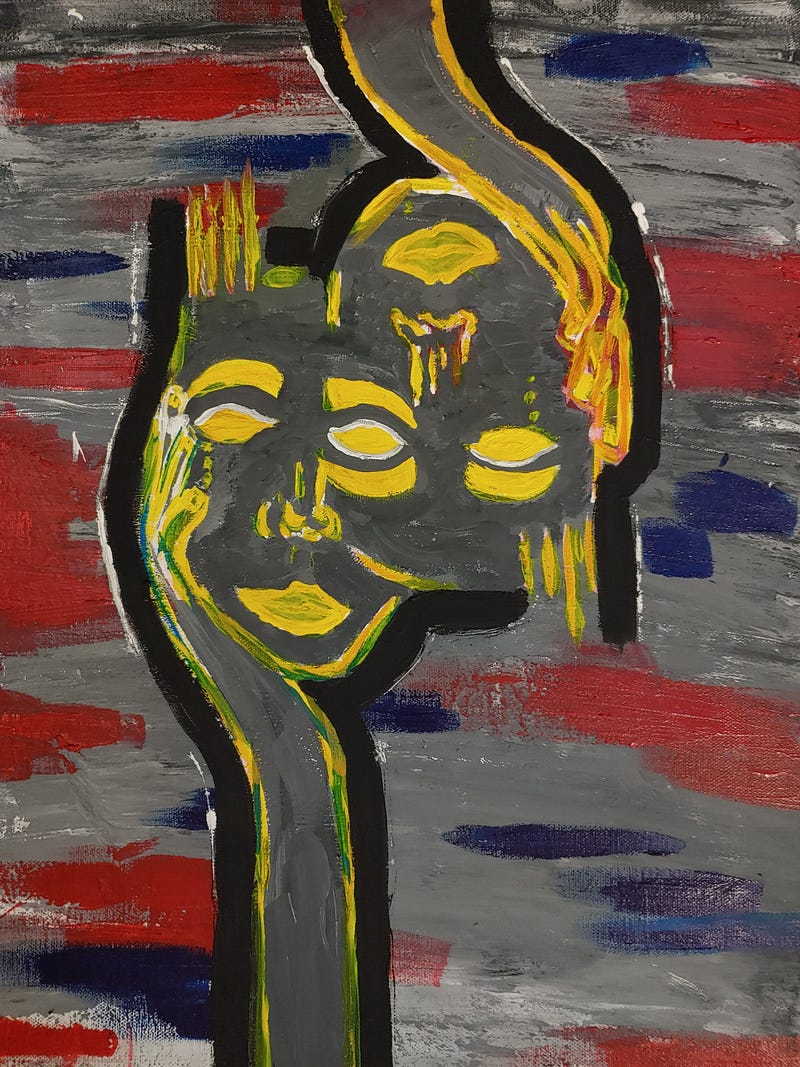
Our Society: Addiction and More Uncovered. Hear the voices of everyday people — a collection of stories and experiences.
Copyright @ 2020. 1st addition on Amazon KDP. 2nd addition Jan 2021 Barnes & Noble. Gumroad December 2021. By Dr. Gabriella Kőrösi. All rights reserved. Dancing Elephants Press.