
ADDICTION UNCOVERED
Addiction And The Individual’s Responsibility
Our Society: Addiction and More Uncovered Ch 33
What can we as individuals do to help people with addiction problems?
Sheila thinks that knowing resources that are easy and accessible would be helpful. Additionally, she describes that we can help people by making it easier to come for us to help. Being nonjudgmental When we are judgmental or just people who are dealing with addiction might think we are they are less likely to seek out help. We don’t judge people with heart disease or diabetes, we help them every time they come to the doctor, hospital, or cardiac rehab.
Shouldn’t be the same with addiction?
Beth describes that we need more role models, she told me to be a leader, be a role model for others. Don’t go out to drink. Beth describes that an important element is to set a good example for others to follow. Be honest.
Mary feels like individual responsibilities include taking care of ourselves, some might have more choices than others, or have limited choices. Self-reflection and thinking of who we are in this world.
Who do we want to be in this world and how do we want to be in this world?
Mary describes if our basic needs are not met it is very hard to think beyond that. Edward states that individual responsibilities by not being greedy. He describes people who are creating drugs that others will use and become addicted to just to make money. Ignoring warning signs during the research, moving forward anyway because they are greedy, and they want money. Coping skills on an individual level.
When I asked Paige what she thinks individual responsibility is. She said it is a very tough question. She was not sure. Maybe to communicate and get up when people fall. On the other hand, she mentioned that she has seen families trying and it is so difficult to navigate the system and know what to do even if someone is a trained professional.
Imagine how difficult it is when people don’t know much about addiction and what to do with it.
Kayla mentioned that as an individual she would like to do more for people who are dealing with addiction. Because she is a mandatory reported she was not sure how could this work how she could help. It all starts with having a conversation. Extend our arm to those who need it. If people can’t at least be educated about it and don’t go out all judgmental.
Tracy feels like as an individual it is her job to teach her children and other people, share her knowledge with other people about addictions. Tracy is trying to go to places with her kids where they are not exposed to alcohol all the time. She recalls having so much exposure and trying to change this for her kids.
Chloe talks about individual responsibility:” do your research, make sure you know what things addictive are”.
Be cautious, she said. If someone knows their family history, don’t try the stuff that made them addicted. People have a higher likelihood to be addicted because of that. She also reminds us that just because something can be addicting it does not necessarily mean that people get addicted to it. Except she mentions drugs, people might get addicted to drugs.
Michelle describes personal responsibility, it is difficult where to draw the line, is it the drugs or the person how much they are responsible for the decision what are the causes in the person’s life. There is still some element where people could have stopped and decided not to use substances. It is hard to think about what she said.
What is the right path for a person?
What are all the factors that caused the person’s decision to use drugs or keep using?
Joel talks about empathy and how important is to be empathetic toward others, not to use labels. Support people instead of judging. Do not identify the person with the disease. So, she said instead of saying” alcoholic, meth head, or drug addict” say their name as a person and then what they deal with. Joel said, do not make assumptions. She described how crazy this makes her. It is so easy to make assumptions.
Janett talks about treating people with equal dignity and respect. Support others, but don’t make them feel judged. Individually try to be healthy, support others.
Era feels people are selfish and stay inside a capsule of protection. People think that bad things cannot happen to them like rape, home breakings, addiction. It happens more often than we think. Era shared multiple stories just from her life, she feels we should help people, not judge people with addiction problems. Era feels that just like her when she was drinking some wine to go to sleep, she was covering things up that happened in her shift while working like short of staff, hard work. She feels there are a lot of monopolies and everybody wants money and the individual gets crushed in the process. She feels like there is a lot of judgment about addiction and a lack of acceptance, but addiction is strong.
Addiction is stronger than we think.
We live in a capitalistic society Flower asserts that people are allowed to make money if they want to be in the marketplace. Flower thinks it all comes down to the individual because no one is responsible for us. She feels like with all the lobbying it is hard to picture things to be less available. There are huge, huge, huge lobbyist groups she said, and they make a lot of profit. She feels that individual has to recognize and protect themselves within the environment they are in even if it is hard.
Flower adds: “This is the unfortunate reality”.
If someone can’t buy something don’t go to the store. The advertisements and stores everywhere make this very hard she said. We have to be very strong to resist buying things we don’t need and be informed and educated at the same time.
Dr. Beatty feels the biggest thing is acceptance, he is very tolerant, people are different and have different needs. He tells me he is addicted to perfection. He likes to go above and beyond to help people. He feels like what we do comes from our experience. He experienced people not helping him, so he goes above and beyond to help others. He describes his experience as an English teacher. He originally had difficulty reading. Reading was a serious task for him. It was horrifying to stand up and read in front of the class. So, he kept practicing and become very good at reading and standing up in front of the class.
He became that guy in the English department to read in front of others.
He turned his weakness into success. He wanted to do a good job. He still does, he does right by his students. He found out later he had dyslexia meaning he did not see the words the way they appeared on the paper until he saw them over and over again. He describes himself as an overachiever. To help others with addiction
Dr. Beatty describes providing resources and understanding on what people are going through. He feels that counseling is important, discusses problems with others. He feels social media groups might help. It can be anonymous. Then people can openly talk about their issues. It could be an app on the phone.
Brenda feels that because we are human, we should care for one another to reach out to those who need help and support the people who succumbed to addiction. Brenda also thinks that we have to hold some people accountable for what their addiction is to help them reach out to themselves. This would help them value not being addicted and being sober. Accountability can help prevent automatic fallback to people’s addictions asserts Brenda.
Overcoming addiction can be achieved through community, through individuals reaching out and supporting people who are interested in overcoming their addiction.
I asked Susan about individual responsibility. She thought about it for a little while, then said hmmm, after a pause Susan told me that she feels that in her personal life if she knows somebody who is struggling, she can help them steer toward the right direction because she had experience with her family. She was always drawn to addiction and mental health areas when it comes to public health. She does not have a specific idea, but maybe developing some kind of program or contributing some way to help a community that is struggling with addiction. She brought up that may be contributing to research.
Dolores feels that everybody needs to be responsible to control themselves own self. It is on us. If we lose control of our body, job, family, relationship because of addiction.
When I asked Bob about the individual’s role he was not sure about this one, he told me everyone is doing their own thing. He asks me for clarification. We discuss individuals and responsibilities. He tells me people on average can be more open about issues other people have. It is hard to know sometimes he said, people might be doing things for any number of reasons.
Being less judgmental toward other people.
He feels people judge all kinds of people for all kinds of things. Can we as humans can be truly free of judgment if we want to be? Then he tells me something that
“learning not to care about it is very important; people put a lot of value in other people’s perception how things should be”.
He tells me nowadays people judge others for all kinds of things. Judge if we drink or not drink too.
Have confidence in our own decision, in the life choices we make.
Being open and not judging.
Thank you for reading,
Gabriella
Read previous chapters here
If you like my writing please follow me here, Subscribe to the Medium platform here, Buy me a coffee here . My Books are available on my website here, Amazon here and on Barnes and Nobles here
This book is dedicated to the memory of Bagóczky József my uncle who died at age 19 — alcohol-related car accident and to everyone else who has been hurt or lost related to addiction
Many people had been supportive and inspiring to me so I could create this book. Both of my wonderful children told me, just write that book, mom. My mom. I could have not done this without all the stories provided and the encouragement love and caring from my family and friends, nurses, doctors, counselors, teachers, professors, friends who are dealing with addiction and staying sober; and children, wives, husbands, mothers, fathers, sisters, brothers of people who are dealing with addiction currently. Thank you for speaking up, sharing your stories and life experiences. Thank you to all the people who read this book while in progress to provide feedback, ideas, and encouragement for me to continue writing. I would like to say special thanks to my friends and family for believing me and encouraging me to go on.
Front cover acrylic painting created by Andrea Mihaly October 2019
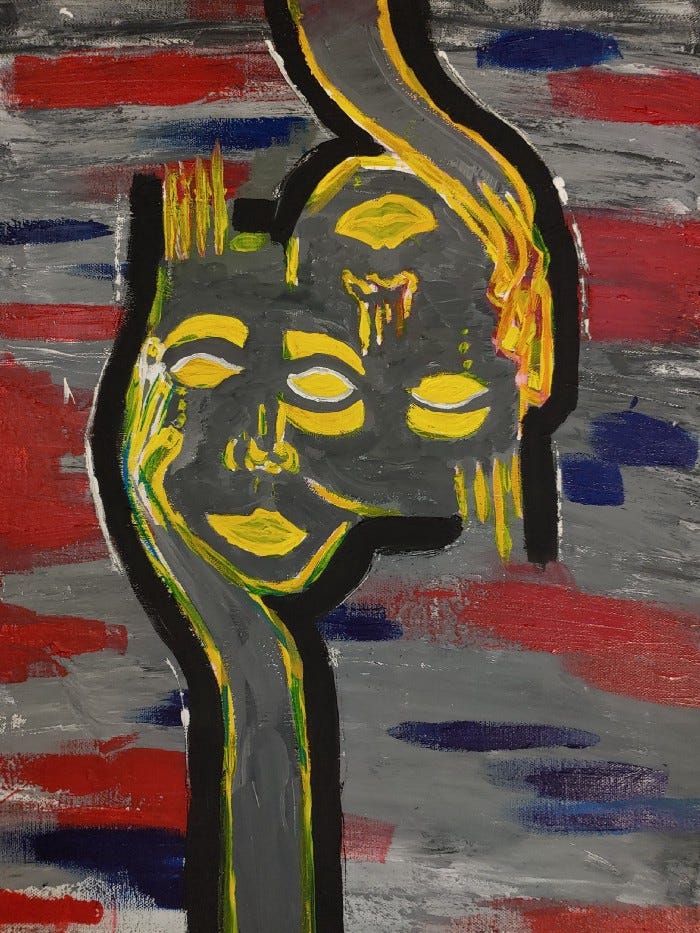
Book cover art by Andrea Mihaly — used with permission
Our Society: Addiction and More Uncovered. Hear the voices of everyday people — a collection of stories and experiences.
Copyright @ 2020. 1st addition on Amazon KDP. 2nd addition Jan 2021 Barnes & Noble. Gumroad December 2021. By Dr. Gabriella Kőrösi. All rights reserved. Dancing Elephants Press.


