
Add Spice to Intrigue Readers
Strategies to sprinkle interest into your writing
Writers who allow me to visit the setting of the story captivate my attention. I love to experience a new place through the words of a gifted writer who provides details that arouse my senses. They inspire my desire to continue reading. The ability to describe an environment requires a writer to share the smells, tastes, sights, sounds and feelings through their attention to detail.
Have you ever smelled an aroma that escorted you back in time? Have you ever heard a song that sparked a memory from the past?
The smell of cinnamon carries me to Mom’s kitchen where fresh snickerdoodle cookies greeted me as after-school treats. Styx singing Boat on the River sends me adrift to a time when I waterskied with friends in high school. The lights of an ambulance transport me to the scene of the car accident where my daughter laid unconscious as the paramedics cut off her clothes to apply lifesaving medical procedures.
Arousing senses sparks flashbacks to past experiences. Effective writers use sensory details to connect to readers by providing details that address the five senses, thus, allowing them to move beyond the written word as they vicariously become involved in the events of the story.
Developing sensory details
Writers can increase readers’ engagement with the text by incorporating sensory imagery. The more specific the details, the greater the impact on a reader. For instance, think about each of the scenarios referenced above and then compare the following excerpts, the first draft without sensory imagery and the revision with the addition of multiple senses woven into the text.
Draft
After school, I walked through the door, and Mom had cookies sitting on the table.
Revision
After school, I often walked through the sliding glass door to be greeted by the smell of warm cookies cooling on the table. The aroma of cinnamon caressed me with Mom’s love and welcomed me home. If the timing was just right, a cold glass of milk sat waiting.
Draft
On weekends, friends would gather at the lake to waterski.
Revision
Most Saturdays, our close-knit gang of eight teenagers met at the dock to launch the flat-bottomed boat into the lake. As one person backed the truck down the ramp, somebody else would crank the rope by hand, while the rest of us shoved the wooden vessel into the water. The task required some work but once on the water; we relaxed to Styx singing Boat on the River as we drifted in the sun, warming up to the idea to jump in the cool water.
Draft
When I arrived at the accident, Kari laid beside the road as several paramedics administered medical attention.
Revision
From a distance, I saw the blue and red lights flashing, penetrating the darkness. Before getting out of the car, I saw Kari's body on the gravel beside the asphalt road. Two paramedics and a police officer bent over her unconscious body. As one cut her shirt to expose her bruised, scraped torso, another prepared an IV while the officer shakily held a flashlight.
Brainstorm sensory vocabulary
Adding sensory imagery to writing is a simple skill to develop. However, it requires a strong vocabulary specific to the topic. Writers who have not consciously practiced this technique will find immediate success if they take time to pre-write prior to the first draft.
Start with a simple statement of the topic. Then list the items that will be important to the narrative. Create five columns next to each item and brainstorm words associated with each of the five senses. Repeat this strategy for different elements of the topic. Sometimes, I find it useful to ask others to share images they visualize when prompted by words I supply. This helps me expand the word bank beyond my own, sometimes limited, vocabulary.
Example
Statement of topic: The football game was awesome! There were marching bands, cheerleaders, and lots of food.
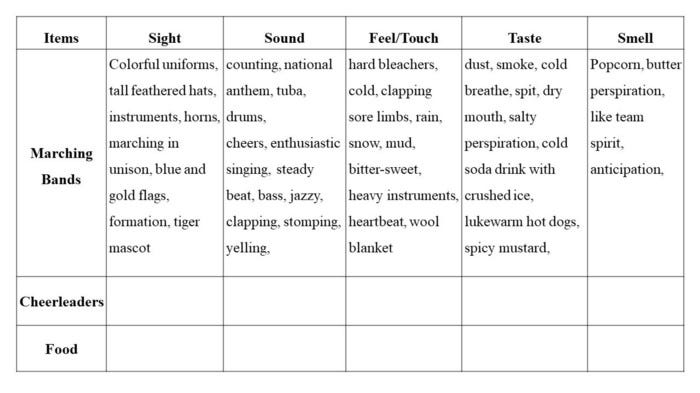
This prewriting strategy activates vocabulary to build a word bank of descriptive words. The first draft flows easier once the creative juices are stimulated. When revision begins, I use the brainstorm of sensory words to breathe life into the writing by adding new details to the narrative.
Incorporate similes to activate images
When writers weave similes into their writing that trigger familiar comparisons, they mold pictures in the reader’s mind. For instance, instead of telling that the football player moved powerfully, think about what the event reminds you of and create a simile. Follow these three steps to consciously produce similes.
List two adjectives
Think of two adjectives that describe the topic, in this case, a football championship game. The adjectives used to describe this setting are explosive and competitive.
List items that the adjectives describe
Next think only of the adjectives, explosive and competitive. Generate ideas of things or events those words might describe: K-9 dogs taking down a violent offender, Superman stopping a meteor from destroying Earth, two trains racing to deliver life saving vaccines, a father defending his daughter from teenage bullying, the destruction after the planes hit the Twin Towers on 9/11.
Link items together using adjectives
The final step is to link the two items described with the adjectives. Each of these comparisons produces a different effect on a reader and can be implemented into the writing to create a different visual. The following examples share three similes that developed using this technique.
- The linebacker, channeling his competitive spirit, charged the quarterback like a K-9 taking down an approaching armed suspect.
- The left tackle, propelled by his explosive competitiveness, blocked the advancement of the opposing team and protected the quarterback from being sacked like a determined father protecting his daughter from teenage bullies.
- Using his explosive strength, the blocker moved like Superman deflecting a meteor threatening life on Earth as he protected the quarterback from being sacked.
Descriptions that illustrate events capture attention. They engage readers in the story. As a writing instructor, these techniques have provided strategies to allow others to develop their skills and realize success.


