
Adam Goodes, The Squad and the nature of patriotism
A true patriot is someone who says I love my country but I believe it can be better
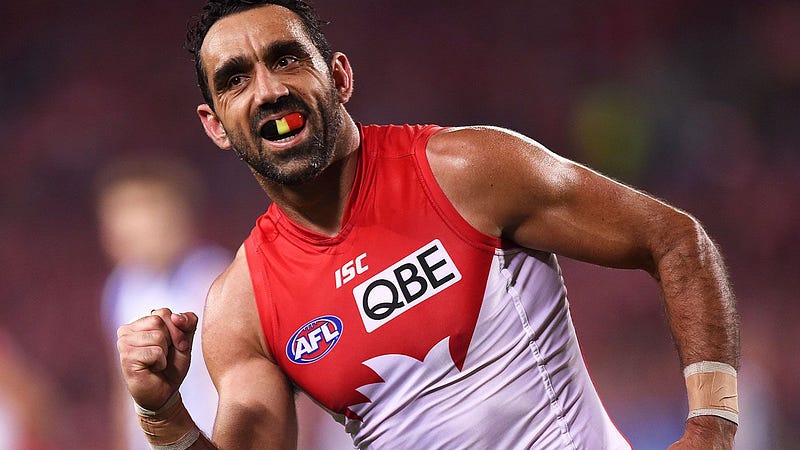
WHAT is patriotism? Is it blind faith in my country, right or wrong? Or is it holding a mirror up to your country’s faults and imploring it to do better?
Does it mean you love your country less if you point out what is wrong with it?
These are the questions that sprung to mind after watching The Final Quarter, the new documentary about the last few seasons of the football career of Adam Goodes.
The film searches for answers as to why Goodes, a man deemed so much an ornament to the nation that he was named Australian of the Year in 2014, was booed incessantly in the last two years of his stellar playing career?
It asks what does the abuse heaped upon Goodes tell us about the the deep divisions and dark history of our country? And how can we have a intelligent public debate about both the past and the future if those who dare to speak up are howled down by the mob?
The Final Quarter is a disturbing film, not only because of the cruel and callous way Adam Goodes was treated, but for what it reveals about the psyche of European and white Australia. It is confronting and it leaves a bitter taste in the mouth.
Well before he was named Australian of the Year, Goodes’ place in football history was already assured: two Brownlow Medals, two AFL premierships, four times All-Australian, AFL Rising Star Award, and (by the time he retired in 2015) Sydney Swans/South Melbourne and Indigenous games record of 372 matches.
On the field, Goodes was a force of nature, roaming the arena like a wild stallion and imposing his 191 cm/100 kg frame on the game at crucial times, winning the ball and kicking goals with both feet. He could play virtually any position on the field and effectively redefined the role of the modern ruck rover.
Off the field, Goodes was thoughtful, articulate and quietly spoken, an ambassador for both the game and his Indigenous culture and community.
Goodes was quietly proud of his Aboriginal heritage and would not take a backward step if met with racism.
In a match against Collingwood in the 2013 Indigenous Round, Goodes heard himself described by a spectator as “an ape” and had the culprit ejected from the ground, not realising at the time she was a 13-year-old girl. The incident reopened the debate about racisim in football, returning the focus to crowd attitudes and behaviour 20 years after St Kilda’s Nicky Winmar had lifted his shirt to point at his skin and declared to abusive Collingwood supporters that he was ‘black and proud of it”.
It was for his stance on racism as much as his exploits on the field that Goodes was named Australian of the Year the following year. During 2014, he sought to use this as a platform to educate his fellow citizens about the history of violence, dispossession, mistreatment and discrimination of the First Australians, and to push the cause of reconciliation.
The European settlement of Australia began with an invasion and theft, it was implemented through a genocidal war, and it continued for almost 200 years of colonisation through incarceration, the removal of children from their parents, the taking away of culture and language and the imposition of a new culture, and the denial of basic rights, including citizenry and suffrage.
And even though today they are bestowed with the same rights as Australians of European origins, Indigenous Australians lag well behind the rest of society, with lower life expectancy, high rates of poverty, crime and addiction, poor health and education outcomes, including mental health, and the victims of subtle discrimination.
We hear continuing echoes of the historical persecution of Aborigine people in the paternalistic outrage over the long-flagged decision of its traditional owners to finally ban tourists from climbing Uluru from October this year.
As Australian of the Year, Adam Goodes confronted Australians with this past, and he then urged for us to deal with it in an adult, mature and honest way. He was saying that great as this country is, it also has a shameful past and present and we can and must do better.
Goodes was pragmatic enough to understand that the past couldn’t be reversed, and he was not seeking reparations or revolutionary change. Rather than confrontation, all he asked for was understanding.
His love for his country was manifest for all to see.
But it was this modest advocacy for Indigenous Australians that was the catalyst for the booing that followed him in 2014 and 2015, eventually forcing him to walk away from the sport that had been his life since his late-teens. In The Final Quarter, we can see Goodes physically age over those three years, the expression on his face changing from a carefree smile to a haggard expression with flecks of grey in his beard as the booing takes its toll.
Did raising these issues make him un-Australian? Was it unpatriotic of him to do so?
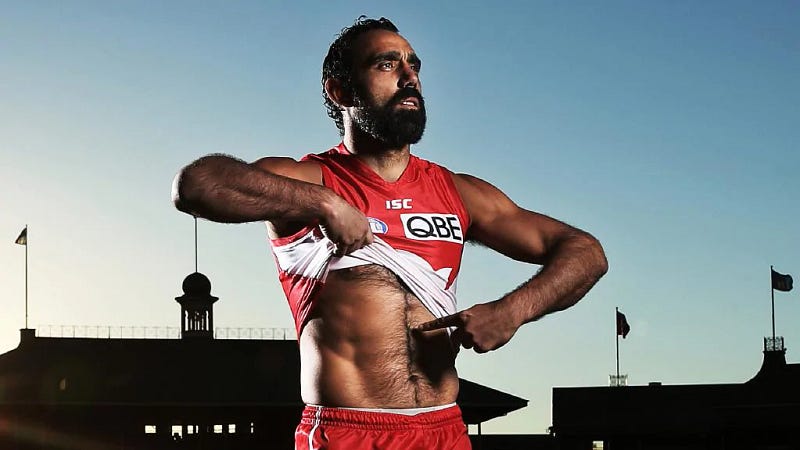
Watching The Final Quarter, it is clear that the abuse of Goodes was encouraged by a small cadre of conservative media commentators — notably Andrew Bolt, Alan Jones and Miranda Devine. What they all have in common is a deep animosity towards ‘the other’ — towards migrants, refugees, Muslims, LGBTIQ people. But especially towards Aboriginals. Bolt infamously fell foul of the Racial Discrimination Act in 2011 over two articles which were found to have racially vilified Aboriginal people.
With the exception of the appalling John ‘Sam’ Newman, sneering co-host of the now defunct ‘The Footy Show’ and the very epitome of white male privilege, the majority of the footballing community supported Goodes, although some (particularly Collingwood president and football commentator Eddie McGuire) inadvertently reinforced the racism against him, and others could have and should have spoken up more vociferously.
Bolt, Jones and Devine fanned the hate towards Goodes by criticising his willingness to speak up about racism and discrimination. In short, their message was that as an Aboriginal Australian, Goodes should be silenced.
Aborigines, especially those who have achieved fame as sportspeople, should be seen, but not heard, they were implying. They deny racism, of course, by insisting that dozens of other Aborigine footballers were not booed like Goodes was. The difference was that Goodes had chosen to be more than a footballer: he had chosen to be a spokesman for his race, and to speak some plain truths.
That, in the eyes of Bolt et al, was Goodes’ crime. To them, Goodes was ‘an uppity N***er’ who should be put back in his box. Unthinkingly, tens of thousands of other privileged white Australians joined the fray.
It is a cop out to simply blame the media for the bullying Goodes received. Jones, Bolt and Devine were outliers; most of the media took Goodes’ side. But the lynch mob mentality of booing tells us there is something ugly and vicious buried deep in the white Australian psyche that made people receptive to the message of hate being spread by those commentators.
We are reminded of the treatment of Adam Goodes when we recall the backlash against the San Francisco 49ers quarter back Colin Kapernick when he bent down on one knee rather than stand at attention during the playing of the US national anthem. Kapernick’s gesture, which was adopted by other African-American sportsmen, was a nod at the Black Lives Matter movement and and a protest at the ongoing brutality and murder of coloured people at the hands of police across the US.
And we hear echoes of the same thing when the President of the United States unashamedly expresses racist and white nationalist views on a daily basis.
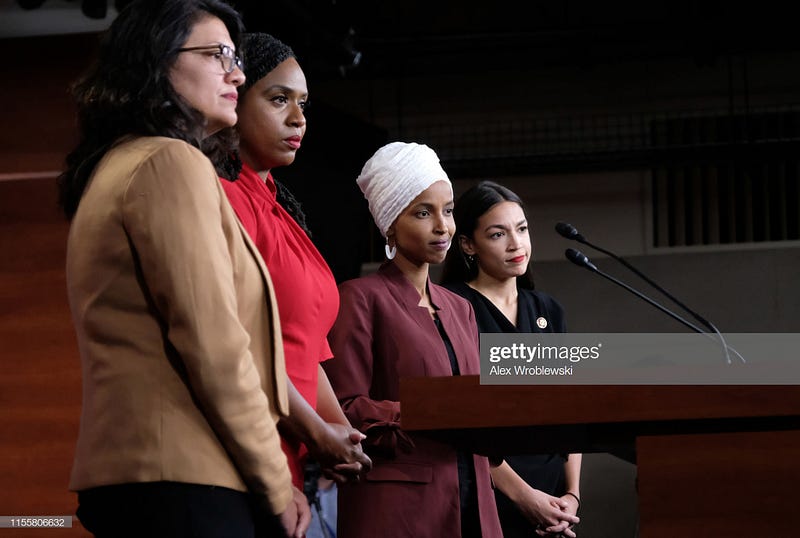
In the same week as The Final Quarter aired on Australian television, Donald Trump stooped to a new low when he said four Congresswomen of colour should “go back home”.
Never mind that three of the four — Alexandria Ocasio-Cortez, Rashida Tlaib and Ayanna Pressley — were born in America. Never mind that the fourth, Ilhan Omar, came to the US as a child refugee and has attained citizenship. Never mind that the descendents of Pressley, like those of millions of African Americans, never voluntarily chose in the first place to be taken in chains from their homeland to the US and then sold as slaves.
Trump’s strategy in singling out the four women — known as ‘The Squad’ — for racist abuse is two-fold. On one hand, it is a tactic to create yet another distraction from the appalling incompetence and policies of his administration — and typically, the US media fell for the bait. Trump’s typical modus operandi when things are going tough is to tweet something outrageous to draw attention away from his own failings.
But more insidiously, the aim is to appeal to a political base of white working class Americans in states like Ohio and Pennsylvania who Trump is banking on to re-elect him to the White House. Not all of those voters have overt racist tendencies, but Trump knows that if he can turn their political frustration against the more culturally diverse Democratic Party, he is on a winner. As a long term strategy, it makes no sense: rapid demographic change and a more diverse population means that core of white voters will shrink in influence. But it’s a short term winner.
(Of course, Trump has form in this area. His father overtly prevented blacks from renting in a Brooklyn apartment building he owned in the 1950s. Trump himself was sued by the Department of Justice in 1973 for the very same thing. There was also a pattern of racism in employment practices at Trump’s casinos. In 1989, Trump exploited racial tensions to take out newspaper ads with the headline: “Bring Back The Death Penalty. Bring Back Our Police!” in reference to five black teenagers charged (and later cleared) of an infamous Central Park rape.
Trump’s political career began with in 2011 with the racist “birther” conspiracy by claiming, without a shred of evidence, that Barack Obama might have been born in Kenya rather than Hawaii.
As President, he has cast about racial insults — for instance, describing African nations as “shitholes” — and refusing to condemn white supremacists who marched on Charlottesville in 2017. His Muslim travel ban implemented in the early days of his presidency was racially targeted.)
Trump has no qualms about aligning himself with openly racist organisations if it can draw him a few more votes. That’s why he described as “incredible patriots” the mob that chanted “send her back” about Omar at a rally last week.
By identifying AOC, Omar, Tlaib and Pressley as a group and choosing the words “go back home”, Trump is making the point that America belongs to white people, and people of colour should not get above their station. They do not have the right to speak up, he says. He is questioning the right of a person like Ilhan Omar to hold public office. And he is implicitly saying that they hate their country, they are unpatriotic and anti-American.
This kind of thing is never said to or about white people. The subtext is that this country belongs to us white people. The rest of you are interlopers who are here as a privilege not a right so behave yourself.
It’s only a short step from here to the burning crosses and pointy white hoods of the KKK.
It’s ironic that Trump — who stormed to office by declaring that US was a hellhole and only he could make America great again — is now accusing others of being anti-American. The same argument could be put that Trump and his supporters hate America.
Indeed, what greater love for America could there be than for a little Somalian refugee to one day grow into a woman who swears allegiance to her adopted country and then seeks to serve her fellow citizens as their elected representative.
The real crime of The Squad, in the eyes of Trump, is to stand up and say there is something rotten about the American dream when millions of Americans like themselves — women, migrants, coloured people — live in cities blighted by crime, drugs and poverty, without proper health coverage, with poor schooling, inadequate housing and jobs that pay barely enough to survive on
They are saying there is something wrong when the opportunities you have in life will largely depend on your skin colour and the class into which you were born. Trump, who inherited millions of dollars from his property developer father when he turned 18, has never been confronted with those disadvantages and he resents them being pointed out to him, especially by women who are not white.
To say these things about America or Australia is not unpatriotic. To recognise what is wrong with your country and then pledge to make them right is the highest form of patriotism, just as it was not unpatriotic for young people in both nations to oppose their military’s involvement in foreign wars in Vietnam and Iraq.
Patriotism has been appropriated by conservatives, by the Peter Duttons of this world, who demand and expect blind loyalty to the government of the day. But they don’t have a monopoly on patriotism.
A true patriot is someone who says I love my country but I believe it can be better. Those are the people who should be celebrated, not denigrated.
And for that reason, Adam Goodes is a great Australian patriot.