avatarDavid Giunta

Free AI web copilot to create summaries, insights and extended knowledge, download it at here

2813

Abstract

tsby game, the player can sell Gatsby’s possessions.</figcaption></figure><h1 id="9a0f">2. You can actually talk to characters</h1><p id="d92c">In all the great works of literature, action is set in stone. You can’t interact with the book’s environment or change a character’s decisions. Now you can. Real conversations can be constructed by game creators. The creators would imagine what a character would say if put in a particular situation or how a character would respond if talked to in a certain way or asked certain questions.</p><figure id="6d74"><img src="https://cdn-images-1.readmedium.com/v2/resize:fit:800/1*02xn-wmy_GA4RIov2Po0Hg.png"><figcaption>You can choose what to say to Gatsby in many different topics of conversation.</figcaption></figure><p id="3d7d">Students don’t have to read about George Washington escaping the British in Brooklyn. They can ask him how he did it. They don’t have to wonder why George shot Lennie. They can ask him why he did it. You don’t have to hate Daisy for not helping Gatsby. You can play as her subconscious to talk her into making different decisions. A great thing about these games — if you don’t like the suggestions above, there are an infinite amount of other ideas to bring to fruition.</p><h1 id="eb83">3. Random occurrences can happen</h1><p id="ccd5">Again, nothing needs to be set in stone. A simple code can be used to allow random incidents to occur. Dozens of my students each year describe how they manipulated one test or another. The test questions were just too predictable. But, we all know that life is anything but predictable. In life, we don’t know what will happen next. But, when we truly engage in life, we realize that its unpredictability is something that greatly enhances our experience.</p><figure id="c135"><img src="https://cdn-images-1.readmedium.com/v2/resize:fit:800/1*uFTEE6gajIb7Ghz_DmVPSw.png"><figcaption>In this section of the game, Gatsby, on a whim, could have asked you what you thought. It’s random.</figcaption></figure><h1 id="77d0">4. Points can be allocated</h1><p id="643b">But, these aren’t any points. They are points game creators shape into whatever they want. Health points can be given. Spirit points can be given to show that a player is advancing in the campaign. Once a player obtains a certain amount of spirit points, they win something. You might be thinking, “I can give points with scantrons.” Yes, true. However, points in a game are much more versatile than scantron points. Points in a game are actually less complicated to distribute than points on a scantron and can easily be given different values or assigned different attributes, depending on the desires of the game creator.</p><figure id="884f"><img src="https://cdn-images-1.readmedium.com/v2/resize:fit:800/1*wWoQUPRz8698a6nL5PSdTg.pn

Options

g"><figcaption>In the Gatsby game, obtaining cash is necessary (just like in life), and Gatsby points are needed to “win” the game.</figcaption></figure><h1 id="dfb9">5. Game creators can conceive universes</h1><p id="cbfc">One thing I realized when having my students create games is that their games started to take the appearance of actual universes. The students would develop the laws governing the universe. Really, any type of universe can be realized. In math class, the laws of the universe can be dictated by mathematical operations. In social studies , playable characters can time warp to a specific point in history to try to change the course of history. For example, in American History class, a playable character can travel throughout time periods of American history to interact with historical characters and influence historical events. In science class, the scientific principles students are studying can be present in the games.</p><figure id="725f"><img src="https://cdn-images-1.readmedium.com/v2/resize:fit:800/1*DPYQKoqjQBPwZRijtDNhPg.png"><figcaption>In this Gatsby game, anything can happen. Gatsby can search for Daisy through a time warp or he can rent an apartment in Williamsburg. And students, with their imaginations, can create their own universes.</figcaption></figure><h1 id="a70b">The Wrap-up</h1><p id="2365">I might have been a little vague in describing the possible ways video games can contribute to learning. But, there is a reason. There is literally an infinite amount of things that can be engineered with video games to enhance learning. And, the number of codes needed to make these game universes a reality can be counted with just the fingers on two hands.</p><p id="9a0b">Whether you are a teacher, a parent, or just a concerned citizen, how minds are being molded needs to be considered. Should learning be dictated by companies looking to maximize profit such as Pearson or McGraw-Hill, or by students who can create universes. What if the world is possibility if only we’ll discover it as quantum physics suggests? Wouldn’t we be doing learners harm by limiting their learning experience to the standardization of the Pearsons or the McGraw-Hills?</p><h2 id="e920">Here is the link to the Gatsby game. Hope you enjoy!</h2><h1 id="5859">Coming up in the next article — How I implemented video game creation in my classes</h1><p id="6858">If you are a teacher interested in trying some of the possibilities mentioned in this article, have a conversation with me. I love to talk about this stuff and I’m not charging. Just would like to spread ideas that can help humankind. To send a message through Medium, highlight a portion of the article and then press on the private comment link. Otherwise, you can email me at [email protected].</p></article></body>

Actually Talk to Gatsby and Experience His Life— All in This Article

For the first time ever, experience an article synthesized with a video game and actually talk to the fictional character Jay Gatsby. You know you want to try.

Ready for the Gatsby experience?

For the first time in the history of humankind, an article and a video game are synthesized into one entity. And, in the same article, also for the first time ever, you get to actually talk to a fictional character, Jay Gatsby. Yes, that one.

This is the second in a series of articles that looks at how video games can revolutionize education. So, much of the article will focus on how game creation and coding can be used in the classroom. The first in the series focused on how creating and playing video games can benefit learners. If you would like to read that article, here is the link.

This article will focus on the possibilities. What can be realized with video games and learning. As the vet in Ralph Ellison’s Invisible Man said, “The world is possibility if only you’ll discover it.” So, I hope you will join me, and Gatsby, on a bit of a crazy ride.

If you would like to play the game now, press the link below. I will place another link to the game toward the end of the article in case you don’t want to scroll back up. If you want to read on, I will be describing five exciting things almost any student, or person, can accomplish by creating and playing games, in class or out.

Link to game and a discussion with Jay Gatsby

Here are five incredible things, that lead to real learning, which can be accomplished with game creation. You might not have previously considered the five as methods of learning. However, despite their untraditional nature, all five are things learners from middle school on up can easily gain competence in.

1. Characters can buy and sell

With some simple code, game creators can design items that can be bought or sold. Imagine literature such as “The Gift of the Magi” being made into a game in which the couple actually sells things in order to actually buy gifts for one another. Or what if Walter used Mama’s money in a different way in A Raisin in the Sun?

In the Gatsby game, the player can sell Gatsby’s possessions.

2. You can actually talk to characters

In all the great works of literature, action is set in stone. You can’t interact with the book’s environment or change a character’s decisions. Now you can. Real conversations can be constructed by game creators. The creators would imagine what a character would say if put in a particular situation or how a character would respond if talked to in a certain way or asked certain questions.
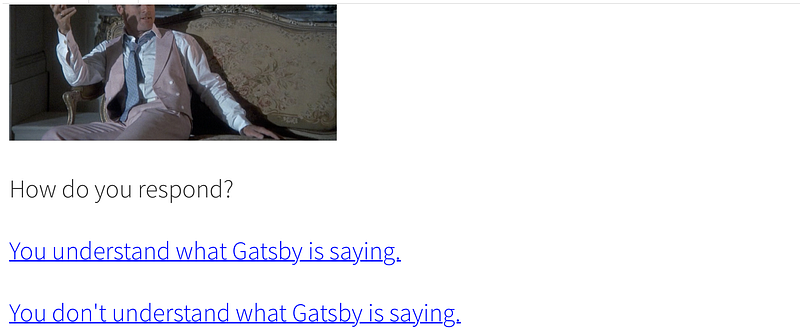
You can choose what to say to Gatsby in many different topics of conversation.

Students don’t have to read about George Washington escaping the British in Brooklyn. They can ask him how he did it. They don’t have to wonder why George shot Lennie. They can ask him why he did it. You don’t have to hate Daisy for not helping Gatsby. You can play as her subconscious to talk her into making different decisions. A great thing about these games — if you don’t like the suggestions above, there are an infinite amount of other ideas to bring to fruition.

3. Random occurrences can happen

Again, nothing needs to be set in stone. A simple code can be used to allow random incidents to occur. Dozens of my students each year describe how they manipulated one test or another. The test questions were just too predictable. But, we all know that life is anything but predictable. In life, we don’t know what will happen next. But, when we truly engage in life, we realize that its unpredictability is something that greatly enhances our experience.
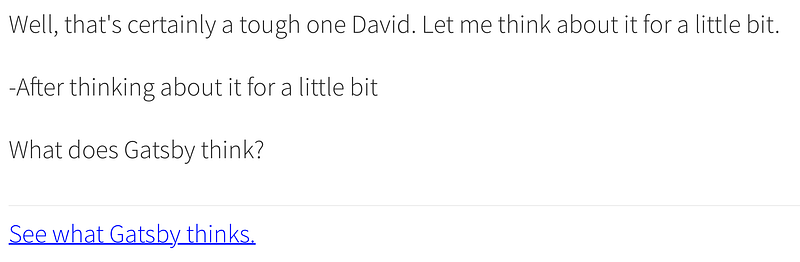
In this section of the game, Gatsby, on a whim, could have asked you what you thought. It’s random.

4. Points can be allocated

But, these aren’t any points. They are points game creators shape into whatever they want. Health points can be given. Spirit points can be given to show that a player is advancing in the campaign. Once a player obtains a certain amount of spirit points, they win something. You might be thinking, “I can give points with scantrons.” Yes, true. However, points in a game are much more versatile than scantron points. Points in a game are actually less complicated to distribute than points on a scantron and can easily be given different values or assigned different attributes, depending on the desires of the game creator.

In the Gatsby game, obtaining cash is necessary (just like in life), and Gatsby points are needed to “win” the game.

5. Game creators can conceive universes

One thing I realized when having my students create games is that their games started to take the appearance of actual universes. The students would develop the laws governing the universe. Really, any type of universe can be realized. In math class, the laws of the universe can be dictated by mathematical operations. In social studies , playable characters can time warp to a specific point in history to try to change the course of history. For example, in American History class, a playable character can travel throughout time periods of American history to interact with historical characters and influence historical events. In science class, the scientific principles students are studying can be present in the games.
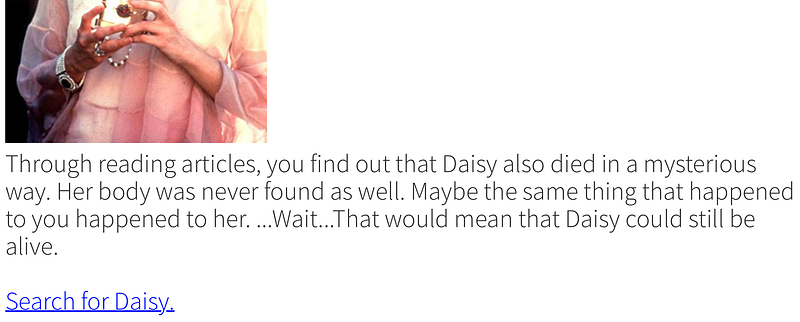
In this Gatsby game, anything can happen. Gatsby can search for Daisy through a time warp or he can rent an apartment in Williamsburg. And students, with their imaginations, can create their own universes.

The Wrap-up

I might have been a little vague in describing the possible ways video games can contribute to learning. But, there is a reason. There is literally an infinite amount of things that can be engineered with video games to enhance learning. And, the number of codes needed to make these game universes a reality can be counted with just the fingers on two hands.

Whether you are a teacher, a parent, or just a concerned citizen, how minds are being molded needs to be considered. Should learning be dictated by companies looking to maximize profit such as Pearson or McGraw-Hill, or by students who can create universes. What if the world is possibility if only we’ll discover it as quantum physics suggests? Wouldn’t we be doing learners harm by limiting their learning experience to the standardization of the Pearsons or the McGraw-Hills?

Here is the link to the Gatsby game. Hope you enjoy!

Coming up in the next article — How I implemented video game creation in my classes

If you are a teacher interested in trying some of the possibilities mentioned in this article, have a conversation with me. I love to talk about this stuff and I’m not charging. Just would like to spread ideas that can help humankind. To send a message through Medium, highlight a portion of the article and then press on the private comment link. Otherwise, you can email me at [email protected].

Gaming
Learning
Education
The Great Gatsby
Coding
Recommended from ReadMedium