
Actually, Latter-day Saints Are Christians
A Response to TJ Seaney
For over two decades, I have been following the arguments that sectarians try to make against The Church of Jesus Christ of Latter-day Saints. I have been surprised many times at the stuff that they come up with. I am seldom surprised these days. One thing that still surprises me, though, is the fact that they feel such a need to publish so much antagonistic content about my faith — much of it outright hateful and dishonest. If you look at our church’s website and at our bookstores, you simply won’t see any content that specifically attacks any other faith. It’s because we’re confident in our position: I have always interpreted this antagonism as a tacit admission that they feel threatened because they know that their house is built on sand. They go on the offensive because they know that they lack defensive capabilities.
Having just read a piece by TJ Seaney, I have to say that his comments are pretty tame as far as antagonism goes, but in the end, I am still left wondering: Why does this content exist? Why do you feel such a need to specifically target us in this way? We never write content for the purpose of “revealing” the “truth” about Catholicism, Methodism, Lutheranism, or whatever. We just teach our message. I don’t think Seaney is a particularly antagonistic person, but I do think that he needs to engage in a little self-evaluation and really think deeply about why he feels the need to write such content. Because from my perspective, it is evident of a subtle but deep sense of vulnerability on his part.
In his article, TJ Seaney seeks to argue that Latter-day Saints (not “Mormons”) are not Christians. He gives three reasons for this. I’m going to address all three points.
Extrabiblical Scripture
This is, of course, a common point of contention from sectarians. I have a lot to say on this note, and I will probably write about it more in the future, but let me sum up my thoughts with several points here.
- The Bible says that there is scripture outside of the Bible. This is fact. If you are going to say that only the Bible is scripture, ironically, this would require you to deny the Bible. The Bible quotes and references many books of scripture that it does not contain. It also tells us of prophets yet to come — and therefore scripture yet to come, as scripture is the teachings of prophets written down.
- Seaney’s appeal to “sola scriptura” is circular reasoning. (Sectarians love circular reasoning. They do it a lot.) The idea of sola scriptura is that we should only rely on scripture, and not on other sources, because scripture comes from God. But here is the thing: Latter-day Saints also believe this! We also believe that we should rely solely upon that which comes from God! It is just that we have more scripture than the sectarians do. And yet, Seaney and the other sectarians will say: “But that’s not scripture.” But how do they know it’s not scripture? “Because it teaches false doctrine.” But how do they know that the doctrine it teaches is false? “Because it’s not really scripture.” Circular reasoning.
- Seaney has not shown that “Mormonism” offers a “new Christ through the Book of Mormon.” This is false. It is demonstrably false. TJ Seaney, if you are reading this, I am issuing you a challenge. Show me one passage from the Book of Mormon that gives a doctrine of Christ that is contradictory to that of the Bible. (You will not because you cannot.)
- Sectarians are the ones who believe in scripture that is not scripture. Whenever sectarians try to tell me that my beliefs are false, they always point to our extrabiblical scripture. Then, they tell us that our theology is false. When I ask for some textual basis for their theology, they don’t appeal to the Bible…they quote a creed, such as the Nicene Creed or the Athanasian Creed. You know…things that are not the Bible.
- Christians existed before the Bible. The first Bible was compiled centuries after the Apostles were gone. If the Bible is synonymous to Christian belief, how were there Christians before the Bible existed?
Continuing Revelation
The fact is that continuing revelation is a key aspect of biblical religion. The religion that the Bible gives us is one of apostles, prophets, pastors, teachers, and evangelists (Eph. 4:11–14). These are listed as the basic positions of authority within the Church that Jesus Christ established. Sectarians like Seaney flagrantly remove apostles and prophets from that framework and then have the audacity to tell us that we are the ones whose faith contradicts what the Bible establishes.
Seaney makes the curious claim that “the apostles, were the apostles, and there is no need for a continuation or succession.” But if that is his belief, then he must be drawing from extrabiblical scripture, because the Bible says no such thing. Note again Ephesians 4:11–14. Apostles and prophets are mentioned alongside pastors, teachers, and evangelists. Are we to assume that there should not be any more pastors, teachers, and evangelists? Probably not. On top of this, the Bible tells us specifically of at least two apostles who came after the initial twelve (Matthias and Paul) and at least three prophets who were not prophets prior to Christ’s ascension (Agabus and the two prophets John saw in Revelation 11).
Seaney continues with this whopper:
Both the Catholic and Mormon churches, negate the warnings of the apostles in the New Testament, to ignore others that would come later, claiming they were the “new” apostles, or the “new” leaders of God’s true church.
This is a flagrant misinterpretation of what the Bible teaches. Note the lack of actual citations. The Bible does not tell us that there will be no more prophets or apostles. As I have shown, it does the exact opposite. What the Bible does is tell us to beware of false prophets. The existence of false prophets does not in any way imply a lack of true prophets. Christ did not say that there would be no more prophets. Rather, He told us how to differentiate between false and true prophets.
Let’s consider that last point very carefully.
Why would Christ tell us how to distinguish between false and true prophets if there were not going to be any more true prophets?
And again, note that John specifically prophesied of prophets yet to come (Revelation 11).
If the time of prophecy and revelation has ended, then we must ask: When did it end? Let’s ignore the many passages that show that it continues and just consider when that could have been.
- When the Apostles died. Seaney’s suggestion seems to be that the Apostles were the standard for doctrinal purity until they died, and that the Bible took over after that. But the reality is that the Bible did not exist at that time. So what was the standard of pure doctrine in the interim?
- When the first Bible was compiled. This happened in 382. But again, this meant that there were centuries in which there would have been no standard for doctrinal purity. On top of that, even though the Bible existed, the vast majority of believers did not have access to it. If we can only gain an understanding of pure doctrine by reading the Bible ourselves, and if almost no one can actually read the Bible, how can anyone know what the true doctrine is?
- When the Bible became accessible to the average believer. The slow development of printing and literacy was such that this actually did not happen until well into the 1800s. So according to Seaney’s standard, again, this means many centuries in which the Christian world, for all practical purposes, had no doctrinal foundations.
Ironically, despite his claims of sola scriptura, Seaney is directly contradicting what the Bible says in many respects. The reality is that he is not really appealing to the Bible at all: he is just appealing to certain common beliefs that sectarians have created regarding the Bible and acting as if those things are the Bible when they are not.
God of the Whole World
There are many arguments that atheists make against Christianity that are quite troublesome for sectarians but not at all troublesome to Latter-day Saints. One of those arguments can be summed up in this popular meme that gets passed around on atheist groups:
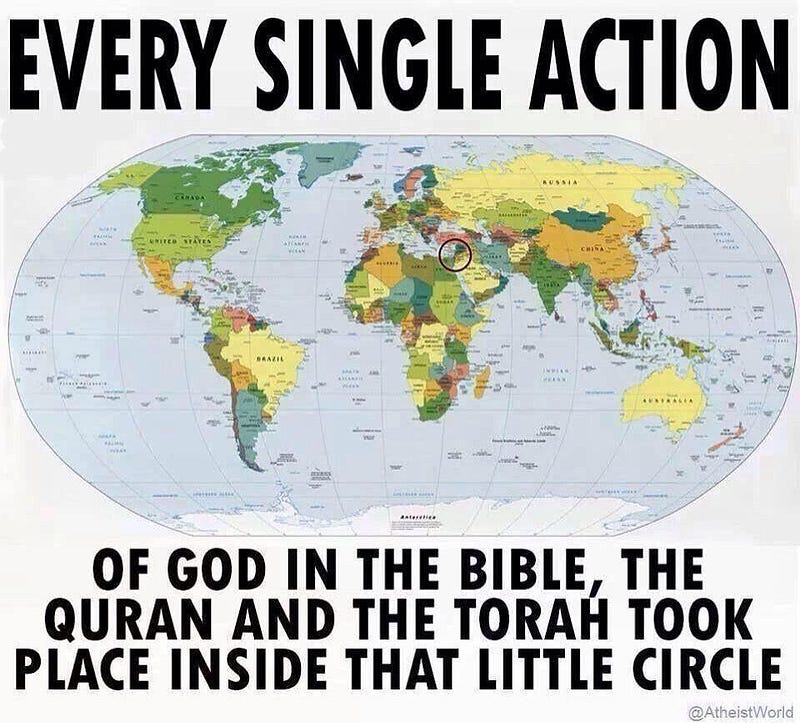
Seaney would have us believe that the God of the whole world — the whole universe — only ever interacted with people inside this little circle…and one day, long ago, suddenly stopped without explanation. One can easily understand why atheists would laugh at this idea.
Not only does this idea defy reason, but it defies the Bible.
Seaney makes this puzzling claim about the beliefs of Latter-day Saints:
Shrouded, in secrecy, is folklore about what Jesus did after his ascension.
I’m not sure what “secrecy” he is talking about. The account of Christ visiting America is given in the Book of Mormon, and at any given moment, tens of thousands of missionaries from The Church of Jesus Christ are running about the world trying to get people to read that account. Where is the “secrecy”? Seaney is using the word “secrecy” to imply something insidious…based on nothing at all.
Anyway…the Bible tells a story other than what Seaney claims. It tells us that Christ did, in fact, go about ministering in many places shortly after the Crucifixion. Consider John 10:16:
And other sheep I have, which are not of this fold: them also I must bring, and they shall hear my voice; and there shall be one fold, and one shepherd.
Sectarians try to tell us that this is just talking about the Gospel being taken to the gentiles. However, that is clearly not the case for three obvious reasons:
- It specifically says that Christ will go to them. They will hear His voice. Not just His message, but His voice.
- The gentiles were not sheep. The “sheep” are those who believe or who at least belong to the covenant or are brought up in the traditions of those in the covenant. Christ described these as people who already, at that time, were His sheep. Who were these people? Not the gentiles. The gentiles were given the ability to become sheep later, but at that time, they were not sheep.
- Christ is speaking in the present tense. He already has them. They are already in a fold. They are not lost, and again, they are sheep already, and so not gentiles. He just wants to visit them and make one fold.
Who were these sheep of another fold? They were among the Nephites and Lamanites as described in the Book of Mormon.
On top of all of this, as often is the case when sectarians criticize us, Seaney is not even giving an accurate representation of what our doctrine is. Let’s look at his statement again:
Shrouded, in secrecy, is folklore about what Jesus did after his ascension. The true Christian belief is that Jesus ascended and will only return at the consummation.
Here is the thing: The account in the Book of Mormon of Christ visiting America does not happen after the Ascension. The Ascension — that is, the event described in Luke 24 and Acts 1 — occurred forty days after the Resurrection. The appearance of Christ to the Nephites and Lamanites occurred almost immediately after the Resurrection — presumably right after His first appearances to the disciples in the Levant. Therefore, this point of contention is based on a false representation of what we believe. It is totally irrelevant.
Weird Beliefs
Seaney implies that what Latter-day Saints believe is too weird or difficult to believe to be true. In response to that, I want to make one single sweeping statement:
Joseph Smith did not bring anything new in to Christian belief that was any weirder or more difficult to believe than what was already there.
It really is true.
Sectarians want to split hairs about the ancestry of Native Americans, saying that their DNA doesn’t adequately match up to Israelite DNA…and yet they want us to believe that all of humanity descended from Adam and Eve just a few thousand years ago. And from Noah’s family again after that!
Sectarians say that there is no record of the Nephites and Lamanites outside of the Book of Mormon, yet they ignore the fact that virtually all archaeologists say that the story of the Exodus was totally made up because no records outside of the Bible corroborate it. And let’s not even talk about the story of Noah’s flood!
Seaney writes:
They have crazy stories about ancient cities, that have never been found, ancient battles, that have never been excavated, and ancient golden tablets with God’s revelation, that have never been publicized.
This is dishonest. Many cities from that period have been found — not just in Mesoamerica, but in North America. It is widely known that the Hopewell and Adena had thriving metropolitan cultures. They even practiced agriculture and metallurgy. Of course, critics will say that we cannot match the city names given in the Book of Mormon to the city names of the Hopewell and Adena, but that is only because we have no city names for the Hopewell and Adena. We know that the cities existed, but we do not know what they were called. This is due in part to the fact that these cultures underwent a complete collapse — exactly as described in the Book of Mormon, and apparently at about the time noted in the Book of Mormon.
Regarding the gold plates, sectarians say that they cannot believe in the Book of Mormon unless they can examine those plates…and yet, if we ask where the resurrected body of Christ is so that we can examine it, they will just cry: “Faith!”
Other Weak Claims
Seaney suggests that it is antibiblical for Latter-day Saints to believe that “God the Father was once a man became God.” And yet, Seaney believes that God was once a man.
“But Ronald, that’s different! That’s the Son!”
Ah, but here is the thing…Seaney, as he suggests right after this point, believes that the Father, Son, and Holy Spirit are one essence. If they are one essence, then you cannot say that the Son was a mortal man but the Father was not. That defies the meaning of “essence”. You can’t believe in the Trinity and have a problem with this.
FYI, Latter-day Saints believe that Jesus Christ — the Son — created the entirety of the universe that we know. This is what it says in the Bible, and this is what it says in the Book of Mormon (Mosiah 3:8). Any origin of God the Father would have to reach beyond this universe, and we have no details on that.
Seaney goes on to say:
Mormons diminish the Bible for another sacred text.
We do not “diminish” the Bible at all. As I have shown, Seaney “diminishes” the Bible by claiming that it says the opposite of what it actually says in many respects.
They believe their text reveals Christ better, but Christ is the embodiment of the Bible.
What we say is that, just as the New Testament brings clarification to the Old Testament, the Book of Mormon brings clarification to both. As for the strange claim that “Christ is the embodiment of the Bible”, this is an example of what I was talking about when I said that sectarians turn the Bible into a pagan idol and worship it. In saying that “Christ is the embodiment of the Bible”, Seaney is pretty blatantly presenting the Bible as his God. That is frightening and, ironically, quite antibiblical.
Mormons believe in continued revelation. They do not believe in the sufficiency of God’s revelation. They desire the revelation to be open and changing to their ever-changing principles.
We absolutely do believe in “the sufficiency of God’s revelation”. And that revelation includes the Book of Mormon, the Doctrine and Covenants, and the Pearl of Great Price. Again, this is circular reasoning on Seaney’s part, in which he declares that something is not revelation because it is not revelation. As I have already shown, the Bible tells us that revelation was always meant to continue. Seaney contradicts the Bible by saying otherwise.
While Seaney claims that there is “sufficiency” in what we have in the Bible, just looking at the beliefs of those whom he believes to be part of “the Church”, we can see that they cannot even agree among themselves on matters as basic as the nature of God and how one is saved. Why do they disagree among themselves on matters so basic? Because they have decided that God is no longer allowed to speak and clear up such doctrinal disputes. It is not that we believe that the word of God is insufficient: rather, it is that Seaney and those like him have the audacity to tell God that He is not allowed to speak anymore…because they are afraid that He would say something that they disagree with.
Conclusion
Here is a summary of the arguments made in Seaney’s article:
- Disregard for the fact that the Bible clearly tells us that there is scripture beyond the Bible itself.
- Circular reasoning in his appeal to sola scriptura as a basis for rejecting scripture other than the Bible.
- A false claim that the Book of Mormon gives a doctrine of Christ different from what the Bible says.
- A claim that Christians are defined primarily by belief in the Bible while disregarding the fact that there were Christians before there was a Bible.
- Blatant denial of the fact that the Bible identifies prophets and apostles as part of the essential organizational structure of the Church.
- A declaration that the original twelve apostles were the only apostles, when the Bible clearly identifies apostles after them.
- A declaration that the time of prophecy and revelation ended centuries ago when Christ and John the Revelator told us the opposite.
- An assumption that the God of the whole universe only ever interacted with people in a very small part of the world a long time ago.
- A puzzling claim that the Church’s doctrine about Christ’s postmortal ministry is a matter of “secrecy” when it clearly is not.
- Disregard for the fact that Christ clearly said that He would minister to people other than those in the Levant.
- False representation of the beliefs of the Church of Jesus Christ in claiming that the appearance to the Nephites happened after the Ascension.
- Disregard for the extensive evidence of cities in the New World during the period described in the Book of Mormon.
- A laughable suggestion that the narratives of the Book of Mormon are weirder and more difficult to believe than the narratives of the Bible.
- Denial of Trinitarianism followed by advocacy of Trinitarianism.
- Presentation of the Bible as if it were a pagan idol, a deity in itself.
- Denial of the fact that the Bible clearly gives us a religion of ongoing prophecy and revelation.
In short, Seaney would do well to actually read the Bible that he claims we don’t believe in…because we apparently believe in it a lot more than he does.
When we say that we are Christians, it is not because we want to be part of your cool little club, TJ Seaney . As God told Joseph Smith, your (antibiblical) creeds are abominations. But insofar as we define a Christian as one who believes in Christ and seeks to follow Him, we are most definitely Christians. You may not like it, but that is irrelevant, as you are no authority and have no real connection with God.


