
Actions Are Based On Intention:
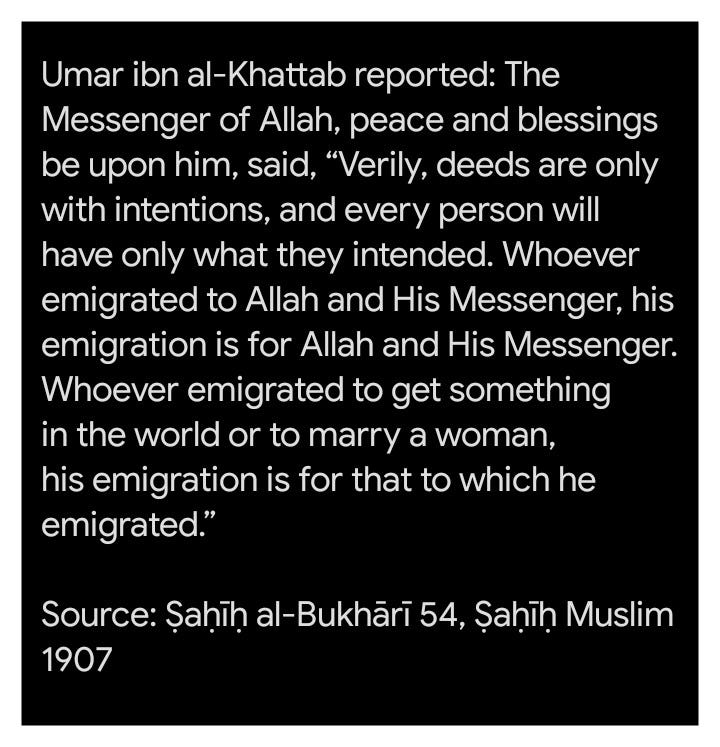
The connection between Action and Intention highlights the connection between the physical and the spiritual components of any human.
Intentions lead to results. When a change in intention occurs, a change in external conditions will follow.
The intention is also enough for Allah (swt) to make a change in our reality, so we should not belittle the necessary change in the intention that has to occur for our external condition to change.
Difference Between Qasd (Objectives) And Niyyah (Intention):
Objective (qasd) in the terminology of the Fuqaha’ means the resolve to do something. Mu’jam al-Mustalahaat wa’l-Alfaaz al-Fiqhiyyah (3/96).
Niyyah, as al-Quraafi (May Allah have mercy on him) said, means:
The intention in a person’s heart of what he wants to do. Al-Dhakheerah (1/20).
Al-Nawawi defined it as Resolve in the heart to do an obligatory or other action. Al-Majmoo’ (1/310).
From the Definition given by al-Quraafi, it is clear that Niyyah and Qasd are close in meaning. Hence niyyah is defined as being Qasd.
Objectives are very important in fiqh. It is sufficient for you to know that one of the most important principles is that matters are judged by their aims and objectives, which is based on the words of the Prophet (saw): “Actions are but by intention and each person will have but that which he intended.” (Narrated by al-Bukhaari (1) and Muslim (1907).
Al-Suyooti (May Allah have mercy on him) said: You should know that there are plenty of reports from the imams which speak of the great importance of the Hadeeth about intention (niyyah).
Abu ‘Ubaydah said: There is nothing in the reports of the Prophet (saw) that is more comprehensive, rich in meaning, or more useful than this.
Imam al-Shaafa’i, Ahmad ibn Hanbal, Ibn Mahdi, Ibn al-Madeeni, Abu Dawood, al-Daaraqutni, and others agreed that it is one-third of knowledge, and some of them said that it is one-quarter thereof.
Al-Bayhaqi based its being one-third of knowledge on the fact that a person earns reward by the actions of his heart, tongue, and physical faculties, so intention (niyyah) is one of these three categories and the most important of them, because it may be an independent act of worship, and the others need it. … Al-Shaafa’i said: It may be entered through seventy doors."
(Al-Ashbaah wa’l-Nazaa’ir p. 9).
Specifically in regard to Islamic work and worship, the quality of intention is very important. Involvement in Islamic work should not be primarily intended for marriage or fame, but to worship Allah, help our community, and spread love amongst our community.
"Actions are according to intentions, and everyone will get what was intended. Whoever migrates with an intention for Allah and His messenger, migration will be for the sake of Allah and His Messenger. And whoever migrates for worldly gain or to marry a woman, then his migration will be for the sake of whatever he migrated for." (Bukhari & Muslim).
This Hadith is Central to Islamic Thought, Culture, and Understanding and shows the Balance between the Internal and External states of oneself.
This Hadith is great in its Benefit and Importance, and it has been said that Islam revolves around it.
Being A Visionary:
The Believers should be visionaries because they should always be checking their intentions and understanding the purpose of their actions.
They should persistently ask themselves about their intentions for their short-term and their long goals.
Overall, the Believer should constantly ask himself; “Why am I doing what I am doing?”
Showing Off:
The showing off of deeds publicly is a major sin that ruins sincerity and can invalidate actions.
In the wording of the Hadith mentioned above, the use of the word “by” in “actions are but by intention” refers to the fact that the acceptance and correctness of any action depends on the intention behind it.
For example, Giving Money in charity will not be accepted as a good deed if it was for the sake of showing off to others.
The Prophet (saw) informed us that if you perform an act for the sake of someone else rather than for Allah’s sake, then Allah will reject that deed entirely and will leave the reward of it for the partner that the person has made.
This highlights the implications of showing off as well as the graveness of associating another person in your actions which should have been for the sake of Allah (swt).

The Religion is solely for Allah, and our deeds must be directed toward Him, seeking His pleasure and His reward.
Allah (swt) said: “So worship Allah alone by doing religious deeds sincerely for Allah’s sake only. Surely the religion is purely for Allah.”
The intention as it relates to one’s deeds comes under two headings:
Firstly: To distinguish between individual acts of worship such as whether one is praying Dhuhr or ʿAsr, whether one is fasting an obligatory fast or a recommended fast etc.
Secondly: To distinguish the intent behind the deed. Is it solely for Allah, or is it shared with others along with Him, i.e., to impress those watching or listening? If it was done to impress others, then that particular deed is not accepted by Allah.
So the Deeds of a person are not accepted unless they are sincere for Allah and in accordance with the Sunnah of Allah’s Messenger (saw).
Ibn al-Qayyim (rahimahullāh) stated that there are four types of people with respect to following the Sunnah (al-ittibāʿ) and being sincere to Allāh (al-ikhlāṣ), three of whom are destroyed:
- The one who follows the Sunnah but without ikhlāṣ. This one is destroyed.
- The one who has ikhlāṣ but does not follow the Sunnah. This one is destroyed.
- The one who has no ikhlāṣ and does not follow the Sunnah. This is the worst and is destroyed.
- The one who has ikhlāṣ and follows the Sunnah. This one is successful and his deeds are accepted.
Everything We Do Has To Be Intended For The Sake Of Allah (swt). A Good Action With The Wrong Intention Will Not Get Us Any Reward In The Hereafter.
JazakAllah (May Allah reward you with goodness)for reading.
Kindly Follow & subscribe to receive the latest insightful stories by email.