
Achieving LLMs as Reasoning Engines for Business
Outline :
Achieving LLMs as Reasoning Engines for Business
Introduces the challenges LLMs face with reasoning and outlines a methodology to address this by assimilating knowledge graphs and using agentic orchestration.
Transition: To enhance reasoning skills, LLMs need expanded training on logical deductions across diverse modes as the next section covers.
Fine-tuning LLMs on Reasoning Tasks
Details how process-based feedback on intermediate reasoning steps instills systematic thinking, based on findings from the paper “Let’s Verify Step by Step.”
Transition: However training alone is not enough. LLMs also need injection of structured world knowledge, which enterprise knowledge graphs provide, as we’ll now discuss.
Injecting Structured Knowledge Graphs
Explains how knowledge graphs act as reasoning scaffolds for LLMs by providing rapid access to curated business logic through 4 key interfaces or “Gates” between symbolic and neural representations.
Transition: To maximize strengths of both knowledge graphs and LLMs, agentic architectures are vital to smoothly orchestrate information flow between components, as the next section illustrates.
Orchestrating using Agentic RAG
Describes how Agentic RAG introduces specialized agents to handle distinct facets of coordinating document retrieval, information assimilation and response generation in a modular, customizable way.
Transition: Realizing performant enterprise reasoning engines requires sustained commitment across model refinement, graph curation and agentic coordination, as we summarize next.
The Path Ahead
Charts out an iterative roadmap focused on diligent nurturing of corporate knowledge graphs, expansive LLM specialization through supervised training, and seamless assimilation between components as key to future returns on investment.
The meteoric rise of large language models (LLMs) heralds a new era where AI systems exhibit remarkable proficiency in natural language processing. However, despite advances in linguistic dexterity, contemporary LLMs still struggle with logical reasoning and drawing coherent inferences. Their knowledge remains intrinsically statistical without deeper structures mapping conceptual relationships.
This limits the utility of off-the-shelf LLMs for business use cases like financial analysis, process optimization, strategic planning or regulatory compliance which require structured analytical thinking and auditability. Simply querying LLMs in natural language often yields incomplete or unreliable responses that fail basic tests of logic. Their hallucinatory tendencies further undermine trust in organizational decision making.
Bridging this reasoning gap is imperative for mainstream LLM adoption. Specifically, systematically assimilating symbolic knowledge representations within neural architectures unlocks explainable inference. We outline a methodology blending strengths of structured knowledge graphs, contextual language models and agentic orchestration as a pathway for infusing enterprise operations with decision intelligence while ensuring transparency and audit trails.
The paradigm entails tightly coupling external knowledge bases encoding expert logic as networks of contextual entities and relationships with internal LLM machinery. Specifically, modular subgraphs get extracted on demand from enterprise knowledge graphs, providing structured scaffolds for grounded reasoning chained across multiple interconnected concepts. Meanwhile, language models handle assimilating retrieved content and generating contextual responses.
Agentic orchestration layers efficiently coordinate the information flow between external structured repositories and internal neural generative engines. LLMs focus entirely on language tasks — understanding user requests, clarifying ambiguities, assimilating relevant knowledge, and crafting insightful replies. Meanwhile, knowledge graph agents exclusively retrieve source material to anchor the reasoning.
This clean separation of responsibilities reduces complexity while allowing custom agents to be developed for niche domains as organizations scale. Tight versioning, change management and observability practices further aid auditability. Most vitally, the approach retains benefits of neural approaches like few-shot adaptation while injecting symbolic logic to tame unreliability — improving transparency, explainability and trust in automated decision making.
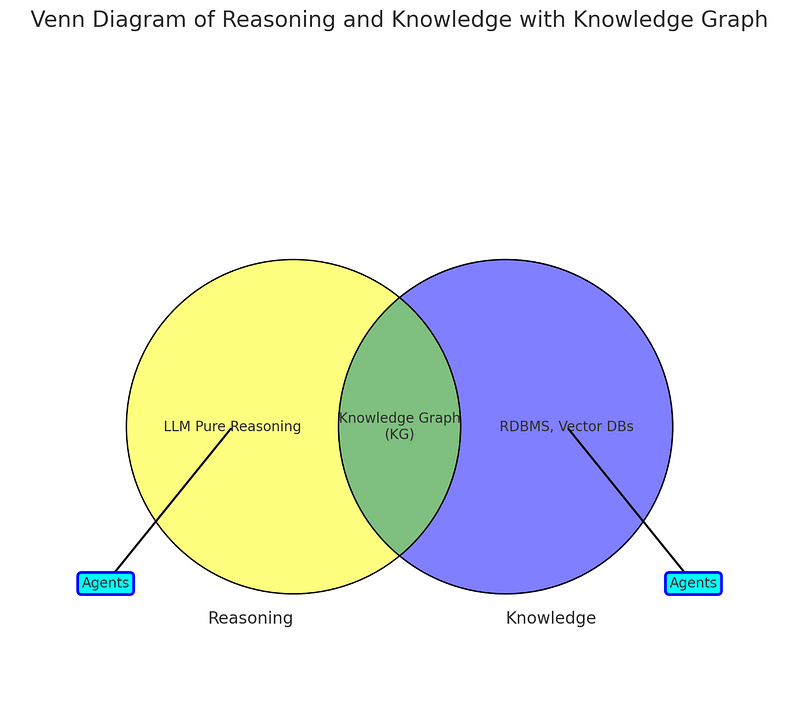
Patiently nurturing this hybrid paradigm combining symbolic knowledge graphs, contextual language models and agentic orchestration promises enterprises an invaluable asset — intelligible reasoning engines that learn continuously from curated expertise while justifying inferences with chained logic. By melding strengths of structure and adaptation, organizations set the stage for next-generation intelligence suffusing operations with strategic acumen and quantitative rigor while accelerating insight velocity.
To enhance reasoning skills, LLMs need expanded training on logical deductions across diverse modes as the next section covers.

Fine-tuning LLMs on Reasoning Tasks
LLMs today are mostly optimized for free-form text generation based on the statistical patterns learned from their training data. To enhance their reasoning skills, LLMs need further training on logical reasoning across different modes:
- Deductive reasoning: Applying rules to reach valid conclusions
- Inductive reasoning: Finding patterns and making probabilistic inferences
- Abductive reasoning: Inferring the most likely explanations for observations
- Counterfactual reasoning: Assessing alternative scenarios and hypotheticals
Exposing LLMs to large datasets that specifically require chained logical reasoning will instill more systematic thinking. This entails curating reasoning-centric training corpora and fine-tuning on benchmarks like proof complexity tasks.
The paper “Let’s Verify Step by Step” (Lightman et at. 2023) demonstrates that process-based supervision significantly improves mathematical reasoning capabilities in large language models (LLMs) compared to outcome-based supervision.
Specifically, the authors train a process-supervised reward model (PRM) to provide step-level feedback on the correctness of intermediate reasoning chains generated by an LLM. This PRM is trained on 800K human judgments labeling each step in LLM-generated math solutions as positive, negative or neutral.
They find the PRM can solve 78% of complex math problems, greatly outperforming LLMs trained only to predict final outcomes. The PRM reliably detects logical errors in reasoning chains and can accurately identify valid solutions even for problems the LLM rarely solves.
This underscores the importance of process-level feedback for instilling robust, systematic reasoning in LLMs. Simply training on final outcomes fails to correct faulty chains of inference. Granular verification of each reasoning step forces tighter logical discipline.
Concretely, the paper prescribes:
- Curating reasoning-focused training sets requiring chained deduction e.g. formal proof tasks
- Eliciting step-wise human judgments on intermediate reasoning during training
- Optimizing LLMs to predict human verdicts on the validity of each reasoning step
- Iterating training with active learning — focusing labeling on gaps and errors
Adopting this methodology trains LLMs to adhere to stepwise logical rigor aligned with human raters. Rather than memorizing patterns, models learn structured reasoning — traversing conceptual dependencies, chaining deductive implications.
This approach is extensible to counterfactual, abductive and inductive reasoning by providing supervised examples demanding those forms of inference.
However training alone is not enough. LLMs also need injection of structured world knowledge, which enterprise knowledge graphs provide, as we’ll now discuss.
Injecting Structured Knowledge Graphs

While fine-tuning equips LLMs with better logical skills, they still lack the structured world knowledge that humans accumulate through years of learning. This is where enterprise knowledge graphs come in — organizing business concepts, processes, rules into structured network of entities and relationships.
Knowledge graphs represent concepts as nodes, related by labeled edges encoding validated relationships. This explicit modeling of entities and logic rules provides structured scaffolds for reasoning. By querying knowledge graphs, LLMs gain rapid access to curated business knowledge for contextual understanding.
4 “Gates” can enable effective integration of knowledge graphs with large language models (LLMs) to enhance reasoning :
First, the Cypher Queries Gate allows precisely extracting modular subgraphs containing entities and relationships that are relevant to an LLM’s current context and reasoning needs. Queries can be launched to retrieve contextual knowledge based on decomposed information needs from natural language questions entered by users. The retrieved contextual knowledge is then injected to help guide and inform the LLM’s ongoing analysis and text generation. However, formulating valid graph pattern matching queries requires expertise in languages like Cypher. So additional interfaces may be needed to enable subject matter experts without this technical query language background to easily integrate knowledge graphs.
Second, the Vector Similarity Search Gate enables quick retrieval of useful knowledge graph content using vector approximations of nodes and edges. Encoding knowledge graphs into a latent embedding space facilitates blazing fast relevance ranking of related entities and relationships without needing to master complex query formalisms. This accelerated search allows assimilating broader contextual knowledge from the knowledge graph to guide the LLM’s language generation. However, symbolic graph traversal paths are lost when operating solely in the approximation space, sacrificing interpretability.
Third, the Graph Algorithms Gate offers complementary topological inferences about the knowledge graph, surfacing insights like explanatory reasoning chains connecting multiple entities or the most influential nodes in information propagation through the network. This structured perspective elevates systematic thinking grounded in understanding connections, rather than just assessing facts in isolation. However, directly applying generic graph algorithms risks unreliable or misleading outputs unless properly constrained based on the semantics encoded in the knowledge graph.
Finally, the Generative Knowledge Graphs Gate provides a statistical approach. By learning probability distributions over the symbolic graph, plausible new nodes and relationships can be sampled to expand coverage for an LLM. Uncertainty modeling allows judiciously propagating these generated assertions as a form of automated knowledge graph augmentation while respecting semantic constraints. However, without oversight, unrealistic propositions may be hallucinated. Joint generation with LLMs bounds imaginative expansion through grounding in the contextual flow of natural text.
Crafting interfaces tuned to the complementary strengths of structured knowledge graphs and flexible neural language models is key. Trading off accuracy, speed, transparency and coverage while mitigating intrinsic limitations allows unlocking reasoning capabilities exceeding what either representation offers alone. Orchestrated appropriately, knowledge graphs can anchor language models in symbolic logic while prompting contextually grounded neural computation — propelling LLMs from basic pattern recognizers toward reliable, explainable inference engines.
To maximize strengths of both knowledge graphs and LLMs, agentic architectures are vital to smoothly orchestrate information flow between components, as the next section illustrates.
Orchestrating using Agentic RAG
Agentic RAG provides an orchestration layer for efficiently coordinating tool execution between language models and knowledge graphs. By introducing specialized agents to handle distinct facets of this workflow, Agentic RAG enables a modular and scalable architecture.
Specifically, Agentic RAG employs document agents that focus exclusively on retrieving structured information from enterprise knowledge graphs based on natural language queries. As subject matter experts encode more business logic and domain concepts into the knowledge graph, these document agents become responsible for rapidly surfacing relevant ontological context.
Meanwhile, the language model agents concentrate solely on comprehending user questions entered in natural language and generating insightful responses. Freed from directly handling retrieval, LLMs can focus efforts on language understanding, semantic disambiguation, contextual inference and explanatory response generation.
Overseeing both sets of agents is an orchestrating controller agent. This meta-agent analyzes user requests to determine the nature of information required. It then launches queries to the most appropriate document agents, collates retrieved results, and passes synthesized context to language model agents for assimilation and answer construction.
The modular separation of responsibilities reduces overall complexity while allowing customization. As enterprise knowledge graphs grow more extensive, additional document agents can be instantiated to manage different ontological subgraphs. Similarly, multiple language model agents with specialty fine-tuning can divide linguistic labor. The orchestrating controller dynamically routes traffic between agents based on runtime needs.
This agentic approach facilitates efficient concurrency, resilience to component failures and incremental expansion as complexity increases in large organizations. The composability also creates emergent meta-intelligence exceeding the individual agents. By coordinating document retrieval, information assimilation and contextual response generation, Agentic RAG propels LLMs and knowledge graphs into an integrated corporate reasoning system.
Realizing performant enterprise reasoning engines requires sustained commitment across model refinement, graph curation and agentic coordination, as we summarize next.
The Path Ahead
Achieving performant and systematic large language models capable of robust business reasoning is no small feat. It demands continued patience and significant sustained investment across three key fronts — expansive model fine-tuning, meticulous knowledge graph curation, and sophisticated agentic orchestration frameworks.
Realizing this vision requires acknowledging that infusing enterprise operations with next-generation AI is not a one-time deployment but an iterative journey demanding commitment. Much as mighty trees grow over years from small seeds nurtured by conscientious gardeners, enterprises must plant the seeds of structured knowledge today and diligently cultivate the saplings into forests of reasoning by incrementally scaling technology and expertise.
Specifically, enterprises must devote resources to curate high-quality corporate knowledge graphs encoding validated facts and business logic as interconnected semantic relationships. Subject matter experts should document ontologies covering essential concepts, infrastructure, processes and rules codified as structured nodes and edges.
Concurrently, an array of large language models must be fine-tuned through supervised training across diverse specialty tasks relevant to the business — from language understanding, to graphical reasoning, to decision analysis. Carefully instantiated models trained in reasoning vertically within specialized domains compounds organizational knowledge.
Finally, all components must seamlessly interoperate within an overarching orchestration paradigm that choreographs information flow. Architectures like Agentic RAG fulfill this coordinator role — allowing language models to contextualize reasoning with retrieved knowledge. Only smooth assimilation between components unlocks true potential.
Reaping future returns on investment demands perseverance despite present costs. But enterprises planting seeds in structured knowledge graphs today and nurturing them to augment intelligent systems will reap rewards for years to come. The patient cultivation of reasoning engines built on sustained commitments to graph curation, model specialization and agentic orchestration cements market leadership for tomorrow by excelling corporate intelligence today.
—
Chief AI Officer & Architect : Builder of Neuro-Symbolic AI Systems @Fribl enhanced GenAI for HR
In Plain English 🚀
Thank you for being a part of the In Plain English community! Before you go:
- Be sure to clap and follow the writer ️👏️️
- Follow us: X | LinkedIn | YouTube | Discord | Newsletter
- Visit our other platforms: Stackademic | CoFeed | Venture
- More content at PlainEnglish.io


