
Gratitude
Accessing Ideas through Collage without Words
A thank you note for a SoulCollage® workshop
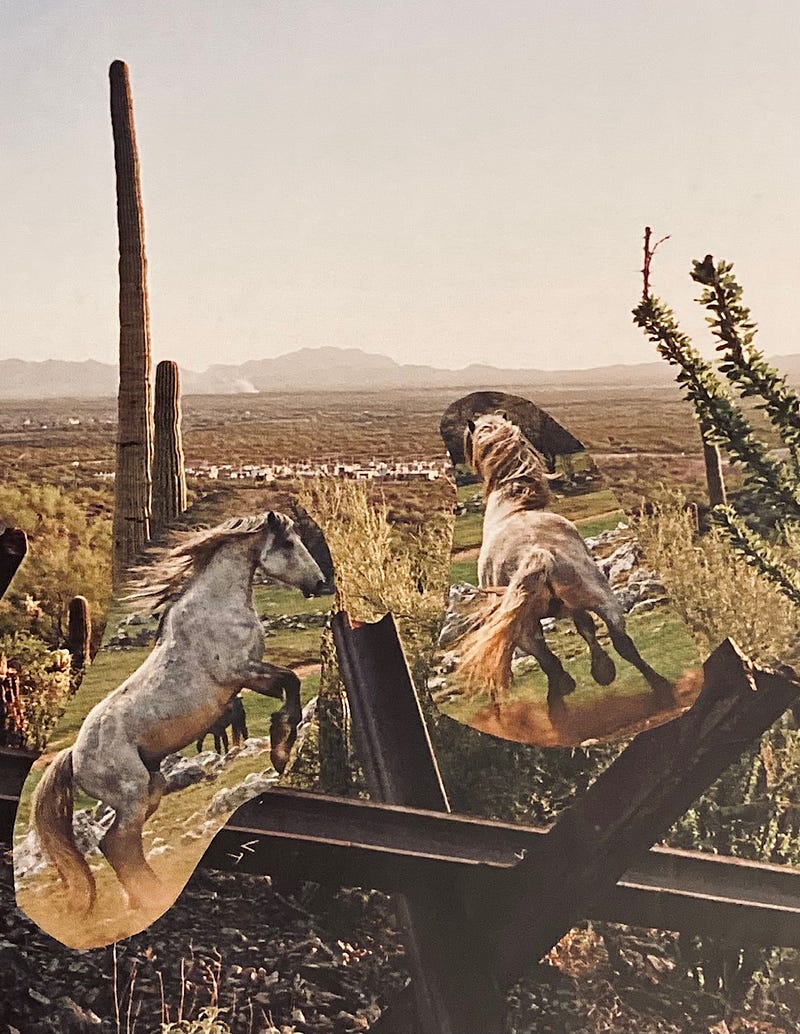
Have you ever tried SoulCollage®? It’s different than “regular” collage for a few different reasons: a couple of the most important ones are that when you do SoulCollage®,
- you never add words or other written text,
- and you allow the cards to open an intuitive dialogue.
The SoulCollage® process was founded by Seena B. Frost, a psychotherapist who had studied at Yale Divinity School. As the subtitle of her book about SoulCollage® suggests, she saw it as a project and process that could help people connect with themselves as well as their communities through wisdom and healing that might be accessed through visual imagery.
When my mom recently heard about SoulCollage®, she bought Seena Frost’s book and hoped to learn more by taking a class. Luckily, my friend Erica is a trained facilitator in SoulCollage®, and she agreed to put together an afternoon Zoom workshop for my mom, my sister-in-law, my girlfriend, and me.
I had learned a few things about SoulCollage over ten years ago when my friend Wendy and I had taken a brief workshop on it, but I remember feeling a little overwhelmed as the facilitator explained a lot about the meaning of the cards, and how we would need to create cards over time to build different suits for our personal collaged deck.
On the one hand, this sounded pretty cool — who doesn’t want to make their own card deck of personally meaningful images? On the other hand, we didn’t get much practice in actually making cards, which as it turns out is what helps you understand how and why SoulCollage® works on our hearts and minds.
Erica’s workshop was very hands-on. She had us start looking at images right away to find ones that we could relate to somehow, that could communicate something about us, and/or that we felt would go together on a card.
She also had sent us a HUGE amount of cut-out images in the mail ahead of time. She sent enough images to cover a card table in my mom’s living room. So we didn’t have to look through magazines and get distracted by words, articles, etc: we could just focus on looking at images and picking up the ones that spoke to us.
With SoulCollage®, you don’t need to think consciously about artistic concepts like composition or balance. You’re meant to be more open to letting ideas walk through the door. This was interesting for my mom because she has been taking watercolor classes (along with continuing her self-study via YouTube), so she needed to kind of suspend her desire to arrange her cards like her paintings.
For me, I realized how often I use text when I make collages. I often use it very intentionally as the focus of the work, as in a series of collages I’ve made where I cut and paste letters to form the words “Thank You.” But I also use it incidentally quite a lot in my work, sometimes letting the words and images balance with or comment on each other.
It helped me a lot to try this unique collage process of working only with images. It made my mind work differently both in the process of making the collage and then in the process of thinking about it later. It felt freer, and I saw how I might be able to use these cards, later on, to come up with a wide variety of ideas for writing because each card feels open-ended rather than having one fixed message.
SoulCollage® also has some built-in ideas for reflection and interpretation, as you ask questions of the cards and answer questions that have been created to guide you in imagining that the collage is asking things of you. These can be evocative, too, in terms of personal insight, connecting with other people, and accessing more ideas for future creative work.
Our afternoon workshop had many good takeaways for me. Here are four things I definitely want to try again:
- Creating in community. I remembered the fun of working with art and craft materials in a small group without feeling like you’re sitting down to Make Serious Art. You can enjoy each other’s company and learn from the ideas and stories that come up in the process of creating.
- Cutting out images ahead of time. I loved Erica’s idea to send us a bunch of images: it was like a special gift. I realized I could give this gift to myself or to a group of family/friends again by cutting out images ahead of time while watching TV or listening to a book, and then I or we would have the fun of looking through (and using!) the big stack of images from various sources.
- Taking a break from words. It freed me up creatively to not use any words in my work during the SoulCollage® process, and I want to do that more, both in making SoulCollage® cards again and in other projects, too, or even just in moments of my life, like taking walks where I listen to the world around me rather than trying to put everything into words right away.
- Remembering that the words can come later. SoulCollage® separates out the steps of creating artwork and putting words to it, and I think this is helpful. You can create something and have no idea what it means, but you’ll figure it out later — or maybe someone else will.
So I want to say thank you to Erica for her wonderful workshop and kind and encouraging presence, to my mom and sis-in-law and girlfriend for a lovely afternoon, and to the many people who are making and sharing collages to create more connectedness in the world!
The photo at the top of this post is one of the collages I made during our SoulCollage® workshop, and it had me thinking about the idea of sharing and collaborating with someone else to jump fences and reach new places you might not explore so readily on your own.
If you want to learn more about SoulCollage® from other Medium writers, Marilyn Flower shared an article about how she works with her SoulCollage® cards to evoke hope.
And Shaunta Grimes posted some images of cards she’s created along with ideas for interpretation. Both her article and Marilyn’s give some good context for how people can work with their cards to inspire further creative thought and action.


