

Access To Capital Is Not A Competitive Advantage
You can’t buy or growth hack into truly sustainable growth
I hope that one enduring lesson from last year’s bubble burst is — access to capital is not a competitive advantage.
Just because SoftBank is willing to lob a billion dollars at you does not mean your firm is no longer subject to the laws of competition. And the fact that your company also develops software on the side of a labor-intensive business does not make you a tech firm.
A nice case study for this is Compass, whose stock and valuation has imploded since its IPO.
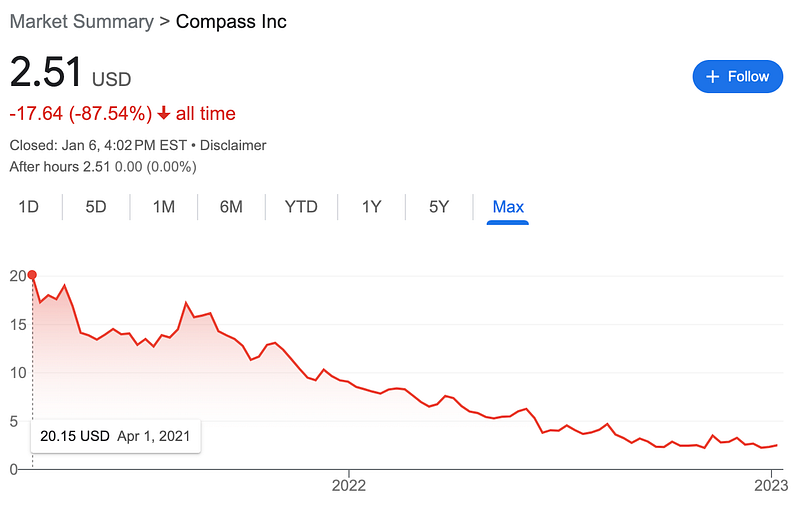
In 2021, Compass IPO’d at nearly a $9 billion valuation. Today’s it’s worth just over $1 billion and has conducted multiple layoffs to try to avoid running out of cash.
How did it get to this point? It raised billions from investors such as SoftBank, which allowed Compass to hire tons of realtors, sometimes even buying up entire brokerages. But in a way, Compass was a lot like WeWork. Where WeWork was an office leasing company masquerading as a tech company, Compass was a traditional luxury brokerage masquerading as a tech company.
Competitors Zillow (prior to its iBuying fiasco) and RedFin actually enhance the productivity of realtors with their tech. Zillow uses its website and app to generate and sell high-value leads to independent realtors. RedFin does the same except that it does so for its own army of realtors.
Compass’ strategy, on the other hand, was just to aggressively purchase real estate market share. It figured that its capital raising edge allowed it to grow faster than peers (by overpaying star realtors or buying up competing brokerages). And this faster growth would allow Compass to earn an increasingly higher valuation, which could be used to raise even more money, creating a growth feedback loop.
In retrospect (and also at the time), this looks obviously unsustainable. The rapidly growing mass of Compass realtors didn’t get significantly more efficient over time as more money was spent and more realtors were added (Compass always operated at middling efficiency according to this report). A brokerage becomes more efficient (and profitable) when it brokers more transactions per person. And it can broker more transactions by either cost-effectively generating more leads (from both potential buyers and sellers) for its realtors or servicing the same number of leads with fewer realtors (i.e. minimize realtor down-time).
Compass was doing the opposite — opening up more physical offices (fixed costs) and bringing on more realtors (and their salaries plus incentives) in hopes of taking up market share by basically being everywhere. This worked when its valuation was going up and the housing market was booming. The fact that Compass’ realtors (and business model) were nothing special could be masked by its rapid revenue growth.
Cue the Fed and higher mortgage rates. Once its stock started to crash (massively reducing the financial incentive to stay with Compass), it began losing many of its best-producing realtors. When you buy a brokerage, you’re literally buying the people that work there — so if you lose those people you basically set fire to your money. And after these departures Compass was left with a weaker workforce in an increasingly competitive market (thanks to the housing slowdown).
And given its weak financial condition and questionable future prospects, neither equity or debt markets would welcome a capital raise by Compass. So its last best hope is to cut costs hard and pray for the economic sun to rise again. When you’re lucky enough to be a hyped company with plentiful and easy access to capital, it’s like you are playing the game on easy mode (which so many startups were over the past few years). But if you never prepare, when factors outside your control suddenly force an increase in difficulty level on all players, that’s when you sink.