
How To Access Greater Healing Through Internal Family Systems
Demystify your inner world through the Internal Family Systems Framework.

What Is Internal Family Systems
Internal Family Systems (IFS) is a framework for our inner world that was developed by therapist Richard Schwarts. It has been a total game-changer in my own personal healing as well as my practice as a coach.
We’ll get into more of the details of what IFS proposes as a framework for our inner world in this article. But first I’d like to list some of the major gifts IFS has given me in my life:
- I can actually have a relationship with myself instead of psychoanalyzing and trying to fix myself all the time.
- It has supported me on my journey from surviving to thriving which is the hardest thing I’ve ever done.
- It has helped me unburden myself from many extreme and limiting beliefs that I couldn’t figure out what to do with before.
- IFS makes communicating with others more clear, easy, and less scary.
- It makes vulnerable conversations less vulnerable.
- For the first time, I understand what belonging to myself and self-love actually mean.
So what is this IFS framework that has made all of this possible in my life?
Let’s dive in.
Demystifying Your Inner World
The general framework of IFS goes like this:
Your inner world is made up of many different parts of you that coexist as a living ecosystem. Each part of you has its own personality and is capable of having a conversation with you and with other parts.
Thinking of yourself as having multiple personalities inside of you might bring up concern about pathology: “As in, multiple personality disorder…?”
No. Not exactly.
Dissociative Identity Disorder (DID) — what used to be called Multiple Personality Disorder, is what happens when the personalities inside of someone get so fragmented, polarized, and split apart (usually by severe trauma) that they present as clearly different personalities.
The truth is, we’ve all got many different personalities inside of us (what IFS calls “parts” of us) but for most of us, our parts are more integrated and significantly less polarized than folks with a DID diagnosis.
Let me give you an example of how parts in the average human can present themselves. Here’s a conversation I have with myself that many people can relate to:
Part 1: I want to eat a slice of that cake.
Part 2: No we can’t eat the cake because it will make us gain weight.
Part 3: Aren’t you supposed to be body positive? You’re not supposed to be caring about gaining weight! You’re supposed to eat whatever you want and love your body!
Part 2: Yeah but if we gain much more weight everyone we love is going to abandon us and we’ll live our life alone.
Part 1: NOW I REALLY NEED THAT CAKE.
We all have thousands of mini conversations similar to this one every single day. I have many conversations about how I relate to people, how much work I am doing that day, and how I want to spend my free time that follow this same pattern of different parts of me with their own agendas arguing with one another.
I chose the example I did because body shame is a burden our society places on both men and women from a very young age, and as a result, our parts can get pretty extreme in their arguments fairly quickly. This will help me describe the different categories of parts according to IFS later on in this article.
For now, I just want to illustrate that we all are having conversations with ourselves all the time. Our thoughts, feelings, and body sensations are the ways our parts communicate with us and each other.
We’ve got an entire ecosystem inside of us that we can actually get to know. And not only that, but change and transform.
Who Are YOU, Then?
As Richard Swartz outlines in the title of his audiobook, Greater The The Sum Of Our Parts, who we are is more than just the sum of our parts.
We are the sum of all of our parts plus our Self.
That’s capital “S” Self. Our Self is our essence that cannot be damaged or destroyed. It’s the part of us that isn’t a part.
Many IFS practitioners don’t recommend talking about the Self when first introducing IFS to people in fear that it will sound too woo-woo or confusing.
I have a different opinion.
To me, creating a Self-led system is the entire point of IFS — and of living our best life in general. So I’m going to give you the run down on the Self first, before we even get into the types of parts..
Welcome to Your Self
In his therapy practice, Dick Schwartz discovered the Self on accident. As he worked with his clients and helped their parts unblend from the driver’s seat of the person’s consciousness, what came forth was this curious, calm, and compassionate energy.
He’d ask his clients, “What part of you is this that is so curious, calm, and compassionate?”
“I don’t know,” they’d say, “It just feels like me.”
To his amazement, everyone seemed to have this “Self” inside of them that came out once their parts unblended. He and other IFS practitioners have worked with people in prisons, people with extreme eating disorders, and even folks diagnosed with Dissociative Identity Disorder, and after getting their parts to unblend, every single one of them presented their Self — even people who, given their trauma history, should not have had the “ego strength” to provide for themselves as well as their Self does.
Everyone has a Self. The Self cannot be damaged or destroyed. I think of our Self as the God or Goddess in us. The divine in us that is always present with us and is the truest reflection of who we really are at our essence.
While I believe each of our Selves has a uniqueness, there are also many things our Selves have in common. Dick Schwartz calls these the 8 C’s of Self:
- Curious
- Compassionate
- Calm
- Connected
- Confident
- Courageous
- Creative
- Clear
All of these qualities are inside of you and can be made available to you no matter how much trauma you have endured in your life.
Healing is what happens when we embody more and more of our Self energy and create what IFS calls a “Self-led inner system.”
We heal when we embody enough Self to begin to build a relationship with our parts. Establishing a Self-led system is only possible when our Self builds enough trust with our parts for the parts to unblend and let the Self lead.
The IFS framework is what allows us to remember our Self, and restablish our Self as the leader of our inner ecosystem instead of the tumultuous and polarized parts that are currently leading our inner worlds.
“But if our Self is so great, then why isn’t it leading our inner systems now?”
Great question. Let’s go there.
The Origin Of Your Current Inner Ecosystem
If your Self is the divine in you, your parts are your humanity. Your Self needs your parts because it is your parts that help your Self-energy participate in this 3D world.
Your parts were born in their natural roles that were helpful in both intention and outcome. They were deeply connected to your essence — to the life force within you — and they loved what they did to help your essence participate in this world.
But somewhere along the line, your parts got the message, “No, no, no. It’s not okay to be you as you are. In order to get your needs met, in order to be loved, in order to literally survive, you must be _________.”
Fill in the blank with whatever message you were told about who and how you were supposed to be. Maybe it was “nice.” Or “quiet.” Or tough, charming, funny, good, admirable, powerful, emotionless — you name whatever it was for you.
When you got this message, your parts twisted from their natural roles to help you be more like how you need to be in order to survive and be worthy of love. In the process of twisting from their natural roles, your parts took on leadership of your inner system and cast the Self aside because they were afraid for your survival.
These new roles your parts took on were still helpful in intention — that is, the intention of your parts is always, always, to protect you and help you survive. However, while these new roles that your parts twist into might be helpful for initial survival, in the long run, their outcomes usually attract the very circumstances they are trying to help you avoid.
An Introduction To Your Parts
Ah, finally, it is time to meet your parts.
Your parts that had to twist from their natural role twisted into two main categories: Protectors and Exiles. Within the “Protector” category, there are two types of protectors: Managers and Firefighters.
Often, the protectors are described before the exiles, but I’m going to switch that up on you in this article and describe the exiles first because in many ways, our inner ecosystem revolves around our exiled parts.
Exiles
When we got the message we arent okay or safe the way we are, our system was struck with extreme emotional pain as well as extreme beliefs about ourselves, others, and the world at large.
Parts of us twist from their natural role to take on these burdens and as a result, other parts exile them from consciousness because it is hard to function when we are in such extreme emotional pain.
These parts that took on the raw burdens of our emotional pain and were exiled from the conscious system are called our exiled parts.
When these parts get exiled, other parts twist from their natural roles in order to protect us from having to feel the pain of this exile. (These are the “Firefighter” protectors we’ll talk about next.) And even more parts twisted to make sure we never experience something that will trigger this pain. (These are the “Manager” protectors.)
In the cake example, none of the parts speaking were exiles. This is normal in many conversations within ourselves because our exiles are so exiled in our systems that they don’t even have a voice.
But if we listen closely, we can hear a reference to the exiled part when Part 2 said, “Everyone we love is going to abandon us and we’ll live the rest of our life alone.” This part is alluding to the raw pain of an exile hidden deep under the surface that carries burdens around abandonment and loneliness.
A big part of creating a Self-led system is getting our protectors' permission to visit our exiles so we can unburden them from their pain. Once the exiles are unburdened from their pain, the protector parts don’t have to work so hard in their twisted roles and in many cases, can then return back to their natural role before they had to twist into survival mode.
Unburdening our exiled parts takes a massive load off our internal systems. For instance, we might be able to eat a piece of cake without being dragged through our extreme abandonment and loneliness issues first.
While unburdening our exiles is one of the most powerful aspects of the IFS framework, it is a delicate process that can be dangerous if not done correctly. I highly recommend getting help and support from a coach or therapist that knows what they are doing. (You can schedule a free consultation session with me here.)
Firefighters
Firefighters are the parts of us that had to twist to take on the role of protecting us from the raw pain of our exiles. They view themselves as the last line of defense before our exile and all their pain blends completely with us.
IFS calls this type of protector “firefighters” because, like actual firefighters, they come out in times of emergency and they will do anything to put out the “fire” of the pain our exiles are carrying.
Firefighters are usually impulsive and take a “devil may care” attitude about saving our systems from the pain of our exiles. They don’t care about the consequences, they just want to take our system out of emergency.
Firefighters often present as rage, addictions, binging, purging, suicidality, self-harm and violence toward others. Dissociation, self-medicating, and numbing are other ways firefighters can present.
Firefighters get a bad rap, but it is important to understand that while their outcome isn’t always helpful, their intention is always and only ever to protect the system. Even though they might not admit it at first, they don’t enjoy the role they are in either, but they believe they have to play this role for the system otherwise you won’t survive. They take their job that seriously.
Because firefighters can become more impulsive the closer we get to our exiles, it is extremely important to establish a trusting relationship between our Self and our firefighters, so we can get the firefighter's permission to access our exiles. Otherwise, they could punish the system for bypassing them and accessing the pain of the exile without their permission.
In the example conversation about the cake, Part 1 showed itself to be a firefighter when it said, “NOW I REALLY NEED THAT CAKE,” after Part 2 mentioned abandonment and loneliness (made reference to the exile the firefighter is protecting the system from feeling).
For Part 1, eating is a way to numb the pain of the exile that is holding the raw pain of abandonment and loneliness. So when the exile was mentioned, the firefighter kicked into high gear and insisted that they eat the cake to stop the pain of the exile from infiltrating the system.
Managers
Managers are the parts of us that have twisted from their natural role to ensure that we don’t experience more circumstances that cause us to feel the pain of our exiles. Their motto is, “Never again.”
Managers are usually looking out into the future, trying to figure out the best possible way to proceed without risking exposure of our exiles. Managers are often in charge of how we present ourselves to others, what opportunities we take, how we do our work, and even how we relate to ourselves.
Our managers work really hard at keeping us safe from anything that might trigger our exiles. When we get in a conversation with them, they’ll usually admit how tired they are at doing their job. But, like our firefighter parts, they believe that they have to keep doing this job otherwise the system will be overrun by the pain of the exile.
In the conversation about the cake, both Part 2 and Part 3 were manager parts.
Part 2 was trying to protect the system from the pain of the exile by urging them not to eat the cake so they wouldn’t gain weight because they were afraid gaining weight would cause others to abandon them, which would trigger the pain of the exile.
Part 3 was trying to protect the system from the pain of the exile by urging them to belong to the body positive movement and love their body no matter what. If the system can agree to love their body no matter what, they can soothe the exile’s pain to make it more manageable.
Both of these manager parts were trying to protect the same exile that holds abandonment and loneliness pain around their body image, but they had different opinions about how to do that. Which is very common for managers.
Resources For Creating A Self-Led System
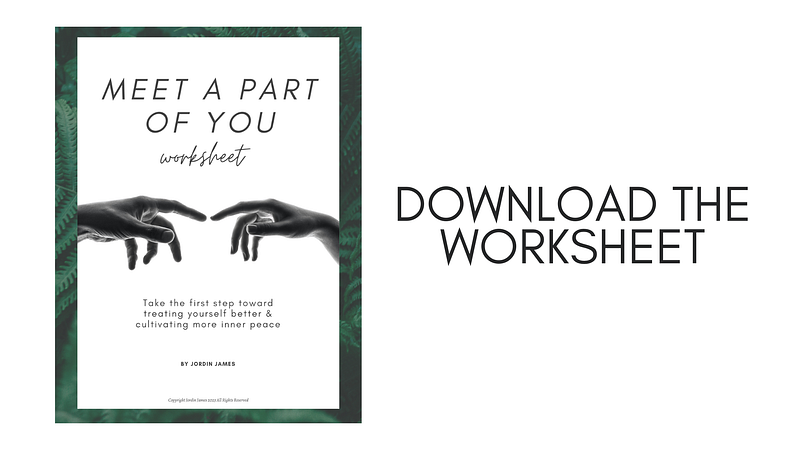
I created a free worksheet that will allow you to meet as many parts of you as you want! It’s called a Meet A Part Of You Worksheet and you can download it for free right here.
The worksheet is pretty straightforward, but you’ll also get a video of me walking you through it step-by-step. (Not to mention a bonus parts-work meditation).
Parts Work Academy is the course I needed when I was lost in my own overwhelming emotions and trauma responses (more on that in this article).
I don’t want anyone to have to navigate their overwhelming inner landscape alone and without the proper tools to actually transform their inner turmoil into lasting inner peace — that’s why I created Parts Work Academy.
In this online course, I’ll walk you through your inner world step by step, and give you all the tools you need to resolve your emotional overwhelm and confusing behavior at the root.
Side effects of completing Parts Work Academy include:
🧘🏽♀️ Feeling relaxed in your body around other people, even in circumstances that used to give you anxiety
💖 “Being yourself” no longer feels terrifying or confusing, in fact, it feels like the simplest, easiest thing you’ve ever done
🌊 You confidently process through even your most complex emotional waves
🌟 Even strangers can’t stop commenting on how bright you are shining
😁 You often catch yourself smiling for no reason
🥰 You can’t stop thinking, “Damn, I didn’t know it could feel THIS good to be me.”
Please join us right here!
That’s all for now, friend. I hope we stay connected and you continue building trust with your own parts, but if not — I wish you the best on your healing journey!


