
Accepting My Voice
A realization that changed the perception of my Self
It’s a very frequent occurrence that people can’t tell me and my sister apart when we answer the phone. Even her boyfriend (now husband) struggled with that.
I was very proud of that and not at all annoyed, because I liked having something in common with my sister. I have spent most of my childhood and teenage years wishing I could look like her. Not just in terms of appearance though; I wanted to be as social and outgoing as she is. Since those were things I couldn’t change (even though I tried), having similar-sounding voices was the next best thing.
However, I would still feel insecure about my voice. I used to believe that my voice would give away my big secret that something was going on with my gender identity. As a result, I would often try to sound “more girly”. Taking music and solfège classes helped a lot because I could change my pitch easily.
Having a part-time job as a guitarist/singer boosted my confidence, but I was still unconsciously concerned, despite being out of the closet. For many years after that, I had just accepted that this concern will be with me — until I got a job as a Psychologist at a Helpline.
Talking on the phone is not something I’m good at when it comes to my everyday life. But I can manage when I’m in a professional role. After the initial training, the time came for me to start answering the phone at the helpline. The supervisors were amazed by the way my voice sounded over the phone. The truth is that I was consciously manipulating my voice to convey more empathy, since there was no visual contact with the caller. Have you ever heard of the “typical therapist voice”? That’s what I probably sounded like, but in a good way (according to my supervisors).
An issue arose during that time, with a man I used to be casually intimate with some years prior. He had a problem and needed some advice, so he called me. After several phone calls, his issue was resolved. That’s when he told me about my voice. Among other things, he said that he finds it soothing. It’s amazing how synchronicity works.
I discussed this with my therapist, and explored how it made me feel. That’s when we started a long descent into the abyss of my unconscious to figure out what the real issue is with me and my voice. Being at the helpline offered plenty of triggers for the issue to resurface to a sub-conscious awareness, but we needed to go deeper.
After a lot of crying and trauma work, I arrived at the answer. As I said initially in this story, a big concern of mine was that my voice would give away my struggle with my gender identity. I was afraid because I thought that this would also give away my sexuality, since my voice isn’t the typical high-pitched “girly” voice. But, since I knew nothing about gender and sexuality back then, I believed that voice is indicative of your gender and sexual orientation — and I feared that others would figure out that I wasn’t cis and straight. So, I grew up being conscious of the way I sound like.
However, another realization brought on the biggest change in the way I see myself. I have used my voice countless times to calm others down, to appear more likeable, and to offer soothing and empathy. That’s not (only) because I want to be a good person and a good therapist.
I realized that my voice became one of my strongest weapons against my mother. Not to shout back at her, but to calm her down. It was a way to defend myself. If you can keep your abuser calm, you hope that they won’t abuse you as much. As a result, I learned how to manipulate my voice in such a way that would calm down even the mightiest of beasts.
To lighten up your mood, here’s a meme I generated that sums up my reaction when everything clicked in therapy:
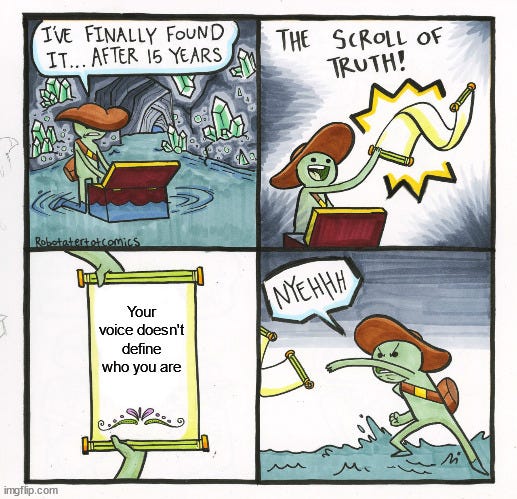
Bringing those two realizations together took some time. After all, I had spent so many years resenting my voice and being unconsciously concerned. For a few months after that, I was a bit lost. I didn’t know what I should do next. Eventually, I accepted the way my voice sounds even if sometimes I still go through phases of wishing that I could make it sound gender-neutral.
Now, I can say that I am at peace with my voice. I understand that some of the behaviors I learned as a response to trauma can be used to help others. I am also more confident to talk on the phone, even when I’m not in a professional role. A part of me still wishes that I could be more like my sister. But that’s for another story.
Have you ever had to work on accepting a part of you that you considered “problematic” in any way? How did that go?