
Abwoon d’bwashmaya, The Vibrations of the Our Father in Aramaic
Unveiling the Vibrant Essence of the Lord’s Prayer in its Original Tongue

The Lord’s Prayer, or Our Father, is one of the most well-known and frequently recited prayers in Christianity. Yet examining the original Aramaic language reveals nuances and meanings lost in translation. When we dig deeper into the word's origins and cultural contexts, surprising new interpretations emerge that can profoundly reshape our relationship with the divine. This treasured prayer contains hidden depths, and re-evaluating it through the lens of its original language opens up new avenues of theological and spiritual inquiry. As we will see, a more accurate rendering from the Aramaic provides beautiful new insights into the nature of God, heaven, and our connection to the divine within.
Let’s take, for example, the first line: Abwoon d’bwashmaya (Our Father who art in Heaven). The prayer begins with the blessing that emanates from the divine creator. The ancient Middle Eastern root ab refers to all fruits, all germinations that come from the source of Unity. This root has been used in the Aramaic word to indicate the personal or spiritual father-abba, but its root does not specify a gender. It indicates, beyond our concepts of male and female, a cosmic birth process.
Our Father from Aramaic
Abwoon d’bwashmaya Abwoon d’bwashmaya Nithqadash shmakh Tey tey malkhutha Neqwe sebyanach aykanna d’bwashmaya aph b’arah. Havlaan lachma d’sunqanaan yaomana, Washboqlan khaubeyn (wachtaheyn) Aykana daph…khayyabayn. Welaa tahlaan l’nesyuna Ela patzan min bisha. Metool dilakhie malkhutha Wahayla, wateshbukhta Al ahlam almin. Ameyn.
English translation
O Birther! Father-Mother of the Cosmos, you create all that moves in light. Focus your light within us — make it useful: as the rays of a beacon show the way. Create your reign of unity now — through our fiery hearts and willing hands. Your one desire then acts with ours, as in all light, so in all forms. Grant what we need each day in bread and insight: subsistence for the call of growing life. Loose the cords of mistakes binding us, as we release the strands we hold of others’ guilt. Don’t let us enter forgetfulness, but free us from unripeness. From you is born all ruling will, the power and the life to do, the song that beautifies all, from age to age it renews. Truly — power to these statements — may they be the source from which all my actions grow.
This translation is taken from the book Prayers of the Cosmos: Meditations on the Aramaic Words of Jesus by Neil Douglas-Klotz
Abwoon
The Aramaic word Abwoon (Our Father) — pronounced Abuuun, is made up of four parts: 1) a: the absolute, unique being, pure unity, source of all power and stability, which evokes the Aramaic word for God, Alaha, literally, the Unity; 2) bw: a birth, creation, a flow of blessing, as from within this Unity towards us; 3) oo: the breath or spirit that carries this flow, which echoes the sound of breathing and includes the forces we call magnetism, wind, electricity, and more. This sound is linked to the Aramaic phrase later translated as holy spirit; 4) n: The creative vibration of the Absolute, of God, resonates in the earth and bodies.
The rest of the phrase completes the motion of Abwoon d’bwashmaya. The central root of d’bwashmaya is in the middle, shm.
Shm can mean light, sound, vibration, breath, name or word. It indicates what arises and shines in space. In this sense, the name includes the sound, vibration or atmosphere, and the sign or name that makes Abwoon knowable is the entire universe.
The final aya shows that this sparkle includes every centre of activity, every place we see, as well as the potential capabilities of all things. So shmaya, the vibration or word with which we can recognize the oneness — the name of God — is the universe, and this is the Aramaic conception of heaven, the radiant vibration that shines throughout the entire universe. Because Aramaic is a language of vibration, it is particularly important to intone it aloud.
The prayer is a practice of tuning into the divine vibration, becoming one with the source of all creation. For this reason, I call this day apart “getting on the wavelength of God,” and we will participate in what Neil Douglas-Klotz, an Aramaic-speaking Sufi, calls in his book Prayers of the Cosmos “body prayers,” which encourage us to participate in the sound and feel of the words, as well as their intellectual or metaphorical meaning. Experiencing the words with all of ourselves on what Douglas-Klotz calls a mystical or universal level of interpretation.
In ancient times as today, prayers are sung by Jews, Muslims Eastern Orthodox Christians, and many other religious traditions. Sacred sound, whether as prayer, music, chant, song, or incantation, is a vital force that permeates all aspects of creation. The Essenes, who were known to be powerful healers, are said to have been instructed in the mystical arts of sound and nature. As already mentioned, Jesus himself is likely to have been a member of the Essene community, and therefore to have also learned these arts. Whether this was the case or not, in singing the prayer in its Aramaic form, as He gave it, it is remarkably rich in long vowel sounds that bring resonance.
Vowel sounds
Relating the colour coding of vowel sounds in prayer to the chakra chart below, it becomes evident that there is a saturation of green among the vowel sounds, indicating a large proportion of ah sounds that resonate with and in the heart chakra, the centre of our being and the centre of love, joy, compassion, and forgiveness. All long vowel sounds are found in the last three lines, influencing each of the chakras and resonating through them.
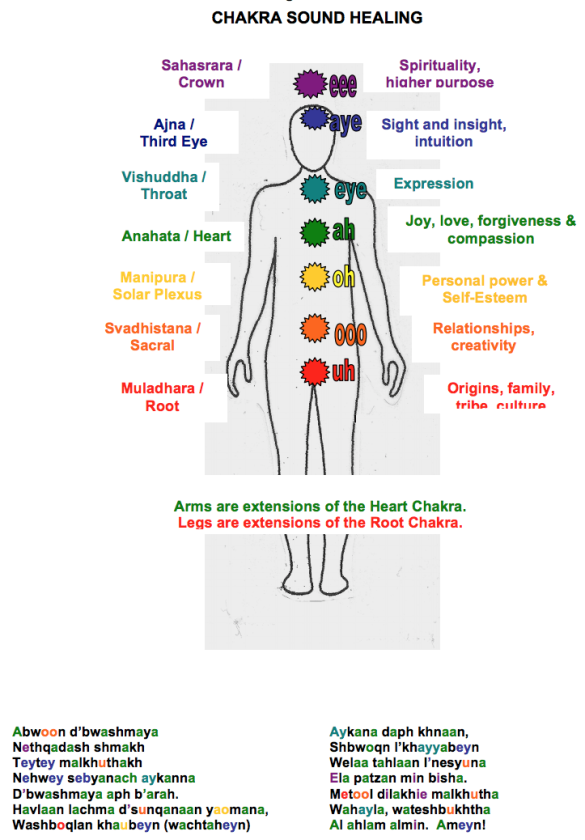
According to the studies of Suchinta Abhayaratna, singing the Our Father in Aramaic can be a strongly mystical healing experience. The intention is to be channels for the divine qualities of unconditional love, compassion, peace, harmony, and healing grace on our planet, as Jesus did
The scholar Rocco Errico interprets the term “Slotha”, the Aramaic word meaning prayer, as:
“putting the mind in a trap to capture the thoughts of God”
and further defines it as “a mood in which we all still have personal thoughts and do not seek to project anything outward,” and “a state of total awareness and attention”. He writes: “Preparing a trap for God” suggests that we can trap all the love, joy, truth, peace, energy, and compassion we need when we are receptive to all that is.
Conclusions and Takeaways
The Abwoon d’bwashmaya prayer is a powerful energetic force to unify the fragmented parts of ourselves, our families, our communities, our countries, and our world with great healing potential for the difficult times in which we live today. At a time when our planet is suffering from numerous wars, natural disasters, environmental devastations, and consequent human suffering, this prayer offers mankind energetic, vibrational, and alchemical support to project Sacred Unity onto our planet. Tapping into the energy of Jesus’ intentions and words given to his followers more than two thousand years ago in Galilee, we express our intentions to manifest unity between Divinity and humanity and bring the peace and harmony of the cosmos into alignment with the earthly plane.
Singing the original Aramaic words of the prayer, we give creative sound to the intention and set in motion a vibrational alchemy in body, mind, and spirit through which man can transform and transcend to experience the divine mystery of Sacred Unity defined as Alaha.
Thanks for reading.


