About the “Mathematical” Quizzes We See on Facebook (And Social Media)
We should call them engagement-bait quizzes instead

Every second day on social media, someone will share such a picture and ask people for the answer.
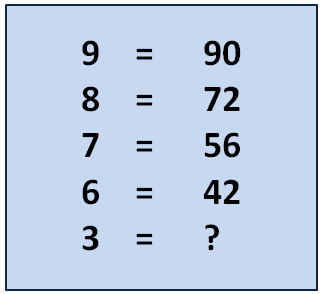
Mathematically speaking, there’s no answer. Or rather, there’s an infinite number of solutions. These quizzes are (at best) psychological games. We’re playing “Guess what the person asking the question had in mind.”
It’s an amusing game but not a mathematical one.
Mathematical Analysis (skippable part, but I kept it simple)
(More accurately, I tried to keep it simple)
The first correct reaction mathematically is that 9 isn’t equal to 90. A better way to write the problem would be:
- F(9) = 90
- F(8) = 72
- …
And ask what’s the “correct” function F.
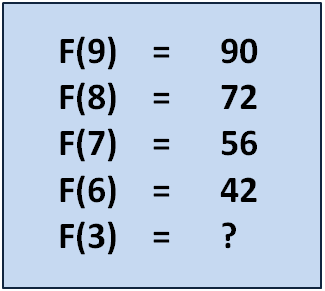
Again, there’s no “correct” function. At best, there’s a “generally accepted answer.”
But, if you ask it in this format, it’s harder to trick people into a “wrong” answer.
People usually answer 12 or 18 depending on several factors:
- Did they pay attention?
- Did they consider that steps 5 and 4 were skipped or non-existent?
Paying attention is crucial because many of these tests trick you into thinking the answer is obvious. It’s the same with standardized tests. Often, there’s an obvious (and wrong) answer, and finding the correct one requires more attention to detail.
In our case, F(X)=X*(X+1) is the generally accepted answer.
- F(9) = 9 x (9 + 1) = 9 x 10 = 90
- F(8) = 8 x 9 = 72
- F(7) = 7 x 8 = 56
- F(6) = 6 x 7 = 42
- And F(3) = 3 x 4 = 12
BUT.
You could apply a different logic, which is:
- I take the 9 and multiply it by 10 = 90
- I take the 8 and multiply it by 9 (the previous number) = 72
- I take the 7 and multiply it by 8 (the previous number) = 56
- I take the 6 and multiply it by 7 (the previous number) = 42
- I take the 3 and multiply it by 6 (the previous number) = 18
This second solution is the same as the first one except that we skipped steps 5 and 4.
- F(5) = 5 x 6 = 30
- F(4) = 4 x 5 = 20
It might be because we went too fast and didn’t notice the numbers were in decreasing order (9, 8, 7, 6) until we skipped to 3.
OR, it might be because we considered the “rule” (multiplying by 10, 9, 8, …) applied no matter what the following number was.
Written as a function, the second solution is F(X) = X*(10 — number of the line +1)
- F(9) = 9 x (10 — first line +1) = 9 x 10 = 90
- F(6) = 6 x (10 — line #4 +1) = 6 x (10 -4 +1) = 6 x 7 = 42
- F(3) = 3 x (10 — line #5 +1) = 3 x (10 -5 +1) = 3 x 6 = 18
BUT.
I could also define the function Smillew as
- Smillew(9) = 90
- …
- Smillew(6) = 42
- and Smillew(3) = BANANAS
- or Smillew(3) = 888
And it will be a valid answer, albeit statistically less common.
Takeaway (that you can read even if you skipped the mathematical part)
The unique purpose of these quizzes, as shared on social media, is to farm for engagement. The quizzes have to be obvious enough to not be too hard, but enough of a challenge to make the puzzle solver feel rewarded.
And they usually have several logical answers because then there’s a good chance people will argue with each other in the comments. And there’s nothing the social media algorithms like more!
If you posted the following question:
1, 2, 3, 4, 5, ?
It wouldn’t work because the “generally accepted answer” is too obvious. People wouldn’t even take the time to answer, except for trolls who might leave an insult or two.
The example from this article works better because there’s a debate on what constitutes the “generally accepted answer.”
One last quiz before you go
(I stole it from Sapolsky’s Introduction to Human Behavioral Biology course — highly recommended)
What’s the next number in the following sequence?
14, 23, 28, 33, 42, ?
Good luck, and don’t forget to leave a comment with your answer!
For the answer and more mathematical quizzes, subscribe to my Top Hat Seminar on Substack!