About Some Poems
a deep dive into four poems on Medium
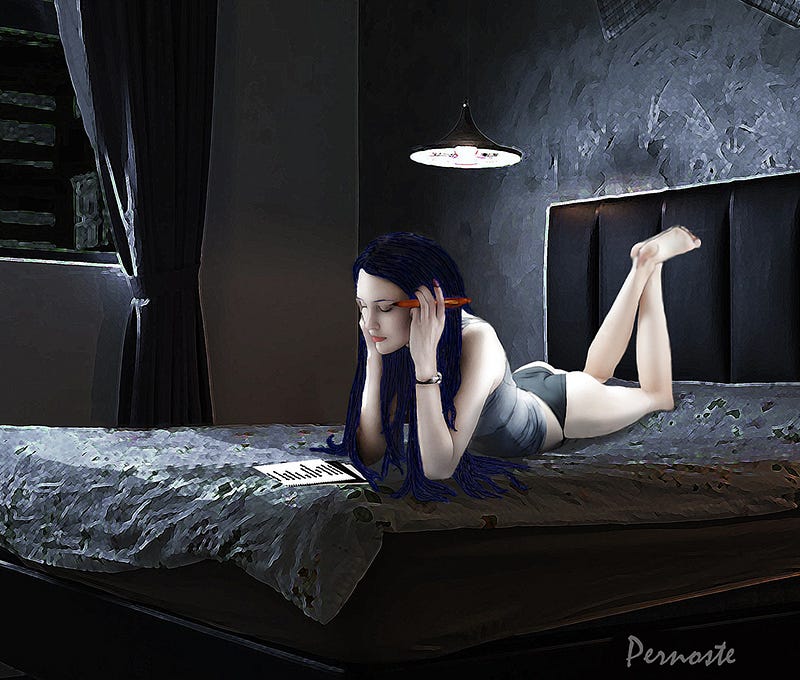
Warning, this is an article about reading and appreciating poetry. Without sufficient care, reading this may cause you to start writing in short lines of highly descriptive words, perhaps causing you to unwillingly incorporate metaphors.
Reading this article may even cause you to actively and enthusiastically seek out poetry here on Medium.
As a final caution, there are also many too many words below for you to possibly read at one sitting in this busy and demanding world. Proceed at your own risk and pace yourself. Come back as often as you like.
We love poetry. What is it about poetry we love so much?
Pernoste claims that there is energy in words that are put together in a certain way with the power of our intent behind them. And it’s different, mostly, as compared to prose, for the concentrated care in the words used. Every line is composed meticulously, not just for the words, but for the sounds of the words, the connotations as well as the meanings, and even the way the writing forces you to breathe and pause. A good poem casts a positive energetic spell on the reader.
Dahl claims that poetry is the language of the heart that each poem speaks fully and completely, not needing so many words because of the deeper meanings within. A good poem can resonate with your heart to make you fall in love with a moment, an idea, a feeling… or bring back memories.
We would proclaim that we’re both right, but what else would a couple of crazy poets say?
We will confess right up front, however, that we don’t love all poetry. We like and sincerely admire most of it. We have our preferences, of course, types of poems and subject matter that we feel speak to us. We especially love poems that we must think and feel deeply about.
This doesn’t mean that we don’t enjoy simple, elegant, and direct poetry as well, but there is something about a poem that makes you think and feel, makes you pause and read it again, that can change you. It is such a magical thing to engage one’s heart in a poem, stumbling unaware across a turn of phrase or a particular word or idea that hits you with the force of a memory or a desire or a hope that you didn’t know you had.
You, dear readers, may enjoy different aspects of poetry, the musicality of rhyming poetry or the subtle simplicity of haikus, and that is great, too. Just never rush though reading a poem. Better to not read at all.
So, we have spent some quiet time lately going through a lot of poetry on Medium across a wide variety of publications to find a couple poems that we could highlight and discuss. [We have copied these poems here, but we ask you also to follow their links, as well, to show your appreciation if you enjoy them.]
Now just to clarify, we are going into this completely biased toward what we like, and we selected some poems that we feel are interesting and strong.
So first, here’s what we are personally NOT as excited about:
1. Very rigid rhyming/meter construction — we generally find it distracting from the heartful part of poetry, though some poetry are certainly admirable in their clever constructions.
2. Excessively long lines (the ones that wrap to multiple lines) — prefer at least a little structure and edible bite-sized lines.
3. Excessively long poems that are only long due to redundancy or beating metaphors to death. Don’t see the latter too much, but the former, yes. Most times less is more. Trim, trim, trim.
4. Love poems comparing one’s lover to the sky and the moon in June — sadly we can’t resonate well with them, and there’s just so much of that out there in the world, and they’re all kind of the same.
5. Very short poems — because there’s usually not enough meat in them (for us, anyway) to get a feeling of the poet or the message.
6. Bad poems ‘nuff said
Our preferences along these lines don’t mean that these other types of poems aren’t great, either inherently or for a reader’s personal reasons, it’s just that they aren’t to our taste. Occasionally, we are blown away by a poem in one of these categories. Except for the bad ones of course, though we really haven’t seen much we would call “bad” on Medium other than apparent AI poetry. Please stop.
Now, here’s what we ARE excited about:
1. Freeverse or minimally rhyming poems with beautiful flow and trimmed down perfectly.
2. Unexpected concepts or phraseology — because we like to be surprised. It’s OK for a poem to cleverly deviate a moment for a well chosen metaphor.
3. Serious/interesting Poems that capture the internal thought process of the author
4. A certain amount of structure (in form and concept) and not overly verbose.
5. Good movement in the idea/story with not too much ‘splaining — Tell your story/feelings in more indirect ways.

So we went on a butterfly hunting expedition through various Poetry publications on Medium with a process of rapidly screening through a lot of poems to identify some authors of particular interest to us. We then took a deep dive into a few specific poets to see if we could find a poem that really spoke to us. There’s so much to read that we can’t say we got too deep into all the poets on Medium, but it’s a start.
Here are the poets and their poems that we would like to discuss. We included a poem of our own that has been little seen.
- Teresa Sutton —”Confiteor 1" (not a member of Medium but published in The Coil)
2. Morgen B Nudel — “U” (published in The Creative Cafe)
3. Aaron Waddell — “Taking the Second Road” (published in Illumination)
4. Pernoste & Dahl — “Lena Sings the Blues” (published in The Howling Owl)
We also took the liberty of narrating and putting their poems to music. Hopefully you like how we did them. We will send you authors the MP3 or MP4 if you like. Just reach out.
Confiteor 1 by Teresa Sutton
[I confess]
That tears from Dad’s crying spells could fill cups of croci. No one craves the sight of a flower after it scatters its seeds and droops. On this key point, science is silent. No one itches to imagine a blossom as it withers.
[I have greatly sinned]
As a habit I slice rose stems, make them shorter daily to add time to their natural lives — I spritz their petals with hairspray, a trick to preserve their good looks longer — I add an aspirin to nourish them in their final days though brown stems cannot drink.
This is a fascinating poem by Teresa Sutton that can be read in a couple of ways. On the surface, it appears to be about flowers, first about the world’s lack of care about withering of flowers once they’re past their prime.
“No one craves the sight of a flower after it scatters its seed and droops.”
And then it moves on to describing tricks to make flowers appear to last longer. The language is concise, yet with some surprising turns of phrase, and it is rich with imagery.
But is this what the poem is truly about? Even without knowing anything about the author, we note some interesting paradoxes. The title is Confiteor 1, and a confiteor is a penitential prayer of confession.
The poem begins [I confess], and the second part begins with [I have greatly sinned]. Maybe the clue is in the reference to her father’s crying spells, perhaps due to grief, but more likely due to the decline of his health written beautifully in metaphor as the withering of a flower. A brief visit to the website of the poet (Tsuttonpoetry.com) reveals that she has written other works about the decline of her father from dementia.
So in this poem, when she further describes her “sin” of tricks to preserve the appearance of health and vitality of her roses, maybe she is concerned that what she does as a loving daughter to help her father is merely “tricks” that really only create the illusion of prolonging health. Unfortunately, though the aspirin helps (a metaphor for dementia treatment or general care), in the final days the “brown stems cannot drink”.
The beauty of this poem (in addition to the crisp and compelling language) is that we really must contemplate the paradoxical nature of the writing to gain some sort of understanding. She could have written a more direct poem about her father’s dementia, but her approach here, using a compelling metaphor, creates a deeper moment with the reader.
It’s a crime that this poem received only 86 claps and 2 comments on Medium.
U, a poem by Morgen B Nudel
I told you you wouldn’t get it wouldn’t get me would only bring silence into my confused world. Quiet enough to hear the unsure hesitation in your breath after I have a breakdown, when you aren’t sure what to do, what to do with me? But I still love you love you like I said I would I said I would always be there for you even when I’m crying in bed while the alarm rings for the 10th time… The 10th day in a row I can’t get up, but I said I’ll be there for you. And you’ll be there, too you’ll be there, silent, careful hesitation on your lips, but I know you’ll always be there. Even if I told you not to, even if I told you you wouldn’t get it.
The free and raw writing of U cuts very deep, a self-aware and painful revealing that she knows exactly what she is and that she is difficult to understand. Her words bespeak a certain strength of character, a commitment to being there for her lover even though unable to rise from bed. The power is in the spare language and the almost free-associative writing style, seeming to be spoken while weeping… trying to explain herself.
There are other poems that speak of depression, but notably the word depression is not mentioned in this poem. Yet this poem packs a lot of emotion, with her lover at a loss for words. It seems it is not because of his doubts that he is silent, but because of his caring and loyal nature. This is all conveyed in the way she speaks of him, which makes it deeper and more unique.
U is a lovely poem that, sadly, garnered only 241 claps and 1 comment.
Taking the Second Road: returning to that “yellow wood” by Aaron Waddell
Two noble roads is a forest split A place I’d been many ages ago Now looking changed from where I sit Their paths in glowing sunlight lit Lightly covered in the fallen snow
The first stretched out straight and long Before bending behind a grove of trees Once I’d followed its siren’s song That day from which it’s been so long Thinking it the only path for me
The second yet still much less worn A mess of branches and scattered stone The fear by which my heart had been torn Now I look at it with gaze forlorn With thoughts of what it might have shown
Oh had I but sought what the latter brings I would have felt so wild and free But regret is such a silly thing And the joy of which this first did sing In truth, I could not have ever seen
Two noble roads is a forest split And when asked of all the places I’ve been Happily, I will tell of that time when with gratitude, I took the second, in it - knowing I shall not pass that way again
This poem by Aaron Waddell was inspired by Robert Frost’s “The Road Not Taken,” a beautiful and famous poem about walking in nature and choosing one path over another. The poem itself has become a metaphor for life choices and the fact that we often must sometimes choose to leave opportunities behind.
There’s a feeling in Frost’s last stanza, that the author wonders sometimes about that other path.
We wonder no longer. A. Waddell brings the same individual back to those yellow woods to take the other path. He adopted the same unusual rhyming structure (ABAAB) and pleasant irregular rhythm (though changing subtly the rhyme scheme in the last stanza… perhaps as a deliberate reminder that he is not Frost.) We do a more in-depth analysis of Frost’s poem in “How to Read a Poem” that includes Pernoste’s reading, if you would like to compare them.
Waddell’s “Taking the Second Road” is beautifully done, and worthy of Frost in our estimation. It harkens back to that original walking of the first path and how it feels to return. It is happy and melancholy and philosophical in much the same way as the original poem.
This poem achieve 1000 claps and 13 comments, but should have gotten much more attention.
Lena Sings the Blues by Pernoste & Dahl
The velvet words favor the night, calling so insistent and tender to me, as the voice folds inside saxophone prayers. I’m immersed in drowsy syncopations, and long, breathless expectations, as I step in from the street.
It’s an old bar that’s half empty and far away from any dreams, just a mix of young couples and old men with the broken look of the blues writ hard on them seen in steel eyes and wry smiles.
Tonight I bring my old guitar and my nerves, and my fears, “If not here, then where, when?” Lena smiles and kisses my cheek, winking at the drunks at the bar with their hopeful dreams of her.
It always becomes quiet in here when Lena sings the blues, and tonight my guitar hums along. Notes cascade and fly like whispers, a music of heart and memory, and smoke and water…and regret.
Her voice, smoky, sexy in its promises, makes you weep gratefully from the memories they bring, while the caress of her piano dries your inescapable tears with soft, comforting hands.
Luckily we know these authors very well, so we can give the inside scoop on this poem. First of all, why are we narrating our poetry now and putting them to music? Anneliese wrote a poem called “A perfect morning” a few months ago, and a nice woman we knew asked if she could feature it on one of her podcasts. It was really a very sweet thing to do, and it was included with a number of other very lovely poems. But when we listened to the podcast, we realized that the host was just reading these poems like reading out of a book.
She had a nice voice and all, but we realized that not many people really were either able or comfortable enough to read poetry with emotion and with consideration of the author’s intent. So we wrote an article “How to Read a Poem” and featured 2 poems (a famous poem) and one of ours, with readings. It seemed a natural thing to put some soft music behind them.
“Lena Sings the Blues” was the first poem we decided to write in which we actually made the words mesh with the music. Anneliese and I both (being musicians) have had experiences going to jazz clubs and bars in which we met and befriended the musicians. Anneliese, in particular, has had the opportunity to join in at times to sing or play, so we made a composite story/poem about the experience of a young woman going to an old dive of a jazz bar and playing guitar with a performer “Lena,” who is like a golden light to everyone who sees and hears her.
Much of our freeverse poetry tends to be storytelling rather than observational, so we take the reader from the street, to the bar, to her nerves, to being welcomed by Lena, to playing and becoming immersed in the moment and the music, and then getting lost in the magic of Lena singing the Blues.
Anneliese listened extensively to the music, and she found the rhythm for the reading of it. Some post-production adjustment of pauses between the words by me further allowed optimal alignment of musical licks with certain phrases. At some points the words even go along with the music.
This poem receive 792 claps and 10 comments.
We were concerned that people may prefer to just read poems on their own, but listening is not required. We repeat… you are not obligated to listen! But we’ve been happy to get very positive feedback on our readings. [Who doesn’t want to hear Anneliese’s lovely voice, after all?] Many tell us they like to read them first and then listen to see how their feeling and interpretation of the poem changes.
We hope you enjoyed our little foray into the work of a few poets. More importantly, we hope the poets enjoyed our little exploration of their poems.
Check out our other writing on Medium and our verse novel “In the Minuses” on Amazon.