
BIBLICAL REFLECTIONS
Abel Brought the Best, Cain Brought Whatever
Day 3: Genesis 4: 3–6 The ultimate sibling rivalry
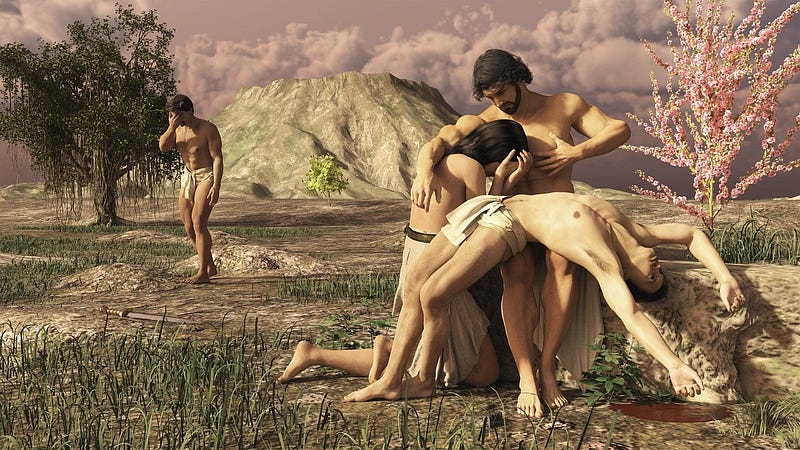
A story of a dysfunctional family with the head of the family (G-d), facilitating trauma
I didn’t realize so much was packed into the story of Cain and Abel. My perceptions of G-d have changed tremendously since I discovered mysticism.
If you want a traditional and very different reflection on the story of Cain and Abel than the one I’m going to give you, read this one.
I’m going to address the following:
Abel who gives to G-d the best of what he raises. He chose the firstborn lamb, the best of his flock. The impression is Cain went out and gathered “stuff” from the field, perhaps the leftovers, and gave those to G-d.
G-d wanted only the good stuff, the unselfish offerings. If those weren’t offered, G-d would express disapproval and favor one over the other.
The favoritism of Abel over Cain led to deadly jealousy, the “Dad/Mom always loved you best” syndrome.
The Creator cursed the land Cain would till, decreeing the soil would not grow crops. This occured after the murder.
G-d gave Cain a mark of protection as Cain wandered the world trying to make a living.
My personal view/relationship with God will be woven throughout these comments.
Personal History
A little of my history. I attended Catholic School grades 1–10. In college, I served as a member of a retreat team at the Catholic Student Center.
A couple of years after graduation from college, I entered the convent for a 20-year sojourn. While in the convent, I completed a Master’s degree in Theology from the University of Notre Dame.
Beginning at 19, I delved into mysticism. First was the Charismatic Renewal, followed by Centering Prayer, and continued with the deepening of my relationship with the Source of all in metaphysics.
And, yes, I’m well aware traditional Christians, especially evangelicals, consider New Age (metaphysics) to be evil and separate from G-d. The Catholic bishops agree with you. My personal experience does not.
My journey led me from a belief in a G-d who judges everyone, relegating them to heaven or hell, to a G-d who loves, accepts, heals, and wants only the best for us. This includes bringing everyone back “home,” under one roof, so to speak.
Give G-d the best
All throughout school, the Sisters taught me to give G-d the best.
Why? Because G-d created me from G-d’s own image, and G-d gives me everything.
Giving the best meant giving the best of my thoughts, words, and actions. My “firstborn” would be what I am proudest of. Doing my best meant I fulfilled my potential.
According to the writer of Genesis, did G-d want Cain to give the best from his fields, and not that which fell on the ground?
The best would be intentional. The produce gathered from the ground is an afterthought.
From my own relationship, the Creator, All That Is, Love Itself, G-d, desired relationship.
When you experience a loving relationship you want to share the best of yourself, the best you possess, with the one you love. The relationship is crucial.
G-d’s disapproval and favoritism led to murder
Genesis doesn’t tell us what kind of parents Adam and Eve were. We only learn about the kind of parent God was.
As a former therapist, I saw many families in which one child is the favored one, the hero, and another child carried the family problems, the scapegoat.
The so-called scapegoat was reinforced by parents to be the screw-up. Nothing good was expected. The family totally by-passed the gifts and talents of that child.
The story of Cain and Abel appears to be lifted from the annals of the typical dysfunctional family with G-d as the father of them all. Cain finally had enough and killed the supposed source of G-d’s displeasure of Cain.
Of course, that didn’t work because G-d, who held all the power, was the one who affirmed Abel as the favored one and Cain as the screw up, now the ultimate screw up.
Punishment then protection
If you watched one of the multitude of “who-done-its” on television or movies, this particular plot line often ends with the parent being horrified at what happened.
G-d was horrified, anthropomorphically speaking. G-d confronted Cain with questions G-d already knew the answers. The All-knowing said, “Listen to the sound of your brother’s blood, crying out to me from the ground.” (Jerusalem Bible, Genesis 4: 10)
Did G-d recognize G-d’s role in the plot? Not in this story.
Cain was sent away from his people as he was cursed to work the land which would yield little. The punishment for murder was ostracism and the land giving little for sustenance.
It’s interesting, in this first murder story, G-d did not take Cain’s life in payment for Abel’s. Killing another wasn’t considered justice. I wonder what Adam and Eve thought about the whole situation?
G-d did protect Cain
Despite G-d crying out against the taking of life, Cain was protected. G-d’s love protected this child who had introduced the most heinous act to the world. People were warned not to touch Cain.
This occured after Cain cried out in fear people would kill him. In crying out, just like his parents, Cain refused to take responsibility for his actions, instead blaming G-d for what would happen. “Today you drive me from this ground. I must hide from you… whoever comes across me will kill me!” (verse 14).
Did Cain have the opportunity to continue a relationship with G-d? We don’t know the answer from this story.
What does this story say about G-d, who is not the G-d I believe in
Over my almost seven decades of life, I’ve come to know a very different G-d from the one of the Hebrew Scriptures.
Let’s stick to what I see in the first four chapters of Genesis.
First is the Creator, the One who wanted to create an amazing world from nothingness. Then follows a Creator who seemed to have no idea of how humans would respond.
The story is an allegory of how pain, sorrow, and death came into the world. The Greek and Romans told stories of the god’s being the source of so much pain through their petty jealousies.
In the Hebrew scriptures, G-d didn’t cause the pain in the world. Instead, G-d appears to be taken by surprise at what happens. Where did this anger come from when the Creator gave only good?
If G-d is all-knowing, how did G-d not know this would happen?
I have my own answer to this question. The religions of the world have their own answer. What is your answer?
At some point, I’ll write about my answer.


