avatarMark Armstrong

Free AI web copilot to create summaries, insights and extended knowledge, download it at here

2159

Abstract

uff’s father, Jack, had died earlier that year. Lincoln wrote to his widow Hannah and offered to defend Duff at no charge.</p><p id="ab70">Armstrong and Norris were accused of killing James Metzker with several blows to the head, using a weighted club. It appeared Metzker had been struck at least twice.</p><p id="54c1">Norris had already been <a href="https://www.clevelandcivilwarroundtable.com/abraham-lincoln-and-the-case-of-the-altered-almanac/">tried separately</a> and convicted of manslaughter for hitting Metzker in the back of the head. Duff would be tried for allegedly striking him a second time, on the <i>front</i> of the head.</p><p id="b9f0">Armstrong’s trial was held on May 8, 1858. The principal witness was a man named Charles Allen who testified he’d seen Armstrong strike Metzker at around 11:00 PM on the fatal night. He testified he’d seen the blow struck at a distance of 150 feet by the light of a full moon shining overhead.</p><p id="3a37">Lincoln <a href="https://www.sj-r.com/story/news/columns/2012/05/08/lincoln-murder-trial-light-moon/44269188007/">produced an almanac</a> which showed that on the night of August 29, 1857, the moon had set a few minutes after midnight. The implication: Allen was wrong about the moon being overhead, and there would not have been enough light for him to see things clearly at 11:00 PM.</p><p id="0573">The jury agreed and returned a verdict of not guilty.</p><p id="7307">Sounds like a <a href="https://en.wiktionary.org/wiki/Perry_Mason_moment">Perry Mason moment</a>, doesn’t it? A courtroom surprise that wins the case.</p><p id="4388">The almanac entry doesn’t change the fact that there <b><i>was</i></b> a moon that night, and that it had <b><i>not</i></b> set by 11:00 PM. So there must have been <b><i>some</i></b> light for prosecution witness Charles Allen to see by.</p><p id="928f">There’s no way to know if it was enough light for him to really see what happened. But Lincoln’s “almanac surprise” discredited his testimony, which is something a good defense lawyer tries to do.</p><p id="1117">I live 4 miles from Dublin, NH, which is home to Yankee Publishing. Yankee publishes

Options

<a href="https://www.almanac.com/history-old-farmers-almanac">The Old Farmer’s Almanac</a> which dates back to 1792 when George Washington was serving his first term as President.</p><p id="aee5">Was <i>that</i> the almanac Lincoln used in the Armstrong trial?</p><p id="fb59">Judson Hale, Honorary Editor of The Old Farmer’s Almanac, <a href="http://wesclark.com/jw/lincoln_almanac.html">thinks so</a>.</p><p id="21b0" type="7">“It’s difficult to prove conclusively, but everything I’ve read about the case — and certainly my examination of the 1857 edition — indicates that it was.”</p><p id="9f36">Lincoln was an innovator. He was able to use the almanac because the judge allowed it to be introduced into evidence as an <i>authoritative fact. </i>In criminal cases, the court must instruct the jury that it may or may not accept said fact as conclusive.</p><p id="69c1">It’s a practice known as <a href="https://www.law.cornell.edu/wex/judicial_notice">judicial notice</a>. It’s common today, but not in Lincoln’s time, when trials relied almost entirely on eyewitness testimony. Jurors in the Duff Armstrong trial were willing to accept the almanac’s “testimony” as fact.</p><p id="fa93">Interesting footnote:</p><p id="a643">Lincoln was elected President of the United States in 1860, two years after the trial.</p><p id="e87b">Duff Armstrong fought in the Union Army during the Civil War (1861–65). When he became ill in 1863, his mother wrote to Lincoln, asking for his help. Lincoln <a href="https://military-history.fandom.com/wiki/Duff_Armstrong">arranged for Duff’s early discharge</a> from the army.</p><p id="620e">Lincoln was there for Duff Armstrong— not once, but <i>twice.</i></p><p id="49e7"><b>Mark Armstrong</b> is an illustrator. He writes about marketing, branding, and communication. He also writes humor pieces. Learn more at <a href="https://markarmstrongillustration.com/">Mark Armstrong Illustration</a>.</p><figure id="0d32"><img src="https://cdn-images-1.readmedium.com/v2/resize:fit:800/1*0lygcw-YkkJaE98Y0WQ8Vw.jpeg"><figcaption>Testimonial & photo: David Yas; graphic: Mark Armstrong</figcaption></figure></article></body>

PERRY MASON MOMENT

The Day Lincoln Pulled an Almanac Out of His Hat and Shot The Moon

Sometimes the best defense is a weather report
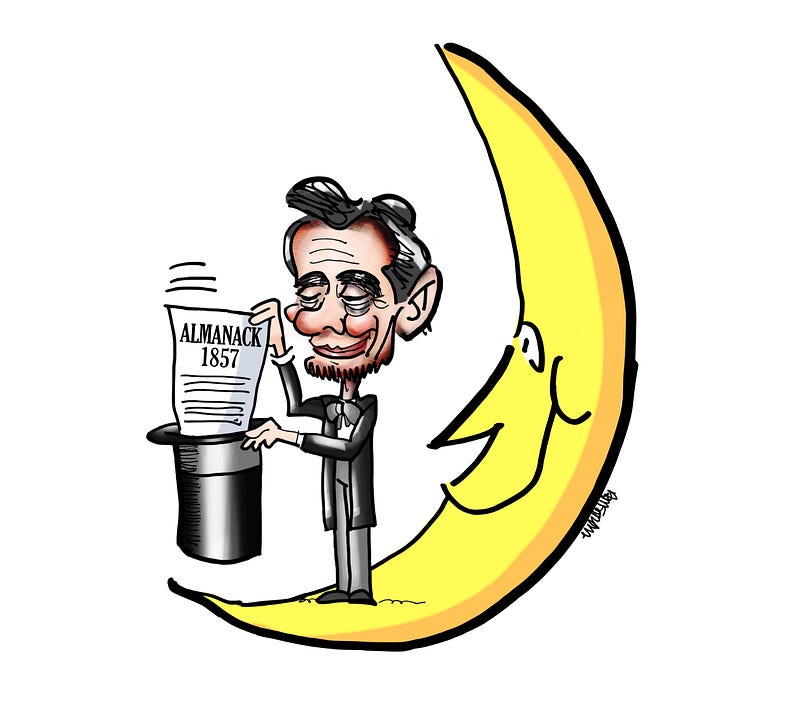
Who needs an ace up your sleeve when you’ve got an almanac in your hat? Illustration: Mark Armstrong

I have a wise-guy friend who sent me an article about Abraham Lincoln and the “famous Armstrong murder trial” in the spring of 1858.

I thought it was a joke, but no, it was a real case.

The accused was a man named William “Duff” Armstrong. Not one of my relatives, I hasten to add, at least as far as I know.

Lincoln was a lawyer before becoming president. He was practicing law in Springfield, Illinois, at the time of the murder. The Duff Armstrong trial is his most famous case. I’d never heard of it.

Lincoln was considered one of the top lawyers in the state, but he’d made his reputation in civil cases. In over 20 years of practice, he’d handled more than 4,000 civil cases, but only a few hundred criminal cases. About a dozen of the criminal cases involved murder. He’d lost half of those cases.

Lincoln had a personal stake in the Armstrong trial. He’d been a friend of Duff’s parents, Jack and Hannah Armstrong, when he’d lived in New Salem, Illinois, from 1831–37. Supposedly, Lincoln had rocked Baby Duff to sleep when he visited the Armstrongs.

Duff Armstrong and second man named Norris were accused of killing a third man in a drunken brawl on the night of August 29, 1857. Duff’s father, Jack, had died earlier that year. Lincoln wrote to his widow Hannah and offered to defend Duff at no charge.

Armstrong and Norris were accused of killing James Metzker with several blows to the head, using a weighted club. It appeared Metzker had been struck at least twice.

Norris had already been tried separately and convicted of manslaughter for hitting Metzker in the back of the head. Duff would be tried for allegedly striking him a second time, on the front of the head.

Armstrong’s trial was held on May 8, 1858. The principal witness was a man named Charles Allen who testified he’d seen Armstrong strike Metzker at around 11:00 PM on the fatal night. He testified he’d seen the blow struck at a distance of 150 feet by the light of a full moon shining overhead.

Lincoln produced an almanac which showed that on the night of August 29, 1857, the moon had set a few minutes after midnight. The implication: Allen was wrong about the moon being overhead, and there would not have been enough light for him to see things clearly at 11:00 PM.

The jury agreed and returned a verdict of not guilty.

Sounds like a Perry Mason moment, doesn’t it? A courtroom surprise that wins the case.

The almanac entry doesn’t change the fact that there was a moon that night, and that it had not set by 11:00 PM. So there must have been some light for prosecution witness Charles Allen to see by.

There’s no way to know if it was enough light for him to really see what happened. But Lincoln’s “almanac surprise” discredited his testimony, which is something a good defense lawyer tries to do.

I live 4 miles from Dublin, NH, which is home to Yankee Publishing. Yankee publishes The Old Farmer’s Almanac which dates back to 1792 when George Washington was serving his first term as President.

Was that the almanac Lincoln used in the Armstrong trial?

Judson Hale, Honorary Editor of The Old Farmer’s Almanac, thinks so.

“It’s difficult to prove conclusively, but everything I’ve read about the case — and certainly my examination of the 1857 edition — indicates that it was.”

Lincoln was an innovator. He was able to use the almanac because the judge allowed it to be introduced into evidence as an authoritative fact. In criminal cases, the court must instruct the jury that it may or may not accept said fact as conclusive.

It’s a practice known as judicial notice. It’s common today, but not in Lincoln’s time, when trials relied almost entirely on eyewitness testimony. Jurors in the Duff Armstrong trial were willing to accept the almanac’s “testimony” as fact.

Interesting footnote:

Lincoln was elected President of the United States in 1860, two years after the trial.

Duff Armstrong fought in the Union Army during the Civil War (1861–65). When he became ill in 1863, his mother wrote to Lincoln, asking for his help. Lincoln arranged for Duff’s early discharge from the army.

Lincoln was there for Duff Armstrong— not once, but twice.

Mark Armstrong is an illustrator. He writes about marketing, branding, and communication. He also writes humor pieces. Learn more at Mark Armstrong Illustration.
Testimonial & photo: David Yas; graphic: Mark Armstrong
History
Criminal Justice
Law
Lawyers
Communication
Recommended from ReadMedium