
Abbott’s Rapid-Response Covid-19 Test; Is the Approval Good News?
Unanswered questions may impede the rollout

What if millions of people could get a quick, reliable test and find out if they are Covid-19 carriers? The Food and Drug Administration granted emergency-use authorization to Abbott Laboratories for a $5 rapid-response Covid-19 test.
Reliable high-frequency testing may present the world with a viable path forward. A widely available test would help kids get back to school safely and allow workers to return to the office. A rapid test might enable us to eat inside a restaurant, take a vacation, or go to a football game.
Is BinaxNOW Covid-19 Antigen Card the solution we have all been waiting for?
Maybe, but we need answers to some critical questions before we hop on a cruise ship.
BinaxNow’s emergency use authorization is approved for use in symptomatic patients in a healthcare setting. But the coordinated release of a free digital health app along with Abbott’s claim to be able to test “millions of people per day” acknowledges this test will be used beyond its limited approval.
The “who, what, when, where, and how” of BinaxNow utilization must be addressed.
What Covid-19 tests are available now?
There are three categories of Covid-19 tests. Each works in different ways to detect evidence of SARS-CoV-2 infection.
- Antibody testing detects a past infection and potential immunity.
- Molecular testing(PCR) detects genetic material from the virus to determine if someone has the virus right now.
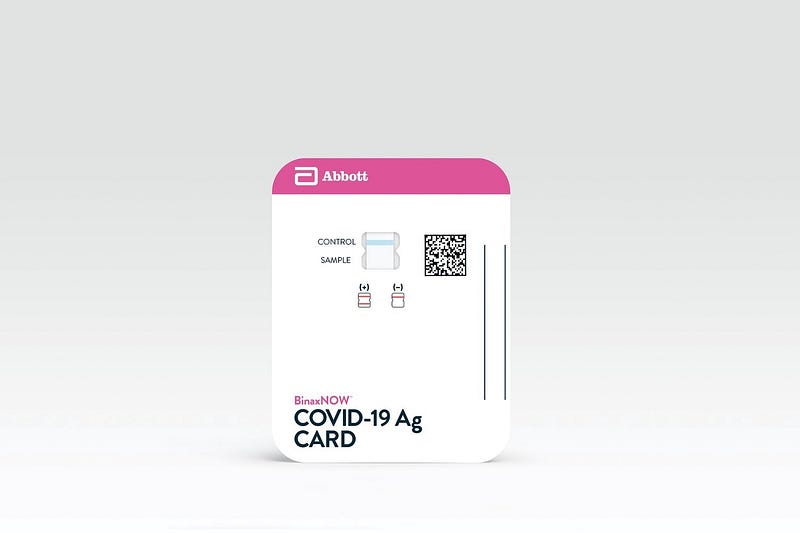
- Antigen testing detects the fragmented pieces of the virus that trigger an immune response. Like PCR testing, antigen testing is used to detect an active infection but can be done much faster. The recently FDA-approved rapid testing BinaxNow uses antigen detection.
BinaxNow is a step in the right direction
Rapid-responding tests are certainly a positive step in the right direction. Getting reliable results as fast as possible will help us reopen our economies and stop the pandemic spread.
Here are the valuable BinaxNow features:
- Fast results. Abbott’s rapid antigen test provides results within 15 minutes.
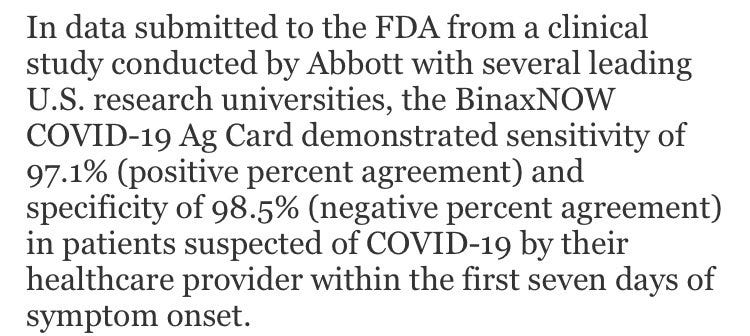
- Accurate results. The test is highly accurate when testing symptomatic patients within seven days of the onset of symptoms. The data reported to the FDA shows a sensitivity of 97.1% and a specificity of 98.5%.
- Pain-free nasal swab. This technology does not require the tickle-your-brain deep nasopharyngeal swab like the PCR tests. A simple, painless nose swab is used to collect the testing specimen.
- No instrumentation required. This test does not require a medical practice to purchase expensive or complicated equipment. The lack of capital investment makes it ideal for CLIA-waived point-of-care testing.
- NAVICA™ app. Abbott released a complimentary digital health tool to pair with the new COVID-19 antigen test to facilitate use.
Let’s tap the breaks on BinaxNow
Before we get too excited, we need to understand the limitations of this specific rapid antigen testing technology.
This specific test has a few problems and unanswered questions.
- Who performs the test? BinaxNow is only approved for clinical use by health care professionals. The Abbott press release makes it clear this test is not approved for use by the general public outside of a healthcare provider’s oversight. The press release states millions of tests can be done per day. If these tests require a healthcare provider, then infrastructure for a scalable rollout of “millions of tests per day” needs to be implemented.
- Antigen testing has limitations. Antigen tests look for pieces of the virus. They are less accurate than traditional molecular PCR testing, which looks for the virus’s genetic material. BinaxNow is not FDA-approved as a screening test. The test is meant to be used only on people with symptoms of COVID-19 and within seven days of the onset of their symptoms.
- The accuracy of asymptomatic patients is unpublished. The FDA approved this test based on a study of 102 symptomatic patients. The results show a sensitivity of 97% and a specificity of 98%. These patients, who were within seven days of the onset of symptoms, would have had high levels of viral shedding. These numbers indicate BinaxNow is an accurate way to test sick people, but how effective is it when testing asymptomatic individuals?
5. BinaxNow will be used off-label on asymptomatic people. The entire world has been waiting for a low-cost test. BinaxNow can and will be used legally off-label on asymptomatic individuals. Health professionals need to know the accuracy beyond the reported specificity and sensitivity in symptomatic patients suspected of having Covid-19. Before off-label use occurs, we must know how to interpret the results.
6. The NAVICA™ app creates a blurry line between screening and diagnostics. The NAVICA™ Press Release makes an excellent case “to help facilitate easier access to organizations and other locations where people gather.” If BinaxNow is limited to the symptomatic individuals within seven days of the onset of symptoms, the app would have limited utility. The creation of NAVICA™ reveals Abbott Lab’s is counting on the widespread use of their rapid antigen test. If so, we need to know the accuracy of testing asymptomatic individuals.
7. The economics of BinaxNow is unclear. The Abbott press release highlights the test will cost $5, but this test is not a direct-to-consumer product. What will this test actually cost, and who is paying for it?
Doctors and hospitals purchase tests through a supply chain and then bill a third-party payer for the cost. BinaxNow is not being released as a direct-to-consumer product. Essential questions for an effective, scalable, and rapid roll-out must be answered before medical offices, hospitals, and consumer lab companies can begin to offer this potentially game-changing testing option.
Here are the practical questions for medical office integration:
- What is the appropriate Current Procedural Terminology (CPT code)?
- There are currently two approved antigen testing codes (86328 and 86769). Will BinaxNow use one of these or a new one?
- Will Medicare, Medicaid, and private insurance companies honor and reimburse for BinaxNow?
- What is the rate of reimbursement for the CPT code?
The reimbursement rates must justify the costs. Medical practices have to evaluate the financial impact of any new technology. If BinaxNow costs $5/unit and Medicaid reimburses $4, then a medical office will not be able to afford to offer the service.
Medical practices will be highly motivated to provide rapid testing to their patients. Without a fair reimbursement rate, practices may find themselves testing their way to bankruptcy.
Rapid antigen testing through BinaxNow could be a game-changing technology. As with many things in Operation Warp Speed, we are missing a nationally coordinated strategic plan.
Binaxnow will be welcomed by the public and the medical community, but we deserve to know how well it works as a screening test and who is going to pay for it.
—