
My Favorite Underrated Martin Scorsese Film: Silence
It’s a film that stays with you
I love Mafia films (I firmly believe that The Godfather and The Godfather Part II are the two best films ever made), and as someone who loves Mafia films I obviously love Martin Scorsese. The trifecta of Goodfellas, Casino, and The Irishman solidified his place in the Italian Mob film Pantheon, and when you throw in The Departed (which was the Irish Mob), it’s no wonder that gangster movies immediately come to mind when you think of one of the greatest directors of all time.
Those four films (and many, many others of his) are gripping, entertaining, and immensely quotable. As superb as they are, however, none of them are films that will keep you awake at night wrestling with essentially unanswerable moral and theological questions. Henry Hill may have wanted to be a gangster all his life, but we all know he should have chosen a different path.
When it comes to one of Scorsese’s most underrated films, 2016’s Silence, we don’t get off that easy. To paraphrase a review I read a few years ago (but could not find again to quote directly), Silence is not a film you like or dislike, it is a film you experience and then deal with for the rest of your life. If that seems like a wild claim, let me assure you that not a week has gone by since I first saw it that I haven’t thought about it. That doesn’t even happen with The Godfather.
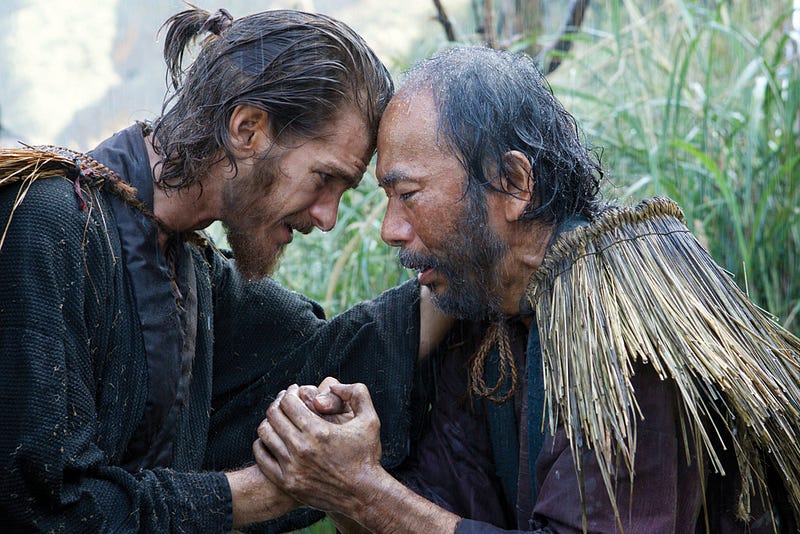
For all his love of the gangster epic, Scorsese has made some amazing films with overtly religious themes: The Last Temptation of Christ (1988), Kundun (1997), and most recently Silence. Adapted from the 1966 Shusaku Endo novel of the same name, Silence tells the story of two 17th-century Portuguese Jesuit missionaries, Sebastião Rodrigues (played by Andrew Garfield) and Francisco Garupe (played by Adam Driver) who secretly enter Japan in search of their mentor Father Ferreira (played by Liam Neeson), who is rumored to have renounced his faith during the persecution of Christians during the Tokugawa shogunate.
In the hands of a typical Hollywood studio today, the novel’s plot would have been bastardized into a rollicking adventure tale with Rodrigues and Garupe as Butch Cassidy and the Sundance Kid, just with crucifixes and holy water instead of pistols. Thank God Scorsese saved it from such a fate. It is a slow burn with brief moments of intense action and achingly beautiful cinematography of a stunning region of the world that is reminiscent of the cinematography in Kundun. It is perhaps this slow pace, combined with a 161-minute runtime, which may explain why it earned only $23.7 million at the worldwide box office against a budget of around $50 million.
Andrew Garfield gives a stellar performance as Rodrigues and was likely only denied an Oscar nomination for the role because his performance in Hacksaw Ridge the same year overshadowed it. Scorsese has a penchant for bringing out the best in his lead actors, so this is no surprise. However, it is the supporting characters who are ultimately the heroes of this film. There is also one whom all will be able to identify with, the continually failing yet continually getting up again Kichijiro (played by Yosuke Kubozuka).
St. Francis Xavier had introduced Christianity to Japan in 1549, and by 1603 there were as many as 300,000 Japanese Christians. By the time the film begins in 1640, only a handful of “hidden Christians” remain, the rest either having renounced their faith or, in the case of tens of thousands, been executed. Those who remain are in constant peril, and a key plot point is the question of whether it is acceptable to renounce the faith to save your life or the life of another, even if in your heart you don’t mean it. Early in the film Rodrigues tells the villagers it is acceptable, while Garupe vehemently disagrees.
The response of the villagers to the persecution is thus set in contrast to the internal struggle Rodrigues wrestles with throughout. In the most powerful scene in any movie of recent times, we see three Japanese Christians who refuse to spit on a crucifix then crucified themselves. In this particular case Rodrigues could have done nothing to save them, but with a later group he can, setting up the dilemma I struggle with to this day.
After Rodrigues is captured by the Japanese inquisitor, he is given the chance to save a group of Christians from death by apostatizing himself. If they recant, they will still be killed; only his denial of the faith can save them. What do you do in such a situation? It is one thing to be willing to die as a martyr because you will not renounce your faith. It is something else entirely to watch other people be tortured and killed because you will not recant.
The Bible doesn’t really answer this question, either. The two verses that come to mind for me are: “But the one who stands firm to the end will be saved” (Matthew 24:13) and “They did not love their lives so much as to shrink from death” (Revelation 12:11). Both of these refer to standing firm in the face of your own persecution, not that of someone else. In the end, Rodrigues decides what the answer is for him.
Normally I will either avoid spoilers altogether or will discuss them throughout the article. In this case, however, I purposely put them toward the end so that those who have not seen the film could read most of this piece without having anything, well, spoiled. There are two specific ones I want to mention, and they are huge spoilers indeed, so if you have not watched the film yet, stop reading right now. You can come back to this part later.
The first is something that happens when Rodrigues finally does apostatize to save a group of Christian villagers who are being tortured. As he is about to step on an image of Christ, he hears Jesus’ voice telling him that he is doing the right thing. There has been much debate over whether Scorsese meant for this to be taken as Jesus actually speaking, as a delusion in Rodrigues’s nearly broken mind, or even as the Devil posing as Jesus. If you listen very closely, after he steps on the image a rooster crows, just as the cock crowed after Peter denied Jesus three times. To me, that makes it quite clear that Scorsese sees this action as a betrayal of Christ.
The second comes at the end of the film when Rodrigues dies after years of denying the faith and serving his Japanese masters. As he is being cremated in a Buddhist ceremony, the camera goes inside the coffin, where we see that his wife has placed a small crucifix that he received from a villager when he a Garupe first arrived in the country. The implication is that despite his repeated denials of the faith, he remained in some small way secretly a Christian.
This was not in the original novel, and Bishop Robert Barron had an interesting take on this change to the ending. He notes that the idea of denying Christ in public while “secretly” continuing to believe in him would outrage St. Ignatius of Loyola, the founder of the Jesuit Order to which Rodrigues belongs, but is something considered almost admirable in our society today where people are fine with someone having religious views as long as they are kept private.
I don’t know whether or not Martin Scorsese changed the ending because he also believes this; the inclusion of the rooster crowing earlier seems to suggest otherwise. What I do know is that he has given us far more than just an amazing and sadly underrated film. He has given us something we rarely get anymore and almost never seek out: a meditation without an obvious yes-or-no answer. Those can be frustrating, of course, but in the end they are the only ones that really matter.
It seems most fitting for me to end with the same dedication with which Scorsese ended this stunning, life altering film:
“For the Japanese Christians and their pastors: Ad Majorem Dei Gloriam” (For the greater Glory of God, the motto of the Jesuits).