
The Magic Art of Saying More with Less
Metonymy and Synecdoche — A linguistic close-up

The unforgettable opening sequence of Sergio Leone’s Once Upon a Time in the West spans ten minutes and captivates viewers with barely a word spoken.
We are taken to a remote train station where three leather faces wait. Every detail is meticulously portrayed, from cracked knuckles to an irritating fly, a squeaky windmill, and jangling spurs.
Leone uses the power of close-ups to build an air of drama and tension.
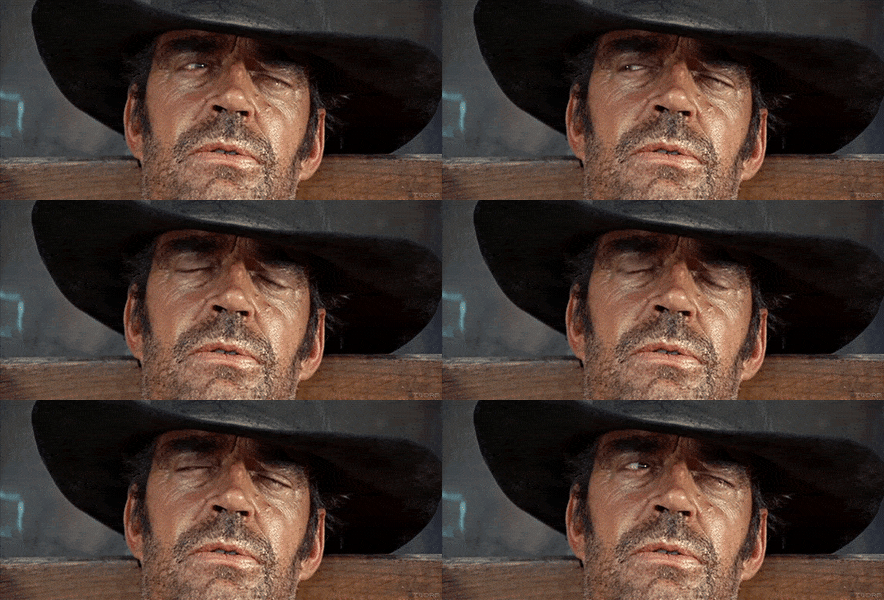
In the scorching heat, the gunslingers' apparent nonchalance is broken by the arrival of a noisy and smoky train. Our mind asks questions. We are hooked.
It’s ground-breaking cinema. Leone was the master of close-ups. By zooming in, the shot is concentrated. We get a snippet, which allows our imagination to fill the whole.
Creative writers use similar techniques in their writing — metonymy and synecdoche.
Imagine your friend tells you he is having trouble with his downstairs neighbour. Pause. Take that in. Does he live in an upstairs flat, or is he using dull-witted symbolism for his wee man?
Metonymy and synecdoche use symbolism, but it isn’t so dull-witted.
Metonymy
Metonymy is a figure of speech where we use a word to refer to something related to that thing, such as wheels to refer to a car. Wheels represent the entire car.
In the same way, the oval office can mean the President of the USA or their administration.
Metonymy is a concept. It comes from the Greek word metōnymía, which translates to change of name. Thus, metonymy substitutes a word or phrase for another word or phrase.
Thus, journalists are collectively known as the Press after the name of the device used for printing newspapers.
The press are adept at using metonymy —
Silicon Valley (the American technology industry) made a movie about Wall Street (the New York Stock Exchange) and it is shaking up Hollywood (the American film industry).
Using metonymy we can say the pen is mightier than the sword where the pen stands for the written word and the sword stands for military aggression.
It’s metonymy when you use a person’s name to refer to the works by that person, as when you say, ‘I’m reading Malky on my holidays’ when you really mean ‘I’m reading books by Malky McEwan on my holidays.’
Metonymy is often mistaken for a metaphor, but a metaphor is when two things are cryptically connected. With metonymy, there is a physical connection — suits could replace businessmen or detectives.
I used it in a recent travel article —
“We make several more stops. Collars, cufflinks, and purple frocks come on board. Older couples. Also on the way to our wine tasting. Hands pat shoulders, eyes crinkle, lips curl. Heads cock and sway.” — Malky McEwan.
I’m on a bus and rather than say several people came on board, I used brief descriptions of their clothing — Collars, cufflinks, and purple frocks.
This does two things rather well. It abbreviates the text and leaves the reader to form their impression of the older couples.
I also used hands, eyes, and lips.
When you use a small portion or an aspect of something to refer to the entire thing, you are effectively using the power of close-ups. This is synecdoche.
Synecdoche
Synecdoche takes metonymy a step further. It is a figure of speech that involves using a part of something to represent the whole, or occasionally vice versa.
Synecdoche is derived from the Greek synekdoche, which translates to simultaneous meaning.
You could use it to describe your team if it needs some fresh legs. You use legs to represent the players as a whole. Synecdoche zooms in on a part of the picture. It adds variety, depth, and emphasis to our language.
A classic example of synecdoche is the use of the term hands to mean workers, as in all hands on deck.
You wouldn’t look at a powder puff wig and feel deferential regard for it, would you? But if you phrase it like Cervantes, it all makes sense —
“Gray hairs should be respected.” — Miguel de Cervantes, Don Quixote.
And Julius Caesar isn’t so stupid to think his subjects would do a Van Gogh for him, but he does want their attention —
“Friends, Romans, countrymen, lend me your ears.” — William Shakespeare, Julius Caesar.
Synecdoche evokes mental imagery in the reader. You can’t read gray hairs should be respected without imagining the group of older people they are attached to.
Caesar’s lend me your ears is the cleverest way of making his people pay attention to him.
Synecdoche can be a part of something that represents the whole, vice versa is also true —
- The world is against me today. The world refers to the jobsworths, red lights, delays, or other inconveniences experienced.
- Downing Street called a press conference. Streets, even one that houses the Prime Minister, don’t call a conference — that’s the job of the press secretary.
We are apt to use synecdoche in everyday speech. You might get bums on seats so you can feed hungry mouths and put your nose into their conversations.
People are apt to get their knickers in a twist over metonymy and synecdoche. Google them and you will see the same examples used for both.
You don’t need to be the brains of the operation to see that they can intertwine.
Thus, when someone likes your threads that’s metonymy if they are substituting threads for your clothes, and it is also synecdoche if threads simultaneously mean clothes.
It’s a subtle difference. Metonymy is when you use a word associated with something to refer to the thing itself. Synecdoche is a specific type of metonymy when you use a part of something to refer to the whole thing.
In either case, these linguistic wonders are there to be used. They give you the ability to use words as a focus for the reader, and that sparks their mental imagery.
We had a teacher in school who had a rather large and hairy wart on her face. She became that wart. “Wart is on her way,” we’d say, as a warning. Although, we never said it to her face.
As cruel as the nickname was, it’s expressive. A keen form of synecdoche. Honing in on the hairy blemish is a vivid close-up of her look and her personality. It fills our imagination.
In the hands of a skilled writer, metonymy and synecdoche are powerful tools for the creative writer's pen.
This article is part of my Writing With Eloquence series where you can discover things like the Beast of Rhetoric and other Mini Mysteries.


