
AAI: Cross-boundary Knowledge Curation
AAS stands for “Architectures of Adaptive Integration”

This morning I saw a diagram about cross-boundary collaboration on Linkedin. JOSÉ LUIS Peralta Barbano shared the diagram and some ideas about seven knowledge necessary for the education of the future, inspired by the French philosopher and sociologist Edgar Morin.
He also mentioned that the above diagram is quoted from a 2015 paper titled Architectures of adaptive integration in large collaborative projects.
This is my favorite topic. So I will write a note about this paper.
Authors and Abstract
The paper was written by Lois Wright Morton (Department of Sociology, Iowa State University), Sanford D. Eigenborde (Department of Plant, Soil and Entomological Sciences, University of Idaho), and Timothy A. Martin (University of Florida).
It was published in Ecology & Society. You can read the full content on their website.
Let’s start with the abstract.
Collaborations to address complex societal problems associated with managing human-natural systems often require large teams comprised of scientists from multiple disciplines.
For many such problems, large-scale, transdisciplinary projects whose members include scientists, stakeholders, and other professionals are necessary.
The success of very large, transdisciplinary projects can be facilitated by attending to the diversity of types of collaboration that inevitably occur within them.
As projects progress and evolve, the resulting dynamic collaborative heterogeneity within them constitutes architectures of adaptive integration (AAI).
Management that acknowledges this dynamic and fosters and promotes awareness of it within a project can better facilitate the creativity and innovation required to address problems from a systems perspective.
In successful large projects, AAI (1) functionally meets objectives and goals, (2) uses disciplinary expertise and concurrently bridges many disciplines, (3) has mechanisms to enable connection, (4) delineates boundaries to keep focus but retain flexibility, (5) continuously monitors and adapts, and (6) encourages project-wide awareness.
These principles are illustrated using as case studies three large climate change and agriculture projects funded by the U.S. Department of Agriculture–National Institute of Food and Agriculture.
Key words: architectures of adaptive integration; collaborative science; team science
My primary focus is not on team management and complex social collaboration, but on the THEORY — PRACTICE Gap and the Knowledge Curation Approach as a solution for closing the gap.
I will read the paper from this specific perspective.
The primary issue the paper addressed is large-scale collaborative projects that require cross-boundary knowledge contribution from scientists, professionals, and stakeholders.
The primary concept is defined as Architectures of Adaptive Integration (AAI) which can be understood as a key to successful large projects. In fact, the concept of AAI is an umbrella that refers to a set of principles.
The second principle echoes my focus. So I will directly move to the related part of the paper.
Introduction
The authors claim that “AAI offers a systems approach for reflexively examining the component parts and synergetic relationships of coupled human-natural systems to better understand adaptive responses to changing conditions.”
From three case studies, the authors found that three large-scale projects require:
- 1) attention to the heterogeneous types of collaboration that can occur within them,
- 2) development of feedback mechanisms that encourage adaptive management that responds to changing conditions in the research and its applications, and
- 3) a purposefulness in incorporating the perspectives and expertise of academic and nonacademic participants to guide project structural adaptation.
I’d like to use “Cross-boundary Knowledge Curation” to refer to the third aspect of AAI.
It is a specific type of knowledge curation within large-scale cross-boundary collaborative projects.
Similar Terms
The authors review similar terms used by others. For example:
- Convergence of sciences (Sharp and Langer 2011)
- Philosophical dialogue in collaborative science (Eigenbrode et al. 2007, Crowley et al. 2010, O’Rourke et al. 2013)
- Collaborative productivity in scientific synthesis (Hampton and Parker 2011)
- Team science and transdisciplinarity (Max-Neef 2005, Stokols et al. 2008a, Lyall et al. 2014, Cooke and Hilton 2015)
This trend led to a hierarchical category of scientific integration (e.g. Tress et al. 2004, Max-Neef 2005, Stokols et al. 2008a)
- Multidisciplinary
- Pluridisciplinary
- Interdisciplinary
- Transdisciplinary
In 2020, I talked about the THEORY — PRACTICE gap with a teacher who was passionate about theory-based reflection. I shared many documents with him. One of these files is a 2010 book titled The Oxford Handbook of Interdisciplinarity.
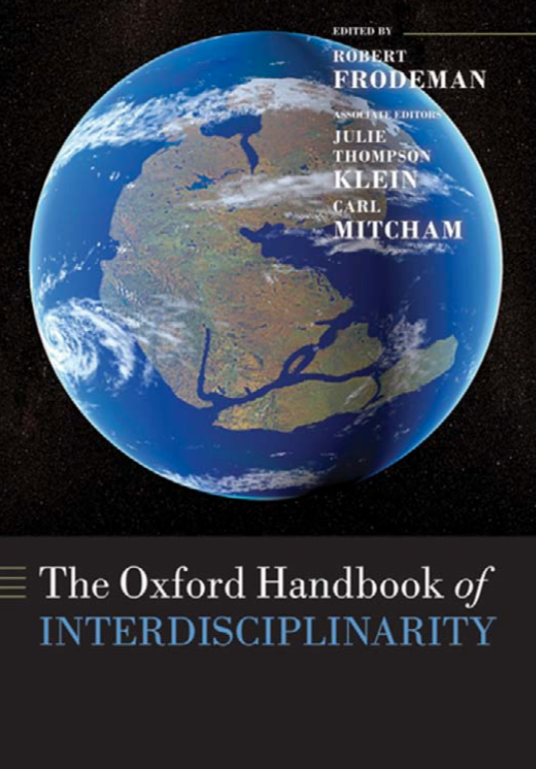
According to the editors of The Oxford Handbook of Interdisciplinarity (2010), there are two words about inter- or transdisciplinary knowledge production.
- The ‘interdisciplinarity’ refers to current efforts of knowledge production that cross or bridge disciplinary boundaries and the ‘transdisciplinarity’ refers to the growing effort to make knowledge products more pertinent to non-academic actors.
- However, in the US, ‘interdisciplinarity’ covers both the integration of knowledge across disciplines, narrow and wide, and the intercourse between (inter)disciplines and society. The latter often goes by the name of transdisciplinarity, particularly in Europe (p.xxx).
I choose ‘transdisciplinary thinking’ to refer to the knowing between academic domains and non-academic domains.
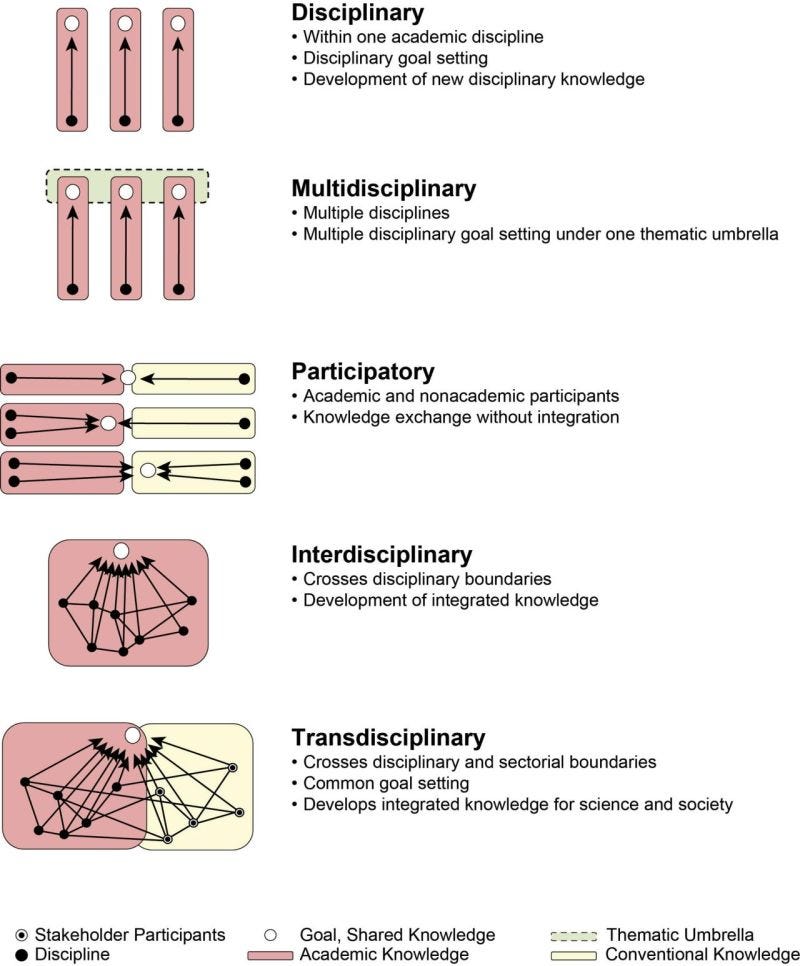
A Typology of Cross-boundary Knowledge
The paper uses a different typology of cross-boundary knowledge. See the diagram below.
The above diagrams are redrawn by the authors and their original sources are from Trees et al. (2004).
Let’s pay attention to the last category. According to the authors,
The last category, typically termed transdisciplinary, has been promoted as uniquely capable of and perhaps necessary for addressing society’s most complex and difficult problems, such as those affecting interacting human and natural systems at different types of scale, i.e., time, space, and human institutions (Tress et al. 2004, Max-Neef 2005, Beachy 2010, Jackson et al. 2010, Hampton and Parker 2011, Hammond and Dube 2012, Lyall et al. 2014).
Conceptually, transdisciplinarity extends beyond interdisciplinary integration to involve nonacademic stakeholders to address the gap that can exist between research and practical application by collaboratively generating knowledge (Lyall et al. 2014).
We have to notice that there is a unique aspect of the last category in Trees’ typology:
Develops integrated knowledge for science and society
What’s “Integrated Knowledge”? How do we produce it?
The authors answer these questions in the following sections.
A New Method of Producing Scientific Knowledge
The authors share a new idea with us, there is a new method of producing scientific knowledge.
Research in the natural and social sciences has evolved from observational, lab-based, and site-specific disciplinary sciences to examination of system relationships to highly connected interdisciplinary efforts that explicitly involve linkages among biogeophysical, human, and social systems (Collins et al. 2011).
Research platforms that undertake to understand these continuously changing human-natural systems and their adaptive capacities must also continuously change and adapt to generate the variety of scientific data and stakeholder knowledge needed.
These platforms are sources of capacity to integrate, synthesize, model, interpret, and apply the data at ever-increasing scales and complexity.
According to Collins et al. (2011), traditional sciences are based on three mainstream methods:
- Observation
- Lab-based experiments
- Site-specific research
The authors suggest that Research platforms could support the new method of producing scientific knowledge by working on highly connected interdisciplinary collaborative projects.
What are Research Platforms?
The authors don’t give a definition of “Research Platforms”. I roughly understand it as “highly connected interdisciplinary collaborative projects”.
Three Types of Knowledge and Integration
Following the above background, the authors move to the objects of AAI. According to the authors:
The AAI of any large collaborative project engaged in knowledge production of these systemic relationships has a variety of structures and processes to effectively integrate three types of knowledge: disciplinary, systems relationships, and stakeholder.
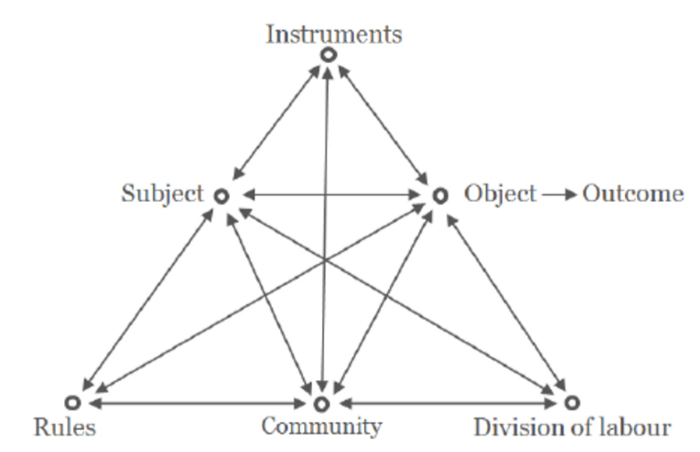
I use the term “Objects” from the perspective of Activity Theory. It refers to things we are working on. The “Objective” of an Activity is to transform “Objects” into “Outcomes”. See the diagram below, you can find more details in Yrjö Engeström: the Activity System Model [Activity Theory].
What are three types of knowledge for large collaborative projects or Research Platforms?
- Disciplinary: Deep, specialized, disciplinary knowledge about system components (Palmer 2012) that is the basis of foundational science …Disciplinary specialization is essential to understanding the specific phenomena that together comprise systems (Johnson 2010, Hampton and Parker 2011).
- Systems Relationships: Understanding whole systems and relationships among system components… Systems research involves several disciplines combining theory development with a variety of research approaches…
- Stakeholder: The third type of knowledge is of practitioners or stakeholders who evaluate disciplinary and systems knowledge against their personal experience and values to create their own perceptions of reality.
While the first type of knowledge is about THEORY, the second type and the third type are about PRACTICE.
It’s not surprising that Negotiated Relationship is a significant aspect of the last two. According to Innes (1994):
Systems research involves several disciplines combining theory development with a variety of research approaches ranging from primary data collection and comparative analyses to synthesis and modeling of primary and pre-existing data and findings.
Theory development and testing that involve two or more disciplines are a negotiation over definitions and methods, and are characterized by agreement on what factors matter, what needs to be measured, how it needs to be measured, and who needs to be counted (Innes 1994).
While the Negotiated Relationship about Systems Research refers to Objects such as methods, facts, etc, the Negotiated Relationship about Stakeholders refers to Subjects such as personal experience, values, motivations, etc.
When scientific knowledge and ordinary stakeholder knowledge are given opportunities to closely interact, both are reshaped and changed (Innes 1994). This negotiated relationship is a valuable feedback mechanism that can lead to adaptions in the research design and new applications of science in the stakeholder community.
The authors emphasize that these three types of knowledge are complementary, “Without disciplinary knowledge, essential processes cannot be known well enough to understand mechanisms and devise appropriate applications. Without systems understanding, specialized knowledge cannot be incorporated meaningfully to generate transformative insights and explanations relevant for the system as a whole. Without feedbacks between practitioners and the research enterprise, academic research may generate knowledge that is not directly useful for solving problems (Christensen et al. 1996).”
It is clear that the primary challenge of AAI is to transform disciplinary knowledge into situational insights and explanations for solving problems.
Now we can return to the Applied Knowledge Curation framework which was inspired by Mike Jackson’s Systems Thinking: Creative Holism for Managers (2003). See the diagram below.
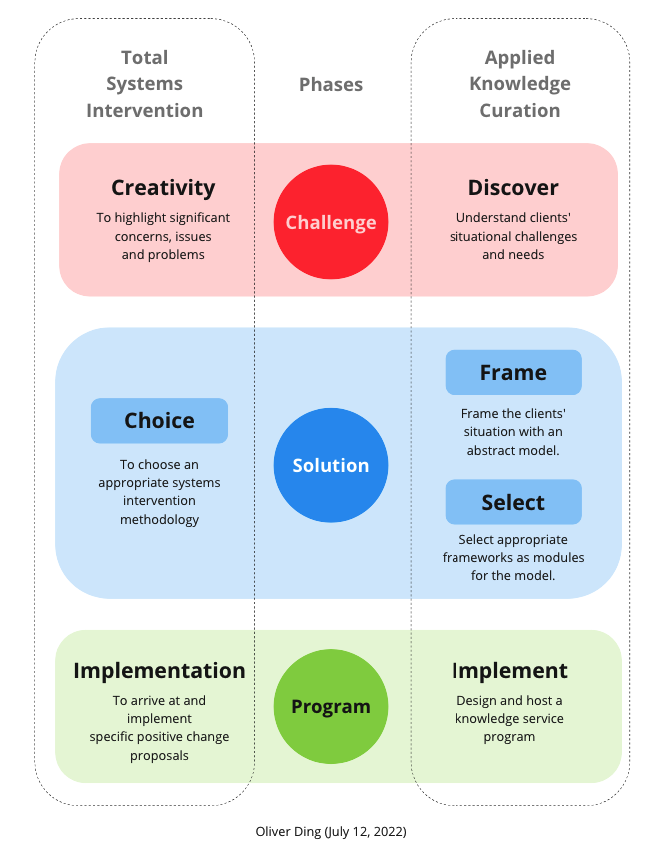
Mike Jackson developed a method called Total Systems Intervention for Managers. The subtitle of his book is Creative Holism for Managers. What’s Creative Holism?
Part III of the book is called ‘creative holism’ and is concerned with the use of different systems approaches, reflecting alternative holistic perspectives, in combination. The various systems approaches cannot be used all at once but they can be employed creatively, in an informed and ethical way, to promote together the overall improvement of organizational performance. This is the essence of creative holism.
It seems very interesting to me because it reminds me of “Curativity” which is my term for describing “turning pieces into a meaningful whole”. So, I made the Applied Knowledge Curation framework. You can find more detail in The Curated Mind: Creative Holism and Applied Knowledge Curation.
What’s the difference between TSI (Total Systems Intervention) and AAI (Architectures of Adaptive Integration)? They have different scales and goals.
- TSI is about organizational development while AAI is about cross-boundary large-scale collaborative projects.
- TSI aims to solve problems for an organization without the intention of producing public knowledge.
- AAI aims to solve complex societal problems and produce public knowledge.
However, the Applied Knowledge Curation framework is an abstract framework. So, we can connect it with AAI.
Key Attributes of AAI
There is a first principle of integration: there is no universal formula for its success (Klein, 2012).
This first principle can be applied to all challenges of PRACTICE.
There is no THEORY knowledge that can claim it will definitely solve your PRACTICE problem.
So, why do we need research universities, scientists, and scholars? Why do we need journals, academic books, and Wikipedia?
In fact, the Progress of THEORY knowledge is based on successfully solving Theoretical Problems, not solving Practical Problems.
Theoretical Problems and Practical Problems are two types of problems. As mentioned above, most practical problems are about Negotiated Relationships.
According to the authors, academic knowledge is still useful for practical activities.
However, a number of literatures suggest that some general AAI traits can be used to guide large project organization in effectively accomplishing the integration associated with transdisciplinarity.
They discuss six AAI attributes grounded in the literature and apply them to case studies.
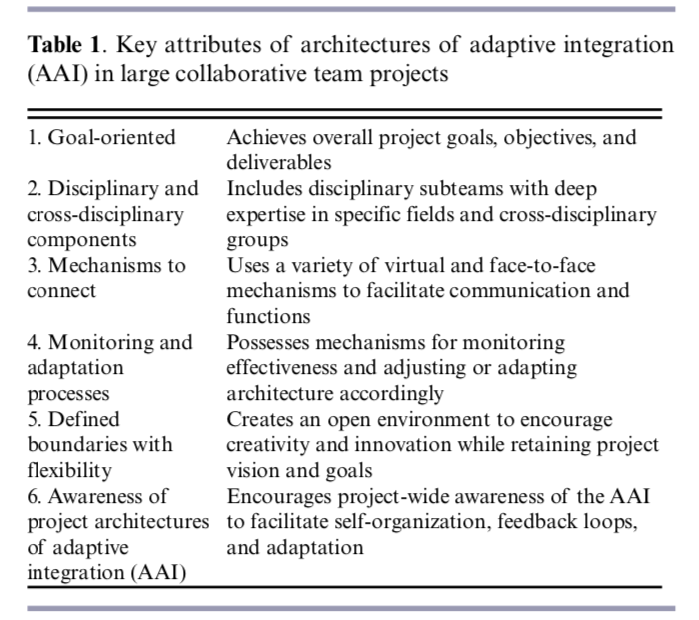
Readers can find more details in the original paper. Here I only pay attention to the second one: Disciplinary and Cross-disciplinary components.
The first suggestion is about collaborative structures that can support an ideal workflow:
- Projects addressing issues that involve many disciplines must have collaborative structures to facilitate integration and synthesis of diverse disciplinary lenses (Pielke 2007, Strijbos 2010).
- Where these problems involve interacting human and natural systems, the integration must also include nonacademic knowledge of stakeholders (Pielke 2007, Bammer 2013, Dietz 2013).
- Centralized task networks help facilitate team performance through a structure of mutual dependences whereby groups of team members acquire work inputs, distribute work outputs to other team members, and integrate the project work flow (Troster et al. 2014).
The second suggestion refers to shared conceptual reality and language.
- Participants in large cross-disciplinary projects must deliberately work to understand the languages of other disciplines.
- “Strong” transdisciplinarity as described by Max-Neef (2005) creates a distinct, emergent, synthetic, and shared conceptual reality and language that draws upon the perspectives of its contributing disciplines.
- In practice this ideal may not be achievable or necessary for success by large projects involving dozens of scientists and many disciplines that exist over a relatively short time.
- Nonetheless, pragmatic evolution of a shared language from Babel through pidgin to Creole (Blackwell and Good 2008) can improve understanding and effectively facilitate integration across the disciplines as a project evolves.
The third suggestion emphasizes the creative aspect of ad hoc workgroups.
- A manifestation of spontaneous creativity and adaptive integration in the USDA-NIFA CAP projects has been the emergence of ad hoc workgroups not specifically delineated in original organizational charts but arising to address newly identified tasks and goals (Fig. 2).
- Some of these ad hoc workgroups are disciplinary, but most cross disciplines to address issues such as climate and cropping systems modeling, integrating regional economic models with climate projection and socioeconomic scenarios, integrating climate projections and biotic models, monitoring greenhouse gas emissions from controlled agronomic experiments, and assessing nitrogen loss via water transport or carbon retention in soil.
- These ad hoc workgroups represent emergent adaptive architecture that builds collaborative environments.
These three suggestions are really useful for developing the concept of “Cross-boundary Knowledge Curation”.
We can also use the model of “Project Network” to understand these three suggestions.
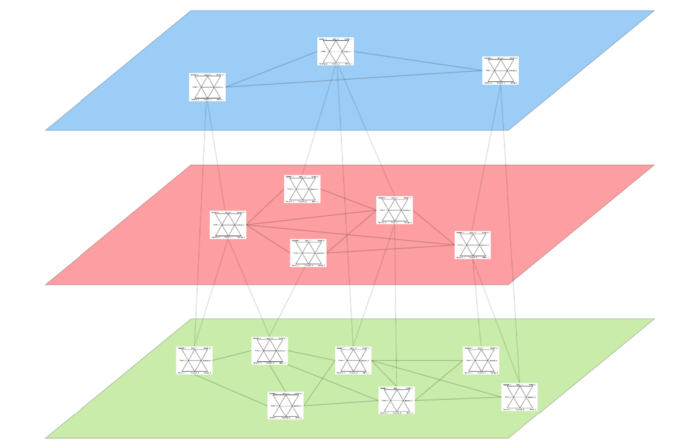
The model of “Project Network” is a multiple-level network that considers 1) a network of Themes, 2) a network of Projects, and 3) a network of People.
- All theoretical approaches and frameworks belong to the network of themes.
- All real activities such as developing a toolkit, designing a canvas, and hosting a program, are part of a network of projects.
- All things about people’s biogeography are located in the network of People.
The above three suggestions can be organized as a three-level network too.
- Themes: shared conceptual reality and language.
- Projects: collaborative structures.
- People: ad hoc workgroups
You can find more details in Life Strategy: Moving between Thematic Spaces.
Case Study: PINEMAP
The authors also share more details about three case studies that are based on USDA-NIFA’s Coordinated Agricultural Projects. USDA-NIFA stands for U.S. Department of Agriculture–National Institute of Food and Agriculture.
The first project is called PINEMAP which stands for Pine Integrated Network: Education, Mitigation and Adaptation Project.
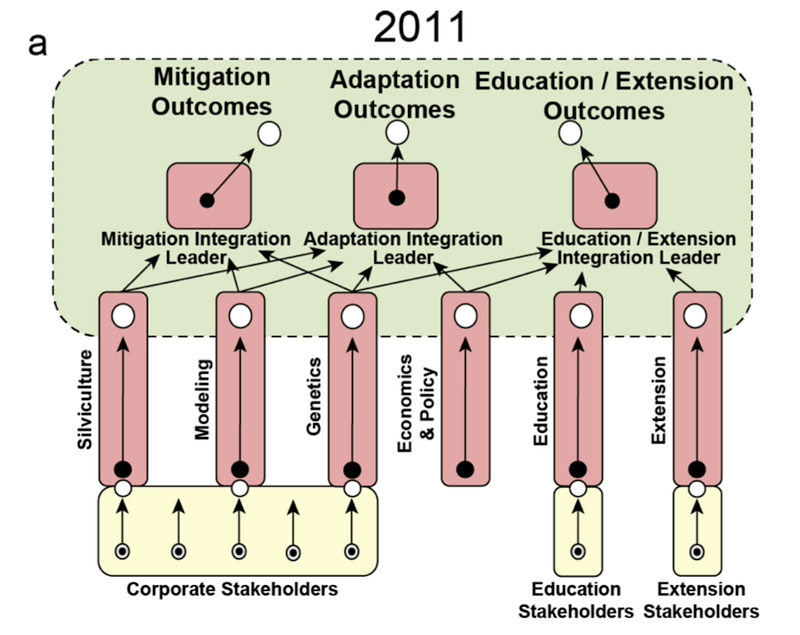
The original 2011 organization structure of Pine Integrated Network: Education, Mitigation and Adaptation Project (PINEMAP) consisted of six disciplinary teams arranged in “parallel,” each with two leaders from separate institutions (Fig. 2a). Integration leaders were assigned with the responsibility to engage and guide the disciplinary teams in carrying out the interdisciplinary collaboration necessary to achieve PINEMAP’s transdisciplinary deliverables.
The authors notice, “As the project progressed, it became clear that this structure was too top down and placed too much responsibility on the individual integration leaders.”
Later, we see a new landscape. See the diagram below.
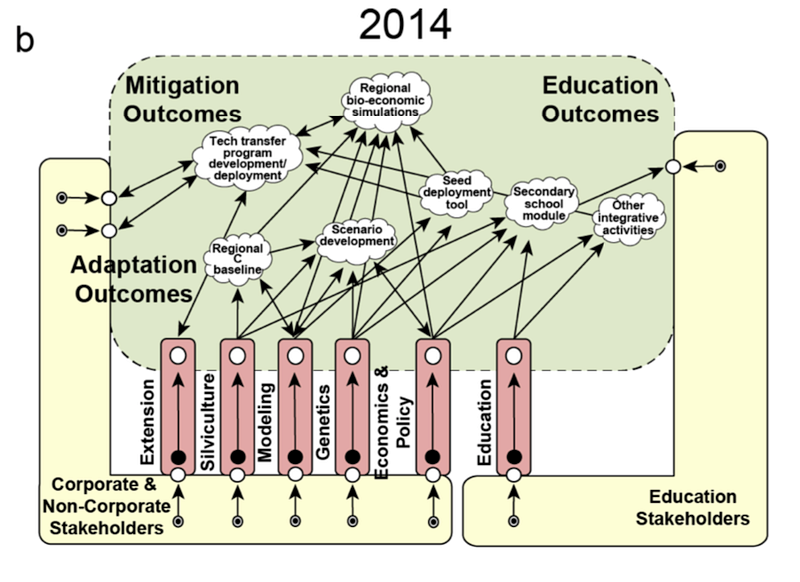
The integration leader construct was supplemented with ad hoc groupings of scientists from multiple disciplines, each based on a particular interdisciplinary activity or integration platform necessary for making progress toward overall project goals. This decentralized structure (Fig. 2b) has been effective at facilitating simultaneous progress on multiple interdisciplinary activities within PINEMAP. There was also a shift in structure, which better accommodates the role of stakeholders in the project.
Case Study: REACCH-PNA
REACCH-PNA refers to Regional Approaches to Climate Change for Pacific Northwest Agriculture. The project was structured in 2011 with nine objectives:
- five scientific, disciplinary objectives;
- two objectives focused on education and extension; and
- two supporting objectives, one focused on cyber infrastructure and one integrating objective.
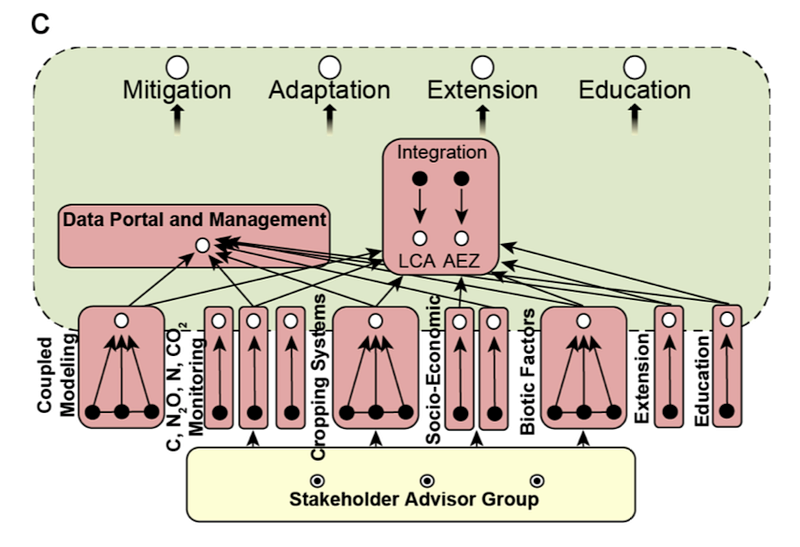
Each team had a designated lead principal investigator. It was envisioned that integration would occur as needed among the teams, especially via the shared cyber infrastructure, extension, and education activities. This structure has remained in place and the objective teams have functioned effectively, but it has also generated 10 emergent, ad hoc working groups that are addressing various cross-cutting activities within the project (Fig. 2d).
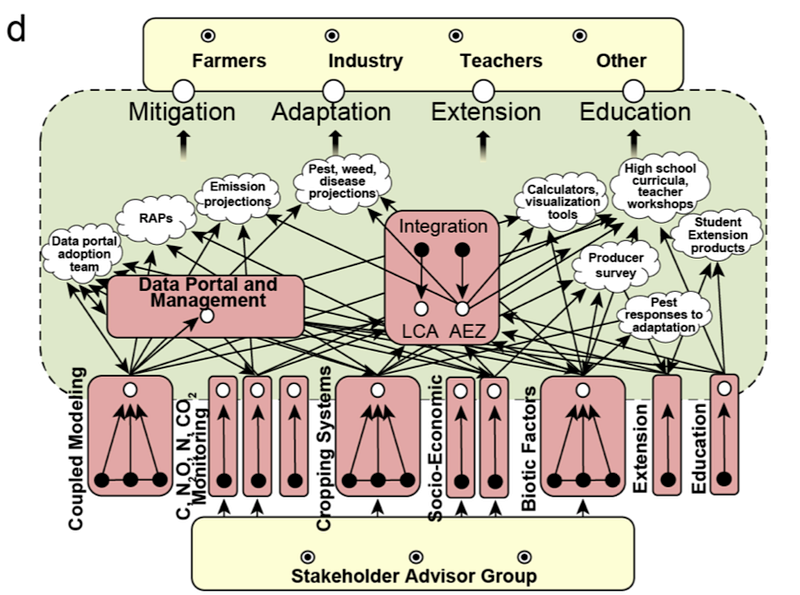
Some of these working groups will likely continue for project duration (e.g., student extension products), and others active at this point may dissipate as their tasks are completed. New ad hoc groups are still anticipated, e.g., one linking biotic factors with integrated modeling. Collaborations have also emerged between REACCH- PNA principal investigators and students and those involved in a NIFA-sponsored project on Site Specific Climate Friendly Farming (USDA-NIFA #2011–67003–30341).
Case Study: CSCAP
CSCAP is the code name of the Cropping Systems Coordinated Agricultural Project: Climate Change, Mitigation, and Adaptation in Corn-based Cropping Systems project.
The project consisted of a linear configuration of five objectives, primarily organized around disciplinary sciences under the direction of a project director and a project manager who coordinated the work of the team (Fig. 2e).
Extension and education were combined into a single objective. One of the first adaptations to the project structure was the separation of extension and education into two distinct stakeholder groups and a deliberate effort to deepen the climate and agriculture scientific knowledge within each group.
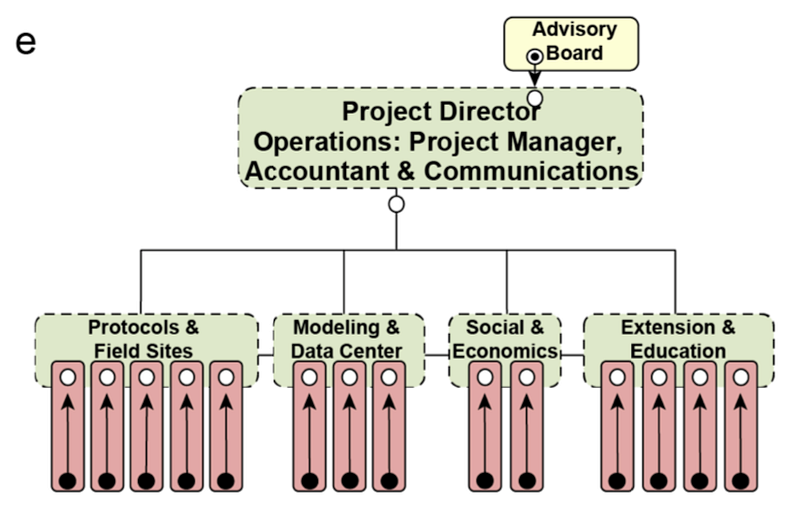
In year 1, deep disciplinary efforts by objective established protocols for standardization of experimental site data for the central database, inventoried the large variety of models used by different disciplines, and developed the theoretical framework for a social-economic survey instrument for farmers.
As the project evolved, the central database facilitated project integration by providing a common focus among engineers, agronomic and social scientists gathering primary data, and a number of scientists who used public data sets associated with water, climate, and agricultural land management practices for modeling.
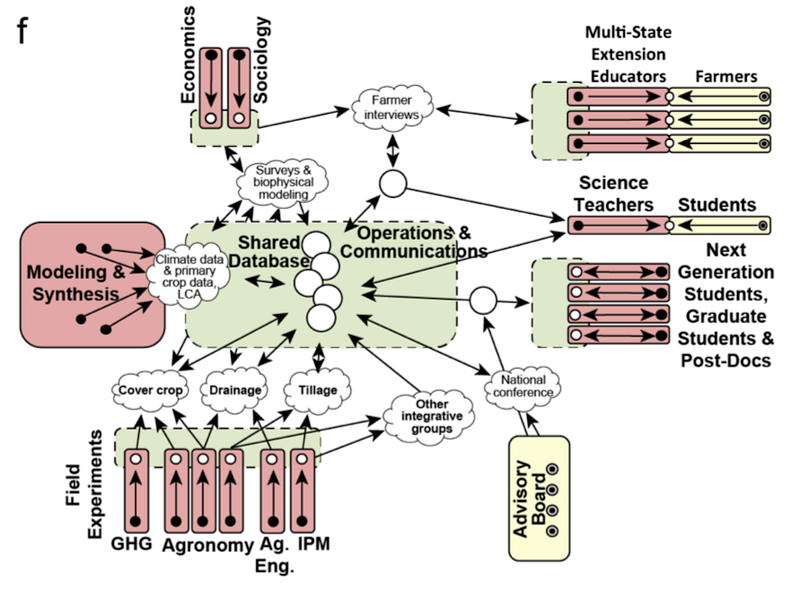
By the third year of the project, the team had self-organized to create a variety of ad hoc interdisciplinary and multidisciplinary groups (Fig. 2f) such as drainage, cover crops, tillage, soybean, national conference, and social-economic climate research with another NIFA project, Useful to Usable (USDA-NIFA #2011–68002–30220; not shown in Fig. 2).
Discussions
This is an awesome paper. However, the authors don’t discuss details of shared conceptual reality and language.
Can we develop it further?
It reminds me of the Thematic Engagement Toolkit (v1.0) and the Knowledge Discovery Canvas.
Building conceptual reality and language can be understood as “Thematic Engagement” and “Knowledge Discovery”.
The picture below is the Knowledge Discovery Canvas which is about mapping a landscape of tacit knowledge around a particular theme. I also wrote a book for the canvas. You can find more details in Knowledge Discovery (Book).
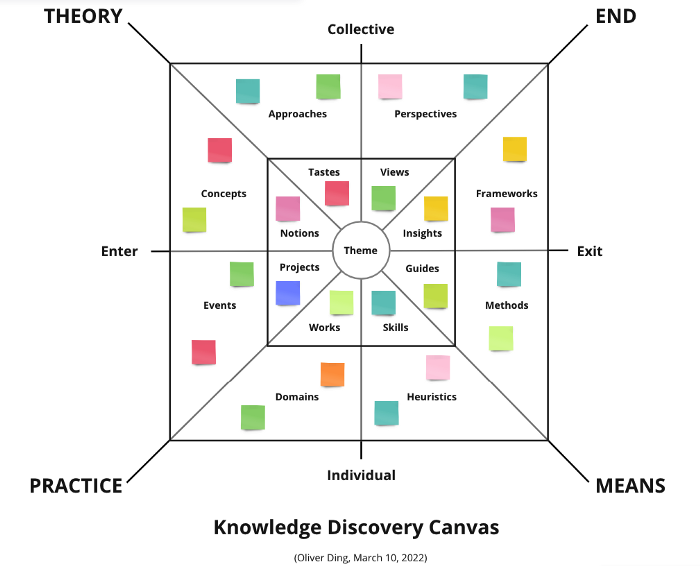
Though I used my own experience to develop the Knowledge Discovery Canvas, I didn’t use “Personal Knowledge” to name the canvas. I always use “Developing Tacit Knowledge”.
Tacit Knowledge can be Individual Tacit Knowledge or Collective Tacit Knowledge.
So, the Knowledge Discovery Canvas can be used for Building conceptual reality and language in the settings of large-scale collaborative projects.
The Thematic Engagement Toolkit (v1.0) also offers other tools for collaborative projects. For example, the Thematic Landscape Map. See the diagram below.
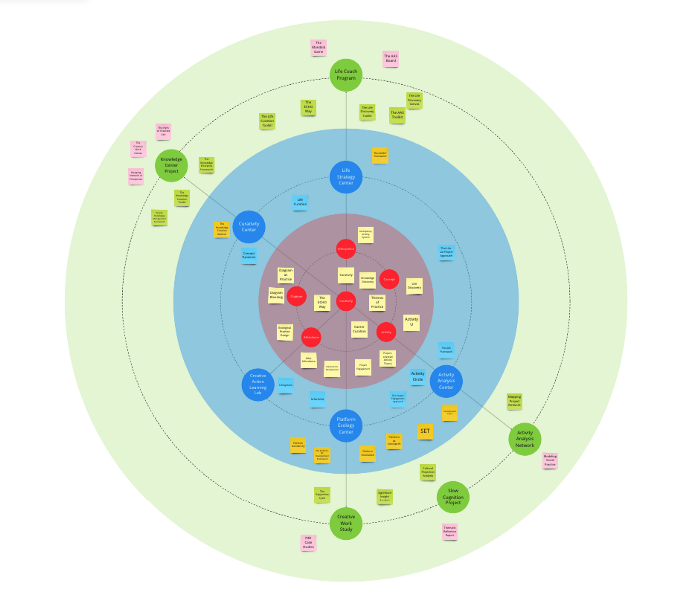
The Thematic Landscape Map uses three circles to represent different significant aspects of complexity.
- Theme: the cognitive aspect of complexity is the primary challenge.
- Work: the material aspect of complexity is the primary challenge.
- Play: the social aspect of complexity is the primary challenge.
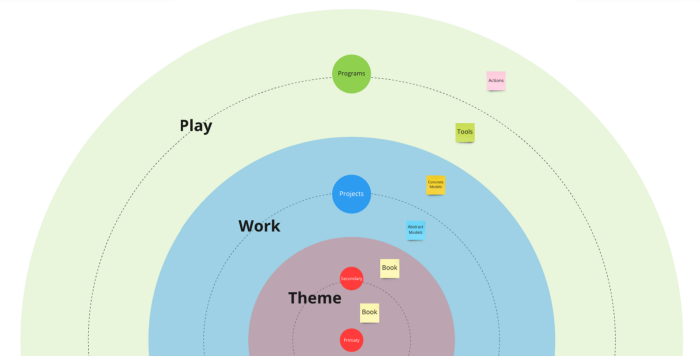
The above model is inspired by a model of Project-oriented Activity Theory. It represents three types of Objectification of a Concept:
- Symbolic Objectification: “Verbal” and “Visual”
- Instrumental Objectification: “designed” and “found”
- Practical Objectification: “Branded” and “Shared”
You can find more details in Slow Cognition: Mapping Thematic Landscape (Curativity, 2019–2022).
We can make a new version of Thematic Landscape Map for the Cross-boundary Knowledge Curation framework and the AAI framework too.
The last issue is about Negotiated Relationships. We can use the ARCH model to deal with this challenge. The ARCH diagram is a meta-diagram for discussing conflict, consensus, and intersubjectivity.
In 2020, I used the ARCH diagram to curate Alan P. Fiske’s Relational Models Theory and Clay Spinuzzi’s typology of Activity.
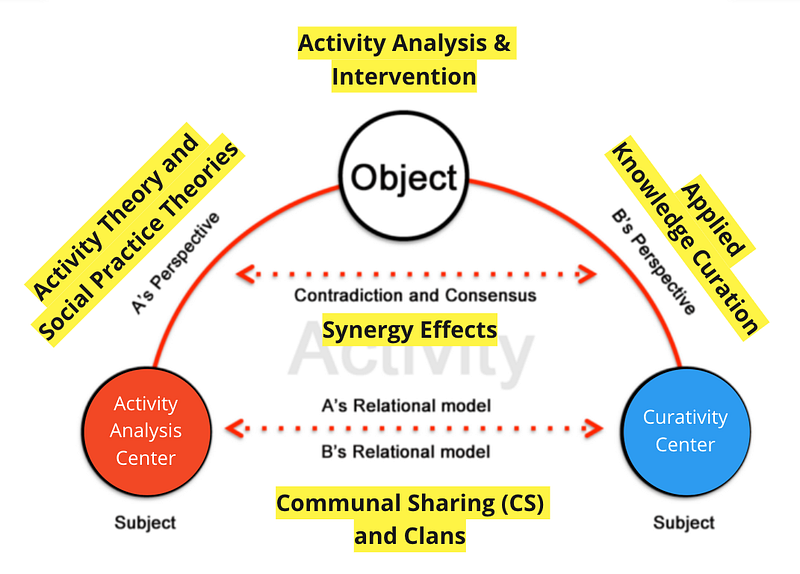
The above diagram is a case study of ARCH. The original version of ARCH model only considers Contradiction and Consensus. This case study expands its object to Synergy Effects.
You can find more details in The ARCH diagram and The ARCH of Synergy Effects.


