Tesla is the future
How Reconstructing Training Data From Trained Neural Networks Is The Future of Self Driving Cars
It’s here what is next, thinking robots?
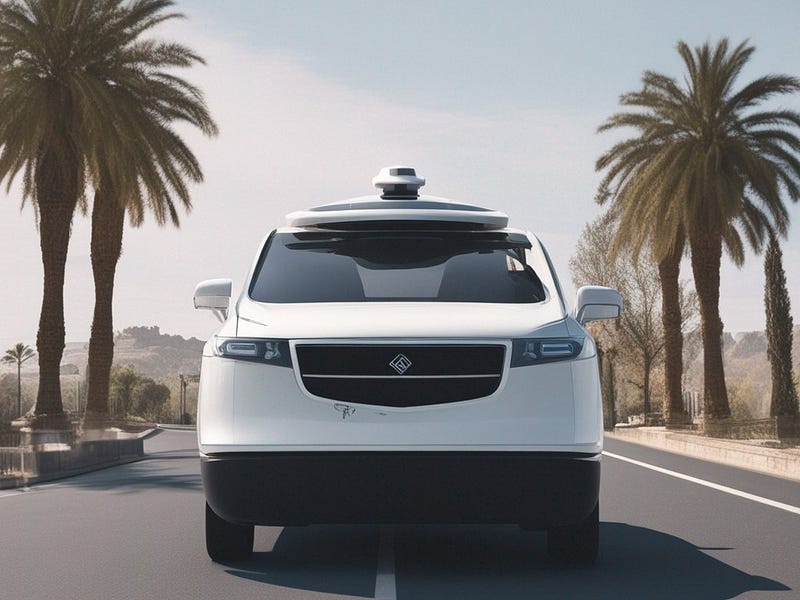
Elon Musk showed the world the future of self-driving cars. And it is the next wave — the future is here.
By reconstructing training data from trained neural networks his self driving car was able to navigate around Palo Alto without any software.
The car is thinking by itself.
But how is it possible?
Thanks to Robert Scoble, he makes it easy for someone like me to understand what just happened.
Yesterday on a live Twitter/X broadcast for 45 minutes, Elon Musk was seen “driving” around Palo Alto, or should we say being driving by a Tesla car equipped with its latest, Full Self-driving Beta V12.
“Very intuitive, smooth speed up acceleration and turns,” — Elon Musk
All in all, everyone is impressed, especially Robert Scoble, on Twitter he shared his views on what he believes is a historical achievement in technology and self-driving cars.
Our world changed tonight.
In 10 years we will look back at the first public demo of a robot that learned to move around the world by watching only videos.
This is a paradigm shift in how software is built. At one point @elonmusk took over because the AI made a mistake.
He said the fix is to feed it more videos. Multi modal AIs are here. At full scale. This speeds up the humanoid robot for me.
Imagine you showing your robot how to make grandmas recipe. And from then on it can make it every night if you want. Cameras just had a paradigm shift. — Robert Scoble, on Twitter
To which Elon Musk replied,
An accurate assessment.
What is also mindblowing is that the inference compute power needed for 8 cameras running at 36FPS is only about 100W on the Tesla-designed AI computer.
This puny amount of power is enough to achieve superhuman driving! It makes a big difference that we run inference at int8, which is far more power-efficient than fp16.
This requires us to do very difficult quantization-aware training at fp16 in order to infer at the lower resolution of int8. But think about that for a minute: int8 only gives you a numerical range from 0 to 255 and yet the car can still understand the immense complexity of reality well enough to drive!
Same caveats here: reaching superhuman driving with AI requires billions of dollars per year of training compute and data storage, as well as a vast number of miles driven.
Tesla also has over 4 million cars on the road capable of training the AI. In a few years, we will have roughly 10 million.
It means Optimus Prime or T-800 from the movie Terminator will not be happening next year, but as Robert believes it is only a matter of time.
What is really fascinating about this is how the self-driving car was able to ingest information not from “reading” but by “watching.”
Watching millions of hours of videos and by this, it is no longer an x and y, where if you do x, it will result in y but it can now make decisions like humans do.
What is a neural network?
A neural network is a method in artificial intelligence that teaches computers to process data in a way that is inspired by the human brain.
It is a type of machine learning process, called deep learning, that uses interconnected nodes or neurons in a layered structure that resembles the human brain.
It creates an adaptive system that computers use to learn from their mistakes and improve continuously. Thus, artificial neural networks attempt to solve complicated problems, like summarizing documents or recognizing faces, with greater accuracy. — Amazon
It is science fiction.
When a computer begins to think without human interference based on what it knows, again decides on its own as neural networks mimic the human mind.
Neural networks are computer models that learn like brains. They find patterns in big data sets to make predictions.
We can already witness how artificial intelligence has grown by leaps and bounds in the last eighteen months. With big servers from many tech companies housing information from pictures, speech, and videos.
Allowing AI to be trained beyond our imagination, it can tell what the picture is all about, it can translate speech to any language, analyze the context and feelings in a text and suggest products to buy.
Neural networks have connected nodes in layers. The connections have numbers called weights that show their influence.
The networks learn from labeled training data. The learning algorithm changes the weights so inputs map to correct outputs. This is supervised learning.
Deep learning uses big neural networks with many hidden layers. They learn features from data on their own.
Neural networks will keep changing how computers learn from complex data like humans.
Reconstructing Training Data From Trained Neural Networks
From the beginning, many of the training models used by the earlier versions of AI are not only limited but could have been corrupted by bias.
The race is on to reconstruct the training data from trained Neural Networks, Think of it as a learned behavior, how can we correct the potential to inflict harm by artificial intelligence if its previous training data lacks the nuances of what the human experience gives us?
In recent years, neural networks have become a popular and powerful approach for solving complex problems in areas like computer vision, natural language processing, and more.
However, one downside of neural networks is that the original training data used to train the model is often inaccessible after the model has been trained.
This lack of transparency around the original training data has raised concerns about potential biases encoded in neural network models.
Why Reconstruct Training Data?
There are several motivations for reconstructing the training data from a trained neural network model:
Debugging — A lot of the original data had a lot of influence from human intervention. By reconstructing the images could help surface labeling errors or bias in the original data set.
Model Interpretation — By going back to its original data set. AI can be retrained to have a better understanding and insight into its behavior in providing model predictions.
Fairness — Reconstruction allows corrections for representation bias as we have seen in the past when Google’s AI labeled “black friends” as gorillas, or when Facebook did the same when a video of black men was identified as primates.
Both companies apologized.
There’s a lot of racial bias in AI and the sooner it is corrected the better for humanity.
Privacy — Training data may contain sensitive personal information. Reconstructing it from a model risks privacy violations. Understanding reconstruction methods helps prevent this.
Intellectual Property — Training datasets can have commercial value. Reconstructing this data from publicly released models allows access without authorization.
Approaches for Reconstruction
A variety of methods have been proposed for reconstructing or approximating training data from neural networks:
Model Inversion
One approach is model inversion, which uses the model’s outputs to find training sample pre-images. Given a trained model f(x) and target output y, it finds inputs x that minimize the loss || f(x) — y ||. For image models, this produces recognizable reconstructions of training images.
Generative Models
Generative adversarial networks and other generative models like VAEs can be trained to produce realistic synthetic training data using the features learned by a target discriminative model. This generated data shares statistical properties with the original training distribution.
Activation Analysis
Analyzing patterns in neuron activations of trained models on test inputs can reveal information about the composition of the training data. Activations indicate which training examples are most relevant for a given input.
Parameter Analysis
The specific values learned for a model’s parameters are influenced by its training data. Analyzing the parameters using techniques like principal components analysis surfaces patterns tying parameters to aspects of the underlying training distribution.
Network Inversion
This technique uses the model’s layerwise representations of inputs to iteratively reconstruct the inputs. Each layer’s representation provides additional constraints for the estimated input, progressively refining the reconstruction.
Optimization-Based Approaches
Various optimization techniques can be used to find training sample estimates that accurately match the model’s predictions. This includes matching intermediate layer representations and using gradient descent to converge to plausible training data points.
Challenges & Limitations
The challenges remain. As what we feed the AI could still operate within our bias. And how can AI unlearn from the original training data especially when it comes to complex data sets like images and videos?
Reconstruction could only lead to producing the same model. Complex models like deep neural networks can represent training data in distributed ways that make full reconstruction intractable. Simpler approximations must be made.
Overall, reconstructing the training data from trained Neural Networks has both beneficial uses like improving the model interpretability but the concern remains on privacy and data protection.
Finding the right balance to enable transparency and accountability is an important step for research and policy development as machine learning and AI in general continues to expand their reach into sensitive application in every part of our daily lives and it has implication for the future of human experience.
Final words
With artificial intelligence, we are summoning the demon.
But before the demon gets here, AI is showing its racial and gender bias.
Musk must be right.
As for what he showed yesterday on his live Twitter broadcast, it is an amazing feat both as a marketing stunt and as showing the world a glimpse of what the future will be like.
In this world, we live, whoever gets in first always wins, and it doesn’t have to be the one who is always right.
Tesla as it grows will continue to have steady training data that it can use to keep reconstructing its original data set.
Self-driving cars will one day be ubiquitous as they becomes safer.
Sooner than later AI will be thinking like humans, will it be better for humanity, who knows?
Thank you for reading.
Subscribe to DDIntel Here.
DDIntel captures the more notable pieces from our main site and our popular DDI Medium publication. Check us out for more insightful work from our community.
Register on AItoolverse (alpha) to get 50 DDINs
Support DDI AI Art Series: https://heartq.net/collections/ddi-ai-art-series
Join our network here: https://datadriveninvestor.com/collaborate


