
This Study by OpenAI Reveals What Jobs Might Be Replaced by GPT-4
Writers and programmers could see this as a threat or opportunity.

OpenAI recently introduced GPT-4, a new version of ChatGPT that can not only work with text but has also amazing new features.
GPT-4 has made some professionals shudder in fear more than ever before, especially after a recent paper was published by OpenAI: GPTs are GPTs — An Early Look at the Labor Market Impact Potential of Large Language Models.
In case you don’t have the time to go through the 35 pages of the paper, here are some key points you should know.
About the study
The research focuses on the potential impact of large language models (LLMs) such as GPTs on the U.S. labor market.
They found that 80% of the U.S. workforce could have at least 10% of their work tasks affected by the introduction of LLMs, while around 19% of workers may see at least 50% of their tasks impacted.
All wage levels are expected to be affected, but jobs that pay more could be affected more by LLM capabilities and LLM-powered software.
You’ll find the list of occupations less and more affected by LLMs later in this article.
How do they measure this?
This study presents the results based on “exposure,” which is defined as a measure of whether access to an LLM or LLM-powered system would reduce the time required for a human to perform a specific Detailed Work Activity (DWA) or complete a task by at least 50 percent.
They used the O*NET labor database to get a sample of occupations, tasks, and DWA. Here’s an example of a data point in the O*NET labor database.
Occupation title: “Online Merchants” DWA: “Execute sales or other financial transactions” Task description: “Deliver e-mail confirmation of completed transactions and shipment”
Now, there are 3 different levels of exposure:
- No exposure (E0): using LLM results in no or minimal reduction in the time required to complete the activity/task
- Direct exposure (E1): LLM reduces the time required to complete the DWA or task by at least half
- LLM+ exposed (E2): Additional software could reduce the time it takes to complete the activity/task with quality by at least half.
Once they had all the occupations split into tasks/DWA, and the common guideline to measure exposure, they asked human experts and GPT-4 to define the exposure of some DWAs and tasks to LLMs.
Here are the results.
The occupations that are “safe”
Let’s start with the occupations without any exposed tasks to LLM. Here is part of a large list of jobs with no labeled exposed tasks.

As you might guess, none of these occupations are office jobs, but most are manual labor jobs. According to the study, some of the “safest” industries are manufacturing, agriculture, and mining (maybe it’s not too late to start learning this stuff!)
High-income jobs aren’t “safe”
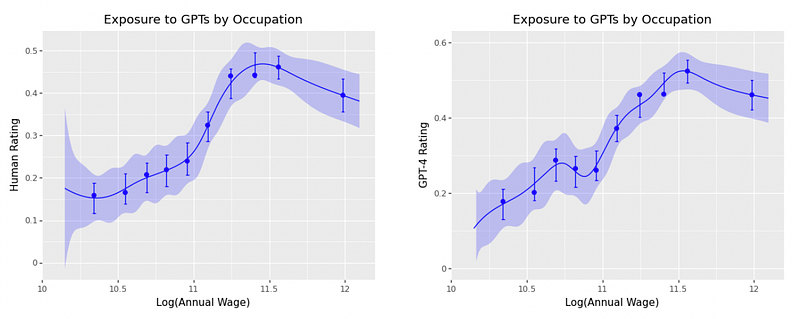
Here’s an interesting conclusion in the paper: Higher-income jobs potentially face greater exposure to LLM capabilities and LLM-powered software.
Most of those high-income jobs required a high level of education, so it seems that the higher the level of education a person has, the more likely he is to lose his job in the future.
I know it sounds crazy, but both human experts and GPT-4 agree: The higher your income, the higher your exposure.
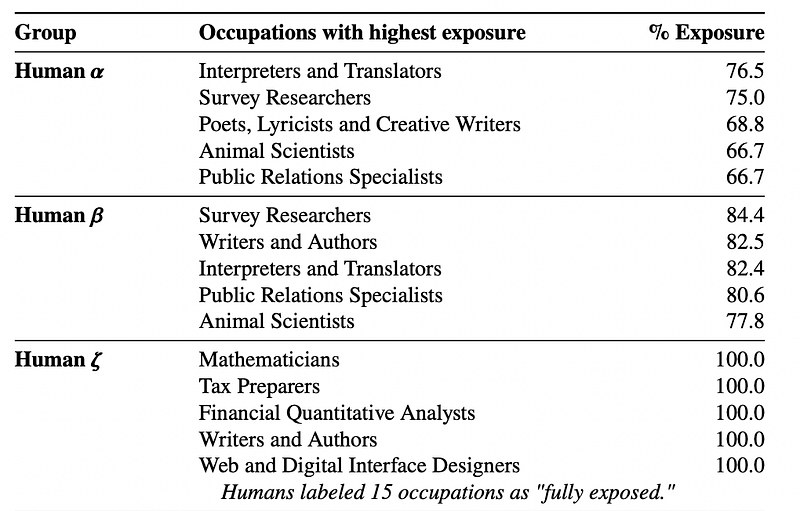
Here is the list of occupations with the highest exposure, according to human experts.
Here is the list of occupations with the highest exposure, according to the models.
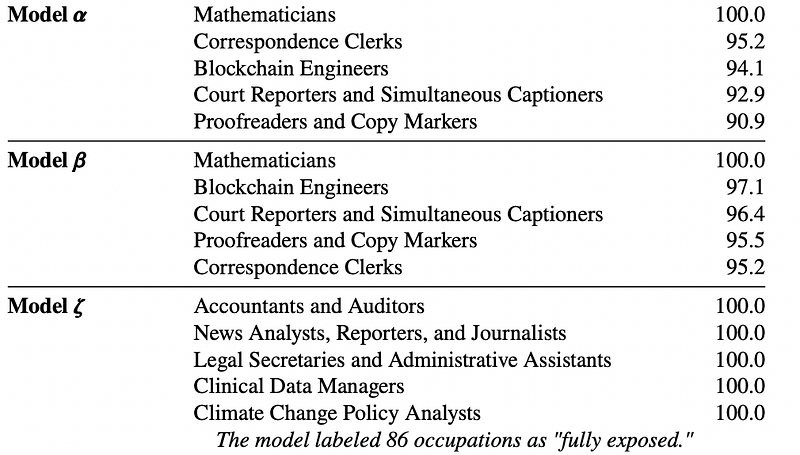
where exposure percentages indicate the share of an occupation’s task that is exposed to GPTs (𝛼) or GPT-powered software (𝛽 and 𝜁 ). Remember that “exposure” is defined as driving a reduction in the time it takes to complete the task by at least 50%.
Now, this doesn’t suggest that the occupations above can be fully automated by AI technology! And before you drop out of college, remember to take this as a warning to keep developing your skills and adapt to our modern world.
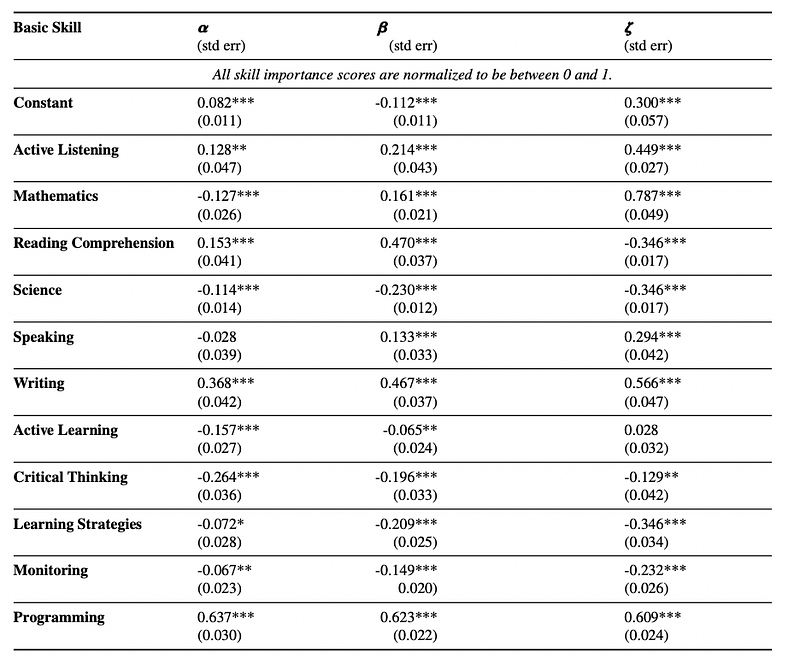
Speaking of skills, the study shows the relation between some basic skills with exposure. The findings indicate that the importance of science and critical thinking skills are strongly negatively associated with exposure, while programming and writing skills show a strong positive association with exposure.
This means that those jobs that required critical thinking are less impacted by LLMs, while programmers and writers are more susceptible to being influenced by LLMs.
Here’s the table with all the skills.
Should you take this paper seriously?
Despite the impressive amount of work, the GPT-4 report left part of the industry bewildered.
Lightning AI CEO William Falcon remarked, “I think what’s bothering everyone is that OpenAI made a whole paper that’s like 90-something pages long. That makes it feel like it’s open-source and academic, but it’s not. They describe literally nothing in there.”
According to Falcon, the OpenAI document does not meet the criteria for scientific research, since third-party developers will not be able to repeat the “experiments” with GPT-4.
Whether there will be a wave of layoffs among the top jobs with high exposure, no one can know for sure. At first glance, it might look like will replace many jobs. On the other hand, generative AI can influence the creation of new products and services that were not previously available and, therefore, provide new job opportunities.
Personally, I want to believe in the second option.
Join my newsletter with 20K+ people to get my free ChatGPT cheat sheet.
If you enjoy reading stories like these and want to support me as a writer, consider signing up to become a Medium member. It’s $5 a month, giving you unlimited access to thousands of Python guides and Data science articles. If you sign up using my link, I’ll earn a small commission with no extra cost to you.