
What Is A Paradigm, And How Does It Enable And Limit Intelligence?
Any New Theoretical Framework Will Be Formulated In Terms That Are Coherent With Your Current Inculcated Paradigmatic Understanding
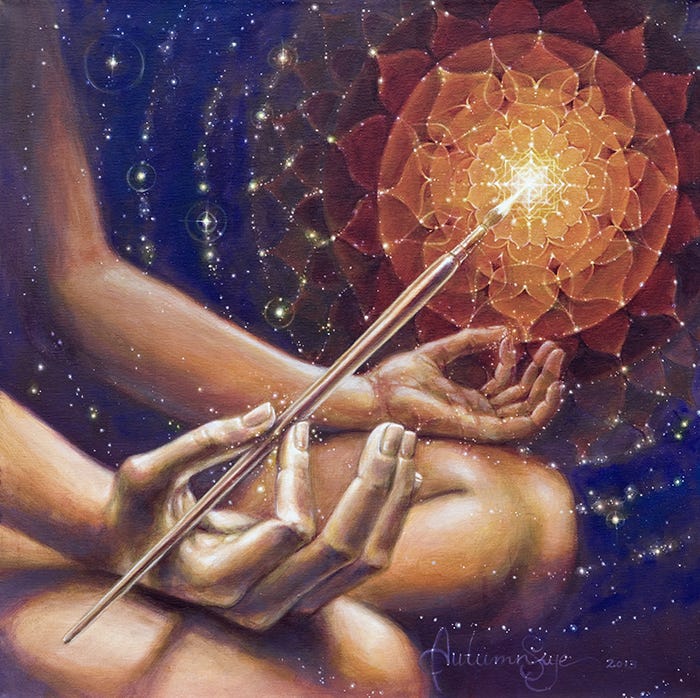

I will be speaking frequently in this book of the novel paradigm of Responsive Naturing, and of how this paradigmatic understanding provides a shared foundation for both scientific and spiritual knowledge, which can revolutionize our understanding of ourselves and of our world, and possibly help us to avoid our current ecocidal path. But my saying that this particular paradigm can have this effect begs the question that I pose in the title: What is a paradigm, and how does it enable and limit human intelligence?
“Paradigm” is normally taken to mean a philosophical and theoretical framework of a scientific school or discipline within which theories, laws, generalizations, and the experiments performed in support of them, are formulated and their results interpreted; or more broadly, just a philosophical or theoretical framework of any kind. Sometimes, it is simply defined as a ‘worldview’ in a rather circular, inexpressive fashion, but one which moves the focus to a ‘philosophy of life’ — meaning how we comport ourselves in our lives — or simply a conceptualization of the world, both of which removes it completely from our lived experience.
A conceptualization of the world is not the world that we experience. It is an abstraction taken from our experiences, and upon which we ratiocinate, in a rather machine-like fashion. Human intelligence is not limited in this way, only scientific intelligence, and machine-intelligence, are.
I want to focus in particular for the moment upon the definition of a paradigm being a theoretical framework in which theories are formulated, as this is the telltale that proves the point I wish to bring into the open: any new theoretical framework will be formulated in terms that are coherent with the theoretical structure of your current inculcated paradigmatic understanding.
This means that if you start your formulation of a new paradigm from your existing paradigm, you will most assuredly not stray from the latter’s limitations and structure no matter how novel you may feel your theory to be. This is one reason why ‘new’ theories of consciousness have, so far at least, been wholly unsuccessful, because our current paradigm is Mechanical Materialism, which doesn’t encompass the human experience from which ‘consciousness’ is abstracted. It is also why we see so many references to “epiphenomena” in modern scientific hypotheses, all of which are trying to deal with evident phenomena that cannot be reduced to physical interactions and relations.
Werner Heisenberg, one of the key pioneers of quantum mechanics, described the problem arising from what I am asserting: the inculcated paradigmatic understanding of science, in his 1950s book: “Physics and Philosophy:”
… quantum theory starts with a paradox. It starts from the fact that we describe our experiments in the terms of classical physics (i.e. material particle interactions) and at the same time from the knowledge that these concepts do not fit nature accurately. The tension between these two starting points is the root of the statistical character of quantum theory. Therefore, it has sometimes been suggested that one should depart from the classical concepts altogether and that a radical change in the concepts used for describing the experiments might possibly lead back to a non-statical, completely objective description of nature. This suggestion, however, rests upon a misunderstanding. The concepts of classical physics are just a refinement of the concepts of daily life and are an essential part of the language which forms the basis of all natural science. Our actual situation in science is such that we do use the classical concepts for the description of the experiments, and it was the problem of quantum theory to find theoretical interpretation of the experiments on this basis. There is no use in discussing what could be done if we were other beings than we are.¹
Of course, we do not have to be “other beings than we are” as Werner Heisenberg put it, if we can see the problem clearly: our inculcated paradigmatic understanding (“Paradigm”) is like an extruder, through which all our thoughts, ideas, and theoretical musing, must pass through. An inculcated paradigmatic understanding is that which structures and identifies that which we perceive and think about. The normal meaning of the word “Paradigm” does not take this into account. Our inculcated paradigmatic understanding is not a collection of verbal concepts, that can be used like Legos — interlocking building blocks — that are joined together to fit our paradigm to the specific question before us, such as: “what is this event that I just experienced?”
As I will explain below, our inculcated paradigmatic understanding operates much as our moral sense does — by limiting what we allow our apperceived experiences to be by affectively judging the correctness of them. This occurs as that which we directly imperience is apperceived into and through our understanding, and it is why certain events, such as ‘spiritual’ phenomena, are rejected outright by our present materialist paradigm, for example.
In the materialist paradigm, such phenomena are ‘beyond the pale’ because our understanding is not made up of language-based entities called “concepts.” Our understanding is prior to language.
It is like the fixed instruction set of any computer processor, which cannot be changed because it is literally the physical design of the processor chip. You can write all sorts of software programs to do various things, but they can never escape the limitations of the instruction set of the architected chip.
Our paradigmatic understanding is only slightly more malleable to change.
I have benefited from a long-term meditation practice whose sole objective is to break one’s inculcated paradigmatic understanding. Breaking down such a paradigm is the ultimate goal of traditional insight meditation practices.
Once one begins to see clearly how our imperiences are apperceived through our paradigmatic understanding, the reason for this disjunction between what is then obvious, and our belief that all a paradigm is, is a conceptual theoretical framework also becomes clear.
The disjunction occurs because our current scientific paradigm does not encompass the whole of what it studies — it encompasses only the quantification of interactions and descriptions of relations between things, and never attempts to engage with the intrinsic nature of those things, because an intrinsic nature is anathema to this paradigm of Mechanical Materialism.
An intrinsic nature creates the possibility of activity that cannot be described in terms of external interactions and relations. The materialist view cannot, in truth, encompass any strictly mental or spiritual experiences without reducing them to physical interactions and relations, and thus cannot even see an inculcated paradigmatic understanding for what it is — a fact attested to by the frequent public protests of scientists that they do not have a ‘worldview’.
Living beings are the perfect example. Scientists rarely treat a living being as a whole, because they cannot make sense of it in terms of interactions and relations when only dealing with a unitary whole — which is why every ‘part’ of a living being needs to be reduced to ‘mechanisms’ and ‘systems’ that can then be related to each other, and treated, as if each is a separate biological machine on its own.
In this way we are both comfortable and unchallenged by seemingly impossible to ‘account for’ parts that are only obvious at the level of the whole, for example consciousness. This reductionism both facilitates a way forward, and creates a debt — a promissory note — that one day, once all the piece-parts of the whole are accounted for, that which is only apparent at the level of the whole will simply ‘fall into place’.
Thus, modern Science wears blinders, and is, for the most part, reductionist; but because of that, it has been very successful at manipulating the interactions and relations of all manner of actual, but hypostatized, things, that are abstracted from some larger whole, thus creating the possibility of everything from the electronic device I am typing this text on, up to and including the willful destruction of all life on Earth by immensely powerful technological means that Science has given to humanity.
However, for this work, the meaning of “paradigm” must be considerably more descriptive of the inner nature of our experience, including our thoughts, judgements, and reasoning. Yet, at the same time, it must not let go of the obvious practical success of modern Science, so that there needs to be a balanced understanding that encompasses both as one whole. This is necessary because the dichotomy between them is not real in any sense, but merely an adaptation for the practical purpose of being able to construct mathematical models, or theoretical frameworks, of the interactions and relations of things. And as one can imagine, it is easier to see how piece-parts fit into a whole, if you start with the whole. This is also why traditional healers treat the person, not the disease symptoms.
So, I will define a paradigm as a hierarchical nexus of patterns of activity that are recognized as such activity is manifested, and again as their intelligibility is apperceived as some conflation of sense perceptions, thoughts, feelings, and other spontaneous mental phenomena.
These categories of activity refer to the biological activity of our senses, nervous system, and our brain, and referentially to the activity of our muscles, facia, organs, and various ‘systems’ with which the former are physically entangled as an inseparable whole, but which are not integrated with the sensory system directly, and to all mental phenomena that we call mind.
In some cases there are neurological correlates of the activity, such as sense perceptions. In others, there do not appear to be such correlates, such as with our affective feelings. And in still others, there are correlates for the brain processes involved in verbalizing, or in some cases, visualizing that which is not a language-based concept, but rather are non-verbal understandings.
Note that these categories are of local phenomena, and say nothing about nonlocal phenomena or their source. Those will be more fully explained as I develop the paradigm of Responsive Naturing in this book, and only hinted at by this new definition of what a paradigm is.
These categories of activity are not the understanding of the patterns of activity, nor the result of the apperception of recognized patterns of activity via the understanding — the mind being other than the physical embodiment, so that the understanding and apperception of the recognition of the patterns of activity are mental responses to the immediate recognition of the activity of manifesting the pattern (informing, in my technical language). These are the Res Gestae Divi Naturans, or “Things Done by Divine Naturing” that I speak about in this book as that which appears, or is manifested, or more technically, informed. The word “divine” being used to indicate that which is “other than” physical activity, but which is not apart from it — i.e., mind.
Both the mental responses and the inseparable recognition of the activity are omnintrinsic and impersonal in nature — the activity and the recognition of the activity being simply two aspects of the responsive naturing of the local ontogenetic form as it is informed Now. I say “simply,” because this is not a dual-aspect understanding. It is like the “particle-wave” duality of Quantum Physics, which is nothing more than a deficiency of our current paradigmatic understanding, and our language which is completely structured by it. This will be fleshed out in the rest of this book.
The understanding of this activity arises in conjunction with the recognition of the activity as a certain pattern of intelligible activity. This is not knowledge in the conceptual sense, but is rather the performative ‘know-how’, ‘savoir faire’, or ‘canosis’, for manifesting that particular pattern of activity — how to dance a certain way, or how to be a type of being, such as a human. This type of knowledge, has been relatively ignored by philosophers because its operational mode has been opaque up till now, unless you consider the phrase ‘muscle memory’ to be accurate — as if muscles on their own remember how to do things.
So, the understanding of the pattern arises referentially via the pattern’s recognition as it is informed. And as that activity and its recognition is occurring — both being omnintrinsic and impersonal — the recognition must be a kind of pattern-matching, but one that participates with the current totality of reality, either as a source pattern if it is new, or a variation that generalizes a pattern, and as a recognized pattern if it already is informed ‘elsewhere’.
To summarize: The understanding is not language-based concepts, it is non-verbal performative knowing how to inform a pattern of activity. This performative knowing is not other than the concurrent recognition of the activity omnintrinsically and impersonally, and thus, universally. As that pattern of activity is being informed in response to the current local context — our body, for example, or that which we heretofore separated out as our mind — it is recognized. This recognition is the ‘presence to’ the activity that we take to be our perspective upon what is happening. I will talk about this later in this book. The source of the activity is omnintrinsic and impersonal, and the recognition, while impersonal, is local to the context. This recognized activity — which is not yet intelligible in a conceptual sense — is itself responded to — since the essential nature of this responsive naturing does not vary. This means that this secondary response arises as mental activity which is also recognized as it is informed (as a thought for instance, or an image, or sound, etc.). This recognition is then apperceived into the understanding, which means its presence either reinforces a pattern of understanding, generalizes it, or possibly even breaks the pattern of the understanding. And then this sequence reoccurs recursively, until interrupted. So, in response to certain conditions now, this activity I describe as responsive naturing, informs a response, which is recognized, and the recognition is of some pattern of the understanding, which also is responded to with some form of mental response, which is also recognized as some pattern of the understanding. The initial activity can be some embodied action — a dance for example, or the normal aging of a body, or a song, a question posed by some other, etc. — or it can be a thought, or a feeling, or some imaginative or hallucinated event. And on and on this goes — as we experience our lives as our ontogenetic form is informed, and our form becomes entangled with other forms, etc.
The paradigm being, then, the hierarchical nexus of the recognized patterns of activity. And, as well, the responsive apperception of these recognized patterns of activity are the necessary condition for the arising of identification, recognition of qualities, and categorization of the underlying activity. In this way, the paradigm, as a pattern understanding, stands ‘beside’ that which appears, as the etymological origins of the word “paradigm” actually implies.
However, as I have stated a number of times in this article, the patterns are of activity, not of conceptual knowledge, and their nature is that of possibilities for a particular pattern of activity. So, for example, the color red is an instantiation of a certain pattern of ocular activity in the eyes, the optic nerves, the nervous system, and the brain. It is the brain’s role to process the signals that are manifested in the optic nerve by the impingement of photons of light of a certain frequency range, and in so doing, the pattern of brain activity is recognized as that of the color red (of some shade). It is in the entanglement of patterns, like the entanglement of beings, that give rise to complexity, and human intelligence. And it is the performative capability that these patterns of understanding represent, that is the source of all ‘thoughts about’ the kinds of knowledge that we humans are so enamored of, for example.
As you can see, the paradigm totally constrains what we can know and do, and if the pattern that is currently recognized is not within the paradigmatic patterns already understood, then we have the choice to ignore it, force it to be ‘like’ some other pattern, or, in rather rare circumstances, we can incorporate it as is. It will then either be made coherent with the rest of the understanding, the rest of the understanding will be made coherent with it, or there will be a disjuncture in the nexus of our understanding that will haunt us until we ‘figure out’ how to bring coherency back to our understanding — or perhaps not bother ourselves trying to bring coherency back. After all, our current inculcated paradigmatic understanding is littered with such non sequitur patterns.
It is here that the way forward to a different paradigmatic understanding can be found — but it must be the outcome of some recognized pattern of activity, and not ratiocinating about conceptual ideas. Concepts cannot escape the paradigm that gave rise to them. Period.
And please note, that when I say ‘our’ understanding, I mean the portion of the total understanding of reality with which we have become entangled. Being that the totality of understanding is not on the side of what is informed as ontogenetic forms of being, but rather is on the side of the origin (genesis) of that informing, there is no actual ‘locality’. Or rather, the totality is local because that is all there is. The origin of this will become clearer as I proceed with the detailed presentation of the Responsive Naturing.
Footnote:
¹ “Physics and Philosophy,” Werner Heisenberg, page 56, Prometheus Books, 1999.


