
FICTION
The Keystone at Chiusi
A place of understanding
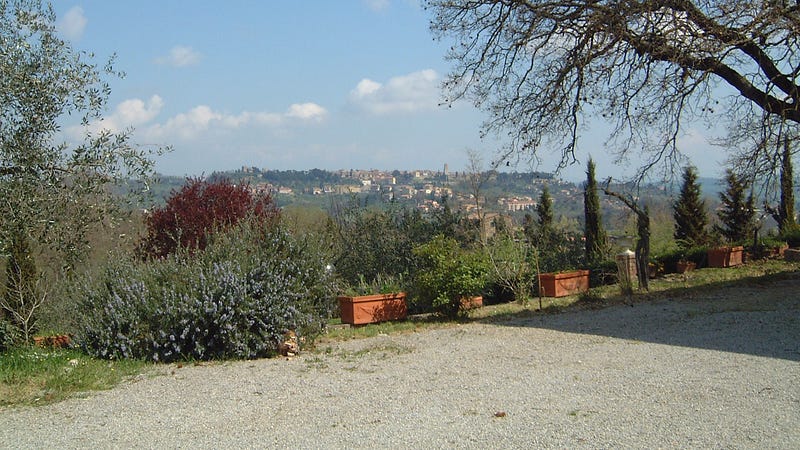
The villa
The idea was to get away with my wife, Lisa, from the dutiful monotony of home and work, and from the lies we told ourselves. It’ll be okay. The grief will pass. It’s all for the best. He’s in a better place. They had become less comforting and more like small tortures. Picking at scabs.
Signor Gennaro was our host at the tiny rental villa in Tuscany, just at the border with Umbria, called Villetta La Boncia. He was also our tour guide for the nearby historical sites, mainly in the ancient village of Chiusi Città which sits atop the adjacent hill. The old Italian gentleman was stern and formal, always wore a suit and tie, and he spoke not one word of English.
Neither Lisa nor I had had the patience or inclination to learn the language before traveling to Italy. We just showed up and hoped to learn enough expressions to get by. That made doing the paperwork to check into the villa a challenge. Our host sat expressionless across the table in the tiny kitchen with his hands folded and pushed papers across to me, pointing his finger where I needed to sign. When I wrote down our address, Texas, he spoke for the first time. “Ah,” he said, “Joan Ween?” I faked my biggest, friendliest smile and nodded as he pointed his forefinger at me, thumb sticking straight up. With no hint of mirth, he pulled the make-believe trigger.
Even in late Spring, the Tuscan countryside was cool at night. Although our host had given us a quick tour of the villa, explaining where everything was and how to use it, we didn’t understand any of it. The only source of heat I could find was a small fireplace in the kitchen that looked as if it might be ornamental, part of the decor rather than a functioning appliance. Nevertheless, I found a couple of sticks of firewood and some old newsprint and did my best to get a fire started. The whole villa immediately filled with smoke.
“What the hell did you do?” Lisa demanded, emerging from the bedroom where she had been unpacking.
“I don’t know,” I said, looking around for something that might be a flue or something. “Sorry.”
“Our first damn night here and now every piece of clothing is going to smell like smoke,” she fumed. “I can’t even take a decent bath to get the stink off me. Have you seen that tiny bathtub in there? It’s barely big enough to stand up in.”
I could see Lisa was getting close to the edge, so I summoned my calmest tone and said, “Hey, it’s no big deal, babe. I’ll just grab a sweatshirt or jacket or something. It’s not that cold in here.”
And that did it. She burst into tears and, in between enormous sobs, said, “I didn’t pack sweatshirts! It was a hundred degrees in Texas.”
This was the new Lisa — the fragile, broken one. She wasn’t always like that. I put my hands on her shoulders and guided her to a kitchen chair. “Don’t worry about it, babe. We’ll buy jackets tomorrow. Look where we are! Let’s just enjoy it and relax.”
It’ll be okay. The grief will pass. It’s all for the best. He’s in a better place.
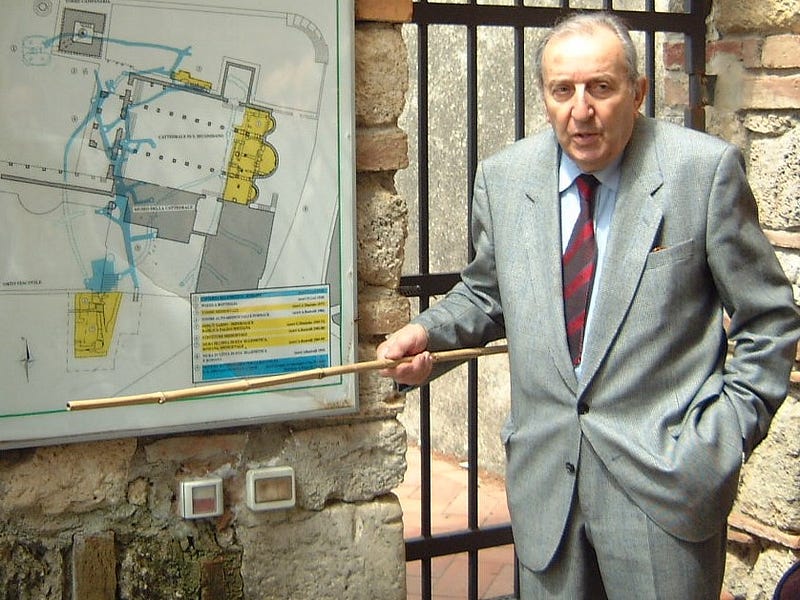
The tour
During our private tour of the Chiusi Cathedral, Signor Gennaro carried a long bamboo cane, which he used as a pointer, and presumably kept at the ready in case of any unruly Texans attempting to touch one of the ancient relics. His young daughter, who spoke passable English, accompanied him on the tour as a translator.
“La cattedrale di San Secondiano fu costruita durante il dodicesimo secolo,” said the tour guide, and his daughter then repeated in English.
“The cathedral was built in the 12th century,” she said, and then continued her translation, alternating and sometimes syncopating with Signor Gennaro’s beautiful, but to us inscrutable, Italian speech.
“It was built atop the ruins of an even earlier Christian church from the 5th or 6th century.”
“Wow,” said Lisa, looking up and surveying the amazing architecture. “Nothing in Texas is that old.”
As we continued the cathedral tour, Signor Gennaro pointed his cane to various works of art and sculptures, explaining the meaning and origin of each one. At some point, Lisa lost interest in the details and began strolling along with her head declined toward the worn, cobbled floor. I was annoyed with her, for wasting this opportunity to learn about another culture and enjoy fine art, but mostly because I knew what she was thinking about, and knowing that made me think about it too. He would have loved it here, we thought together, but apart.
We ended outside, in the garden, with its panoramic view of the surrounding Tuscan countryside from atop the ancient hilltop site. After the tour, Gennaro, still having never smiled in our presence but attempting to be casually conversational, asked a seemingly innocent question.
“Hai una famiglia?” he asked.
“Do you have a family?” his daughter translated.
I was a little taken aback by the abrupt transition from dry tour guide narration to this personal question, so I answered weakly, “Well, sure. My sister and Lisa’s brother, and some cousins we stay in touch with.”
The daughter didn’t wait for her father to clarify as she shook her head and did it for him. “Do you have any children?” she asked with a big smile.
I could see Lisa tense and look up sharply at the little girl with something that might have been an expression of anger on her face. She must have imagined that her thoughts had been read, that the question was designed to hurt her in some way. Luckily, the anger passed quickly.
“Perché tua moglie è così triste?” asked Gennaro, shifting his concerned gaze from Lisa to me.
The odd reactions from Lisa and me caused our young translator to forget to translate, but I thought I knew what he was asking. For some reason, when I opened my mouth to reply, the unfiltered truth spilled out.
“We had a son,” I explained. “His name is Stevie, and he was studying architecture at the university. But he died last Christmas.” My eyes began to water and my voice broke ever so slightly as I added, “He was our pride, and we loved him very much.”
Lisa began to cry again. Racking sobs of grief emerged from deep within her chest, causing her to bend forward slightly and her knees became unsteady. Gennaro quickly stepped toward her, wrapped his arm around her waist, and gently guided her to a nearby garden bench where he sat beside her. No one said anything for a long time until Lisa’s sobs had subsided into sniffles. Gennaro retrieved a folded, white handkerchief from his suit pocket and offered it to her.
Signor Gennaro said something to his daughter, who nodded and walked away. Then he looked at me and said, “Vieni con me. Ti aiuterò.” Without the benefit of translation, I had no idea what that meant, but it became clear as the old man rose and began walking, motioning with his hand for us to follow and indicating the direction with his pointed cane.
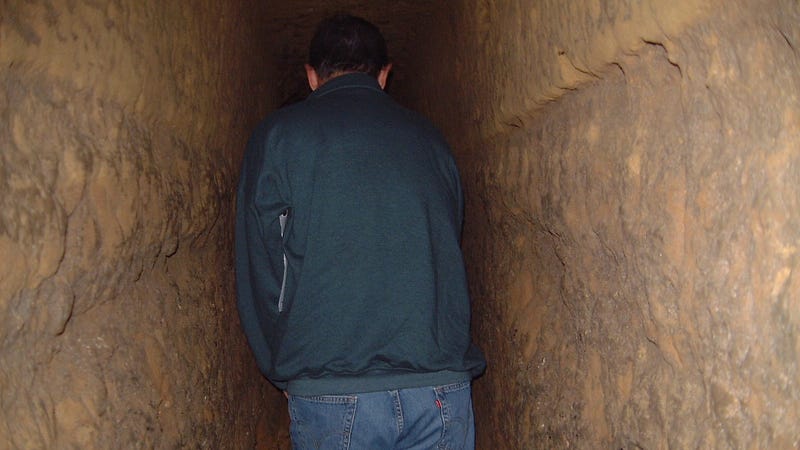
The catacombs
We followed Gennaro a short distance and came to an old, cast iron gate covering the entrance to what looked to be a cave in the side of the hill. Retrieving a set of keys from his pocket, Gennaro unlocked and opened the gate, then motioned with his cane for us to follow him into it. The stone tunnel on the other side became progressively narrower as we followed, single-file with Gennaro guiding the way with a pocket flashlight while clicking his bamboo cane on either side as we strode along. He moved quickly and seemed to know exactly where we were going. Lisa and I were less certain, but there was little choice at that point other than to follow and hope for the best.
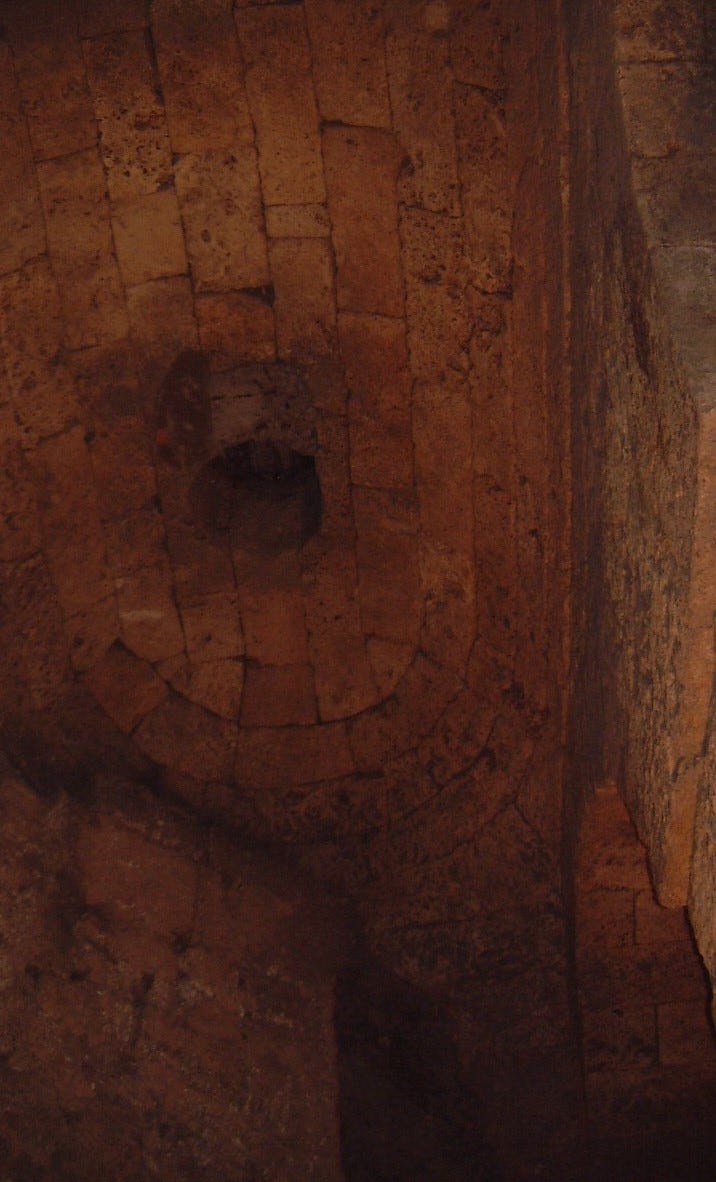
Finally, the narrow tunnel opened into a large underground space, a man-made cavern of sorts. When Gennaro shined his light around, I could see the cavity was egg-shaped, elongated toward the ceiling, which was probably forty feet high. The walls were covered in smooth, dry clay up to a certain height, above which the clay covering had fallen away to reveal a supporting infrastructure of intricately carved stones placed with great care arching upward and inward toward the peak.
“Some people believe this was an ancient cistern,” said Gennaro, “a storage place for water.”
I was so amazed by this great cavity, deep beneath the Chiusi hill, that I momentarily failed to grasp the other amazing thing that just happened.
“What… why… Signor Gennaro, you do speak English!”
For the first time since we met, Gennaro smiled warmly at me and said, “No English, it is not me you hear, it is the stone.” He pointed his cane directly upward toward the very top of the subterranean cavity. There I saw a single stone, the highest one in the structure, that had been intricately carved and polished and placed to fit perfectly with the others around it.
“It is the keystone,” said Gennaro. “It holds all the others in place and supports… everything.” He waved his cane aloft to indicate the entire space around us, and maybe beyond.
Gennaro continued to speak, and I continued to understand him perfectly, although his mouth seemed to move mysteriously out of sync with the English words I heard.
The keystone
“This place, and the labyrinth we walked through, were built by Etruscan architects. It is older, hundreds of years older than even the oldest parts of the cathedral you saw earlier. But this was no cistern to the Etruscans. It was a place of understanding. And it still is today.”
Lisa, dazed and slightly baffled, asked, “You mean the keystone somehow translates what you say into English for us?”
“No, I am not speaking English, nor you Italian. We are simply understanding each other now.”
Lisa folded her arms and shivered while whispering, “It’s…. unholy.”
“Not unholy,” said Gennaro, “it is pre-holy. A millennium before Christianity began, the Etruscans thrived. They traded peacefully with the ancient Greeks in the south, with the Celts in the north, and later, with the Roman empire. And they knew this: without understanding, there can be no peace. So they built places like this. Places of understanding.”
Lisa stared up at the dimly-lit keystone and said, “I don’t think I like it here.”
Despite her words, I knew what she really meant, and shared her trepidation. Do we want this? To admit the truth about what we are feeling?
Signor Gennaro watched our exchange of looks and then softly excused himself into one of the tunnels, just outside our view, leaving the light on a stone slab in the center of the cavern.
Lisa and I sat on the slab and began to talk — about our lives, our son, our feelings, and our sadness. And for the first time since we lost him, we began to share the truth about that loss with each other. It didn’t change anything — nothing could. But as we shared the honesty of our grief, the burdens we had been carrying alone started to seem just a little lighter. We began to understand.
It’ll be okay — but never quite the same. The grief will pass — but we will not forget him. It’s all for the best — but our memories are precious. He’s in a better place — but he’s there alone, and we miss him so.
Jim Dutton © 2021